Job costing is the practice of tracking every cost labor, materials, subcontractors, equipment against a specific job, so you know exactly what each project actually cost to complete, not just what your business spent in total that month. Done well, it’s how a contractor or trades business finds out which jobs are genuinely profitable and which ones are quietly losing money.
That last part is where most guides to this topic stop short. This one covers the fundamentals, then follows the data forward into what a CFO actually does with it.
Key takeaways
- Job costing tracks costs — labor, materials, subcontractors, equipment, and allocated overhead — against each job, rather than lumping expenses together across the whole business.
- Job costing differs from process costing, which averages costs across repetitive, identical production runs instead of tracking each job separately.
- The real value shows up when actual job costs get compared against the original bid estimate — that gap is where you find out where the profit actually went.
- Job costing applies just as directly to a single skilled trades job as it does to a multi-month construction project; the categories are the same, just scaled differently.
- Job costing data is the raw input behind an accurate WIP report — a WIP report built on sloppy job costing is wrong before the math even starts.
What is job costing?
Job costing is an accounting method that tracks every cost associated with a specific job or project — labor, materials, subcontractor fees, and equipment usage — so you can determine the true profitability of that individual job rather than just your overall business performance for the period. Each job functions almost like its own small business, with its own revenue and its own cost structure to track against it.
This matters because a business can look profitable overall while individual jobs are quietly bleeding margin, offset by other jobs that ran well. Without job-level costing, there’s no way to tell which is which — you just see the blended average and have to guess at the cause.
Job costing vs. process costing
Job costing tracks costs against individual, distinct projects, while process costing averages costs across large volumes of identical, repetitive production — the difference between building one custom deck and manufacturing a thousand identical widgets. Construction and skilled trades work is almost always job costing territory, because no two jobs are exactly alike, even when the work looks similar on paper.
Some smaller contractors default to a simpler, averaged approach out of convenience — essentially treating every job like process costing, using a rough per-square-foot or per-unit rate instead of tracking actual costs job by job. It’s faster, but it hides exactly the information that matters most: which specific jobs are actually making money.
The four cost categories every job costing system tracks
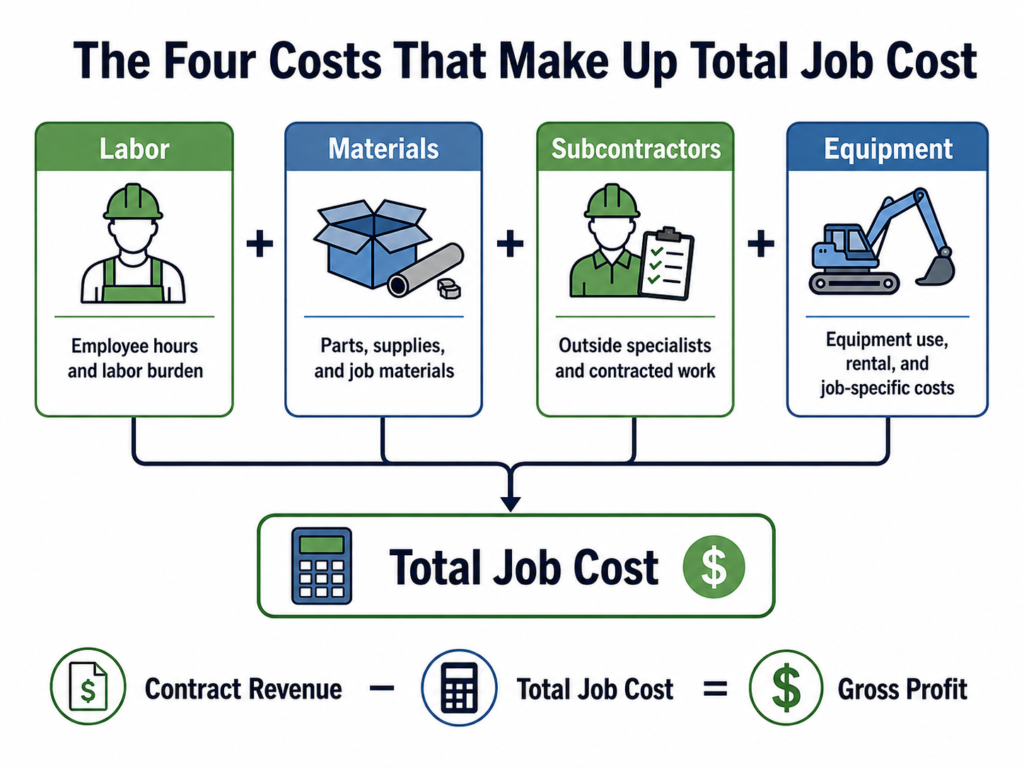
A complete job costing system tracks four categories against every job: direct labor, materials, subcontractor expenses, and equipment usage, with overhead allocated across jobs on top of those four. Each category answers a different piece of where the money actually went.
Direct labor ties every hour and wage directly to the job, which matters most because labor is usually the highest single cost on any project. Materials get assigned to the specific job’s cost codes, making material overruns visible at the job level instead of buried in a company-wide supplies expense. Subcontractor expenses get recorded against the job they support, so a subcontractor cost overrun on one project doesn’t get lost in the noise of your total subcontractor spend. Equipment usage, whether owned or rented, gets allocated to the jobs that actually used it. Overhead — the costs that don’t attach to any one job directly — gets allocated across jobs using a consistent method, so every job’s numbers reflect a fair share of what it actually takes to run the business behind it.
A worked example: where the profit actually went
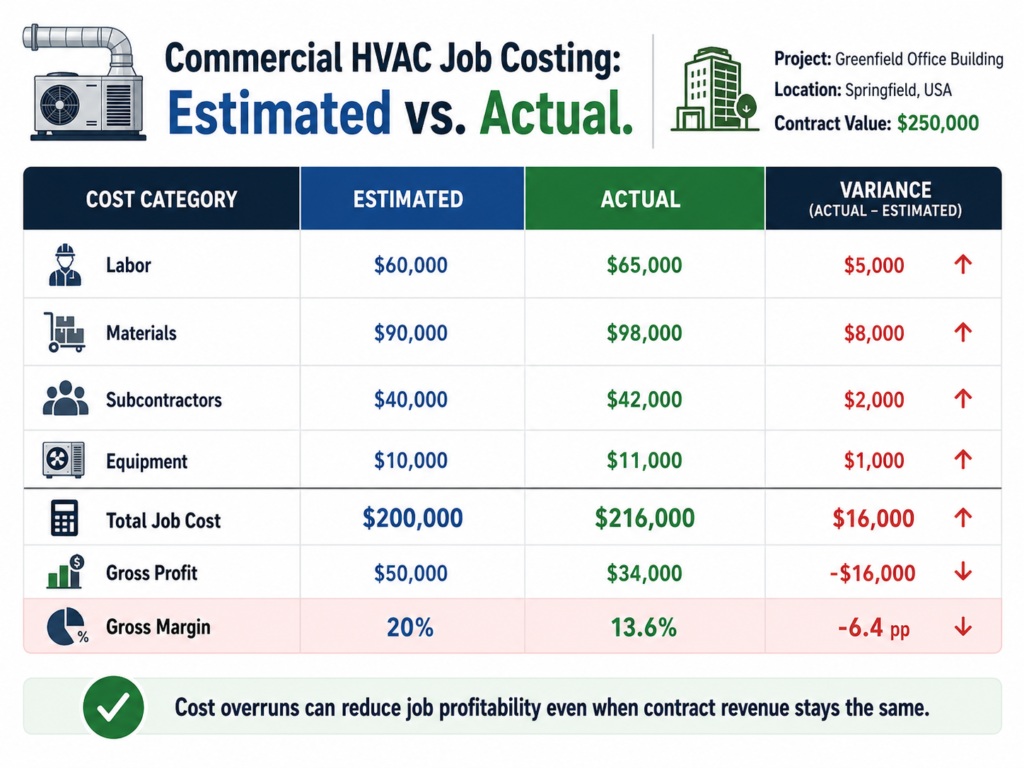
Numbers make this concrete. Take a commercial HVAC replacement job bid at $85,000, originally estimated to cost $68,000 — a projected 20% margin.
| Cost category | Estimated | Actual |
| Direct labor | $18,000 | $22,000 |
| Materials and equipment | $34,000 | $38,000 |
| Subcontractor (electrical tie-in) | $6,000 | $6,500 |
| Overhead allocation | $10,000 | $9,000 |
| Total cost | $68,000 | $75,500 |
| Gross profit | $17,000 (20.0%) | $9,500 (11.2%) |
The job still made money — but less than half the margin it was bid at. Job costing is what reveals exactly where that gap came from: labor ran $4,000 over, materials ran $4,000 over, and a modest overhead saving didn’t come close to covering it. Without job-level tracking, this shows up as a vague sense that “the quarter wasn’t as profitable as expected.” With it, you know precisely which line moved and by how much — information that’s useless for this job, since it’s already done, but genuinely valuable for pricing the next one like it.
Job costing in construction vs. skilled trades
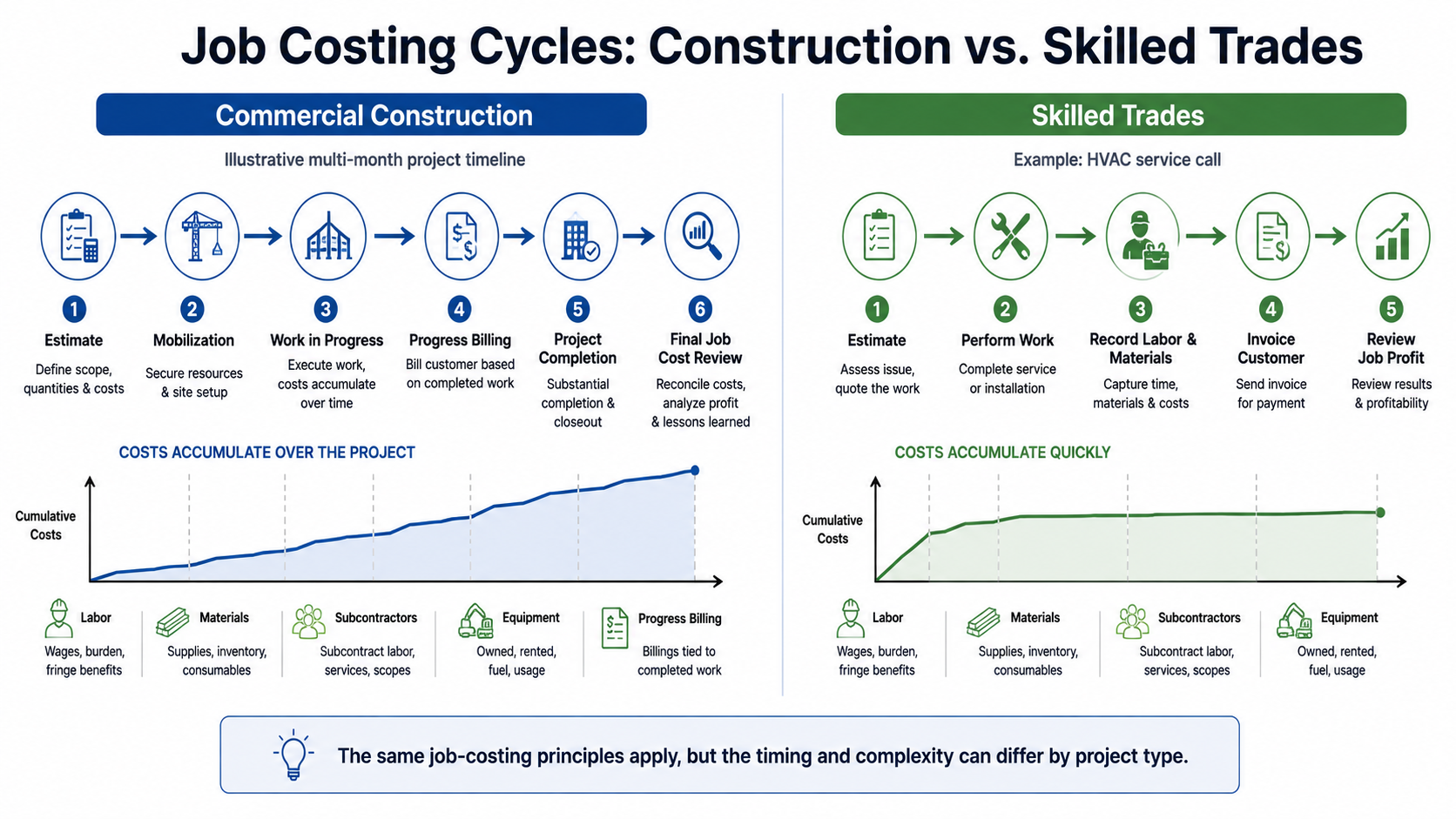
The core methodology is identical for a large construction project and a single skilled trades job — the same four cost categories apply either way. What differs is scale and duration: a construction project might run job costing across months and multiple phases, while a skilled trades job like an HVAC install or an electrical service call often completes in days, with cost categories collapsing into a tighter, faster cycle.
That compressed timeline doesn’t make job costing less important for trades businesses — if anything, it makes the discipline easier to build, since the feedback loop between estimate and actual closes in days instead of months. A trades business running dozens of small jobs a month without tracking each one individually is missing the same signal a construction company would miss on a single large project, just spread across more, smaller instances of the same blind spot.
How job costing feeds your WIP report
Job costing is the underlying data source behind an accurate WIP report — specifically, the “costs to date” figure that drives the entire percentage-of-completion calculation comes directly from job-level cost tracking. If job costing is sloppy or inconsistent, the WIP report built on top of it is wrong before the math even starts, regardless of how carefully the formulas themselves are applied.
This is why clean job costing matters even for businesses that don’t think of themselves as needing a formal WIP report yet. The moment a project runs long enough to need percentage-of-completion accounting — which happens sooner than most owners expect — the quality of the WIP report is entirely dependent on job costing discipline that should have started on day one of the project, not day one of noticing the numbers don’t add up.
The mistake most contractors make with job costing
The most common mistake is tracking job costs diligently and never closing the loop — comparing actual costs against the original estimate once the job wraps, and feeding that gap back into how the next similar job gets bid. Job costing data that just sits in a completed project file isn’t doing its job.
In 30-plus years of CFO work, the pattern Stan Alhadeff sees most often is a contractor who can tell you, when asked, that a specific job type tends to run tight on margin — but has never actually pulled the job costing data together to confirm it, size the gap, or adjust pricing accordingly. The instinct is usually right. The discipline to turn that instinct into a repricing decision, backed by real numbers, is what’s missing. If you want a second set of eyes on whether your own job costing data is actually feeding your pricing decisions, our free discovery call includes a GAP Analysis that shows you plainly.
Turning job costs into better bids
Job costing that stops at “tracking what happened” is only doing half its job. The real value shows up when actual-versus-estimated data from completed jobs actively shapes how the next bid gets priced — closing the loop between what a job was supposed to cost and what it actually cost.
Stan Alhadeff worked with one client, Amerigo Metal Recycling, through more than a decade of growth from $8 million to nearly $50 million in revenue, where disciplined cost tracking at the job and project level was part of what kept margins intact through that scale-up. If you’d like a straight read on whether your own job costing is actually informing your pricing, book a free strategy call with Stan — it starts with a look at your real numbers, not a generic framework.
FAQ
What is job costing? Job costing is an accounting method that tracks every cost — labor, materials, subcontractors, and equipment against a specific job or project, so you can determine that job’s true profitability rather than just your overall business performance for the period.
What is the difference between job costing and process costing? Job costing tracks costs against individual, distinct projects, while process costing averages costs across large volumes of identical, repetitive production. Construction and skilled trades work is almost always job costing territory, since no two jobs are exactly alike.
What costs does job costing track? A complete job costing system tracks four categories: direct labor, materials, subcontractor expenses, and equipment usage, with overhead allocated across jobs using a consistent method. Each category shows a different piece of where a job’s money actually went.
How does job costing improve future bids? Job costing improves future bids by revealing exactly where actual costs diverged from the original estimate on completed jobs — which specific cost category ran over, and by how much. That gap, tracked consistently across similar jobs, is what should inform how the next comparable job gets priced.
How does job costing relate to a WIP report? Job costing is the underlying data source behind an accurate WIP report — the costs-to-date figure driving the entire percentage-of-completion calculation comes directly from job-level cost tracking. Inconsistent job costing produces an inaccurate WIP report regardless of how correctly the formulas themselves are applied.

Stan Alhadeff
Founder & Fractional CFO