A WIP report — short for work-in-progress report, also called a WIP schedule — tracks the financial status of every active construction project at a point in time: costs incurred, revenue earned, amounts billed, and whether each job is over- or underbilled. It’s the single report that tells you whether a project’s cash position matches its actual progress.
Most guides to this topic stop at the definition and the formulas. This one includes both, plus a full sample table and what a CFO actually does with the numbers once they’re built.
Key takeaways
- A WIP report tracks costs, earned revenue, and billing status for every active project, using the percentage-of-completion method.
- Overbilling means you’ve collected more cash than the work performed justifies; underbilling means you’ve performed more work than you’ve billed for — and underbilling is the one that quietly drains cash.
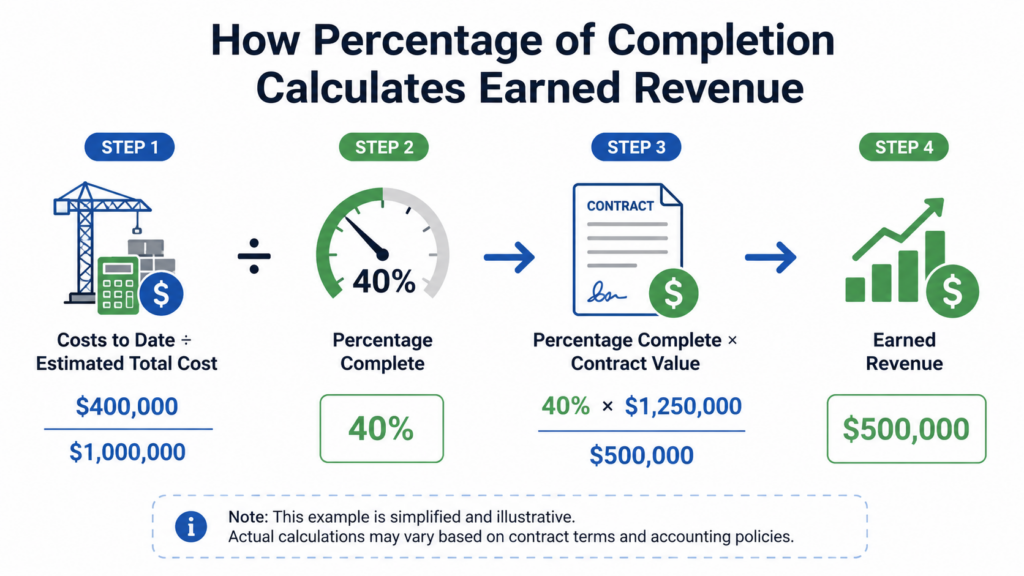
- The core formula: Percent Complete = Costs to Date ÷ Estimated Total Cost, and Earned Revenue = Percent Complete × Contract Value.
- Surety companies and lenders rely on WIP reports to assess bonding capacity and creditworthiness — the SBA’s own bonding program requires one (Form 994F).
- A WIP report prepared only once a year for taxes or bonding misses its real value. Updated monthly, it becomes an early warning system for cash problems before they hit the bank account.
What is a WIP report?
A WIP report is a financial schedule that shows the status of every active construction project — costs incurred to date, revenue earned based on progress, amounts billed to the customer, and whether each job is over- or underbilled relative to its actual completion. Each project gets its own line, and the report as a whole shows the financial position of your entire backlog at once.
It exists because construction revenue doesn’t work like most businesses’ revenue. A six-month project that bills $100,000 only at completion would show zero revenue for five months and a sudden spike in month six — which doesn’t reflect what actually happened. The WIP report is where percentage-of-completion accounting gets applied project by project, recognizing revenue and cost in proportion to real progress instead of waiting for the finish line.
Why construction companies need a WIP report

Construction companies need a WIP report because it’s the only tool that shows whether individual jobs are actually profitable and properly billed while they’re still in progress, not after it’s too late to fix anything. A company-wide income statement can look healthy even while a specific project is quietly bleeding money — the WIP report is what catches that at the project level.
It also connects directly to how revenue gets recognized on your income statement and balance sheet. Under the percentage-of-completion method, the WIP report is the underlying schedule that produces the revenue and cost figures that flow into your financial statements — get it wrong, and the statements built on top of it are wrong too, even if every individual transaction was recorded correctly.
The key components of a WIP report
Three numbers drive every WIP report: percent complete, earned revenue, and the over/underbilling position, and each one builds on the one before it. Percent complete measures progress; earned revenue translates that progress into a dollar figure; over/underbilling compares that figure to what’s actually been invoiced.
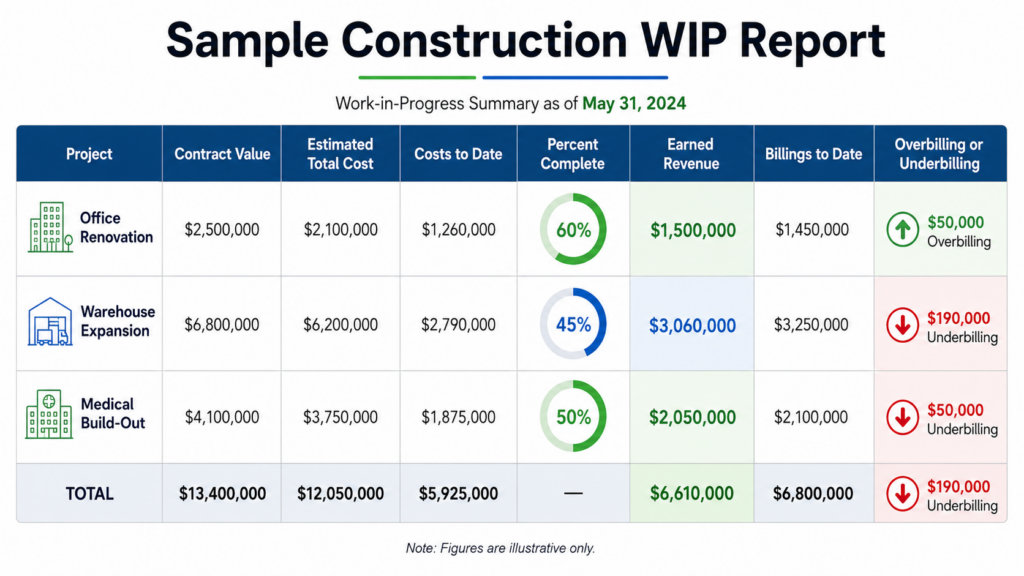
Percent complete = Costs to Date ÷ Estimated Total Cost. This is the foundation — if your cost-to-complete estimate is wrong, everything built on top of it is wrong too. Earned revenue = Percent Complete × Total Contract Value. This is the revenue you’ve actually earned based on progress, regardless of what you’ve invoiced. Over/(under) billing = Billed to Date − Earned Revenue. A positive number means you’ve billed more than you’ve earned (overbilled); a negative number means you’ve earned more than you’ve billed (underbilled).
Sample WIP report
Numbers make this concrete. Here’s a WIP report for a contractor running three active projects at the same point in time.
| Project | Contract Value | Est. Total Cost | Costs to Date | % Complete | Earned Revenue | Billed to Date | Over/(Under) Billing |
| Office Renovation | $500,000 | $400,000 | $300,000 | 75% | $375,000 | $400,000 | $25,000 overbilled |
| Warehouse Build | $1,200,000 | $950,000 | $475,000 | 50% | $600,000 | $540,000 | ($60,000) underbilled |
| Retail Buildout | $300,000 | $260,000 | $234,000 | 90% | $270,000 | $285,000 | $15,000 overbilled |
Three projects, three different stories. Office Renovation and Retail Buildout are both slightly ahead on billing relative to progress — normal, and even a healthy cash cushion in moderation. Warehouse Build is a different situation entirely: the company has performed $60,000 more work than it’s billed for, which means it’s effectively financing that gap out of its own cash reserves until the next invoice goes out and gets paid.
How to read overbilling and underbilling
Overbilling means you’ve collected more cash than the work performed actually justifies; underbilling means you’ve performed more work than you’ve billed for, and it’s the one that creates real cash strain. A modest amount of overbilling across a portfolio is common and not concerning — it’s cash collected ahead of the work, functioning as a buffer. A pattern of significant underbilling, especially on a large project like the Warehouse Build example above, is the one that deserves immediate attention.
Underbilled amounts don’t show up as a problem on your bank balance right away — they show up two or three weeks later, when payroll or a vendor bill comes due and the cash that should have already been invoiced still hasn’t landed. That lag is exactly why underbilling has to be caught in the WIP report, not discovered later in the bank account.
How to build a WIP report step by step
Build a WIP report by listing every active project, then calculating percent complete, earned revenue, and over/underbilling for each one using the current cost and billing data. Start with an accurate estimated total cost for each job — this is the number most likely to be wrong, since it requires a real forecast of what’s left to spend, not just what’s already been spent.
From there: pull actual costs to date from your job-costing system, calculate percent complete, multiply by the contract value to get earned revenue, then compare that to what’s actually been billed. Do this for every active project, then total the columns to see your company-wide over/underbilling position. The single most important habit is updating this monthly rather than quarterly or annually — a WIP report that’s three months stale has already missed the window to act on what it would have shown you.
What a WIP report tells your bank or surety
Lenders and surety companies rely on WIP reports to assess a contractor’s financial health, bonding capacity, and creditworthiness before extending credit or issuing a bond. According to the U.S. Small Business Administration, contractors applying for the SBA’s Surety Bond Guarantee Program must submit Form 994F, the Schedule of Work in Process, as part of that application — a direct, official confirmation of how central this report is to bonding decisions.
A current, accurate WIP report signals to a lender or surety that a contractor has real visibility into its own project performance. A stale or inconsistent one raises exactly the opposite question, often at the worst possible moment — mid-bid, when bonding capacity is what determines whether a contractor can even compete for the next job.
The mistake contractors make with WIP reports
The most common mistake is treating the WIP report as a once-a-year document prepared for taxes or a bonding renewal, instead of a monthly management tool. That timing gap is exactly where cash problems go undetected until they’re urgent.
In 30-plus years of CFO work, the pattern Stan Alhadeff sees most often with construction clients is a WIP report that’s technically accurate but reviewed too infrequently to actually change a decision. A project quietly running underbilled for two months doesn’t show up as a crisis on the WIP report itself — it shows up as a crisis in the bank account, after the cash gap has already forced a hard choice. The fix is treating the WIP report as an input to your cash flow forecast, not a document that lives separately from it. If you want a second set of eyes on how your own WIP reporting connects to your cash position, our free discovery call includes a GAP Analysis that shows you plainly.
Making the WIP report work for you, not just your bonding company
A WIP report that only gets pulled out for a bonding renewal or tax season is doing a fraction of its real job. Updated monthly and read alongside your cash position, it becomes the earliest warning system a contractor has for a project quietly going sideways — long before it shows up anywhere else.
For construction-specific fractional CFO support that treats the WIP report as a live management tool instead of a compliance form, book a free strategy call with Stan — it starts with a straight look at your current projects, not a generic checklist.
FAQ
What is a WIP report? A WIP report is a financial schedule that shows the status of every active construction project — costs incurred, revenue earned based on progress, and whether each job is over- or underbilled. It’s the primary tool for tracking project profitability while work is still in progress.
What is a WIP schedule in construction? A WIP schedule is another name for the WIP report — the two terms are used interchangeably in construction accounting. Both refer to the same document tracking percentage-of-completion revenue recognition across active projects.
How do you calculate percentage of completion? Percentage of completion is calculated by dividing costs incurred to date by the estimated total cost of the project. The result is multiplied by the total contract value to determine earned revenue for that stage of progress.
What does overbilling mean in construction? Overbilling means a contractor has billed and collected more cash than the actual work performed justifies, based on the percentage-of-completion calculation. A modest amount is common and generally not a concern, functioning as a cash buffer.
What does underbilling mean in construction? Underbilling means a contractor has performed more work than it has billed for, effectively financing that gap out of its own cash reserves. Significant or growing underbilling is one of the clearest early warning signs of a coming cash flow problem.
How often should a WIP report be updated? A WIP report should be updated monthly as part of the regular close process, not just annually for taxes or bonding renewals. Monthly updates catch underbilling or cost overruns while there’s still time to act on them.

Stan Alhadeff
Founder & Fractional CFO