Most business owners don’t think about worker classification until something goes wrong.
They hire someone as an independent contractor, sign an agreement, collect a Form W-9, issue Form 1099-NEC when required, and assume the relationship is properly classified.
But paperwork alone does not determine whether a worker is an employee or an independent contractor.
The actual working relationship matters.
Worker classification is the process of determining whether someone providing services should be treated as an employee or an independent contractor under the applicable federal and state laws.
Getting that decision wrong can create significant financial exposure.
Depending on the circumstances, a business may face unpaid employment taxes, wage-and-hour liabilities, unemployment insurance assessments, workers’ compensation issues, penalties, interest, and additional professional expenses.
Some classification problems remain unnoticed until a worker files a complaint, an agency conducts an investigation, or a potential buyer reviews the company’s financial and employment records.
From a CFO’s perspective, worker classification is not simply an administrative or human resources issue.
It is a financial risk that deserves attention before it becomes an unexpected liability.
What Is Worker Classification?
Worker classification determines the legal and tax treatment of people performing services for a business.
The two commonly discussed categories are employees and independent contractors.
Employees generally work within an employment relationship and may be entitled to protections and benefits under applicable laws.
Independent contractors generally operate their own businesses and provide services under arrangements that satisfy the relevant classification requirements.
However, the distinction is not based solely on the title the business assigns.
A company cannot automatically establish independent contractor status by:
- Signing an independent contractor agreement
- Issuing Form 1099-NEC
- Paying someone by invoice
- Requiring the worker to establish an LLC
- Describing the position as freelance
- Allowing the person to work remotely
These circumstances may be relevant evidence, but none automatically determines worker status.
The IRS explains that businesses must consider the actual relationship and the degree of control and independence.
Different laws may also apply different classification standards.
That is why a business needs more than one generic contractor checklist.
Employee vs. Independent Contractor: What’s the Difference?
The distinction often involves how the work is controlled, whether the worker operates an independent business, and the nature of the relationship.
| Factor | Employee Relationship May Be Indicated By | Independent Business May Be Indicated By |
| Work Direction | Business controls how work is performed | Worker generally controls methods |
| Business Independence | Worker depends on the hiring business | Worker operates an independent enterprise |
| Equipment and Investment | Business provides important tools and resources | Worker makes meaningful business investments |
| Financial Opportunity | Compensation primarily follows employer-established terms | Worker can potentially increase profit or experience losses through business decisions |
| Relationship | Ongoing, integrated employment arrangement | Independent service arrangement |
| Customers | Worker primarily serves the hiring organization | Worker markets services independently |
These are general indicators rather than a definitive legal test.
No single factor automatically establishes the classification under every applicable law.
For example, a worker may own equipment but still be classified as an employee based on the full relationship.
A contractor may also have only one client during a particular period without that fact alone deciding every legal question.
Businesses should evaluate the relevant law and supporting evidence.
The Three Main Worker Classification Frameworks
One of the biggest classification mistakes is assuming that passing one legal test establishes compliance everywhere.
It does not.
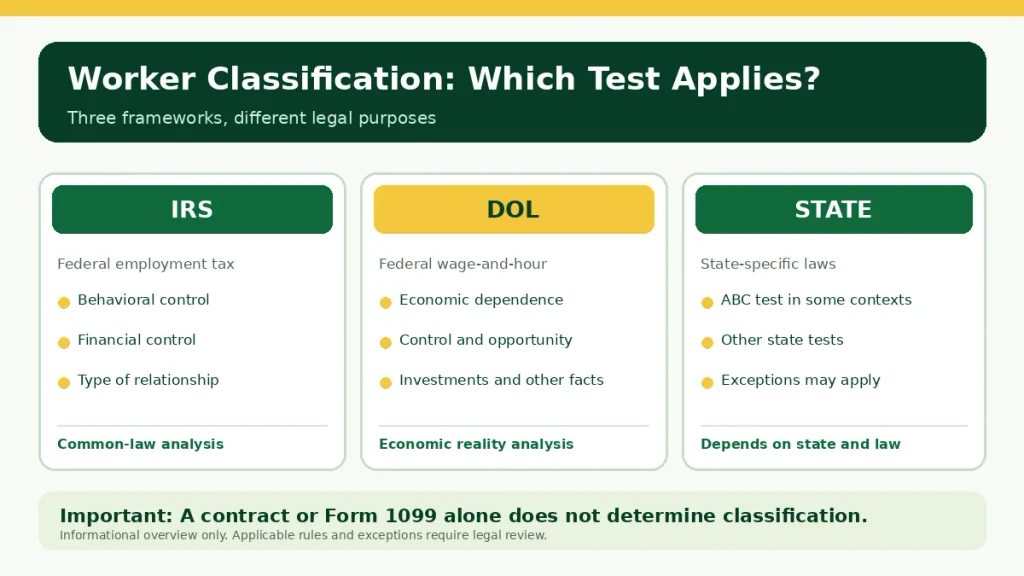
For U.S. businesses, three important frameworks are the IRS common-law test, the federal wage-and-hour economic reality analysis, and applicable state classification tests.
1. IRS Worker Classification Test
The IRS evaluates worker classification for federal employment tax purposes using common-law control principles.
The analysis generally considers three categories.
Behavioral Control
Does the business control, or have the right to control, how the worker performs the services?
Relevant considerations may include:
- Instructions
- Training
- Work procedures
- Supervision
- Evaluation of how the work is performed
For example, requiring a worker to follow detailed procedures and providing continuing instruction on how to complete routine tasks may indicate employee-type control.
However, the analysis depends on the full circumstances.
Financial Control
This category examines who controls the business and financial aspects of the work.
Factors may include:
- Investment in equipment
- Opportunity for profit or loss
- Availability of services to the market
- Payment arrangements
- Reimbursement of expenses
A worker operating an independent business may have greater opportunities to make managerial decisions that affect financial outcomes.
Type of Relationship
The IRS also considers the nature of the parties’ relationship.
Relevant facts may include:
- Written agreements
- Employee-type benefits
- Expected relationship duration
- Whether the services are an important aspect of the business
- Other circumstances showing the parties’ relationship
A written contractor agreement may support the parties’ intended arrangement, but the actual facts remain important.
The IRS does not use a universal checklist where a specific number of factors automatically proves independent contractor status.
All relevant evidence must be evaluated.
2. Department of Labor Economic Reality Test
For federal wage-and-hour purposes under the Fair Labor Standards Act, worker classification focuses on economic reality.
The central question concerns whether the worker is economically dependent on the business for work or is operating an independent business.
Relevant considerations may involve:
- Opportunities for profit or loss
- Investments by the worker and business
- Permanence of the relationship
- Nature and degree of control
- Whether the work is integral to the business
- Skill and business initiative
The applicable legal analysis must reflect current regulations, judicial decisions, and enforcement policies.
Important 2026 Department of Labor Development
The Department of Labor issued guidance in May 2025 directing its investigators not to apply the 2024 independent contractor rule’s analysis in current enforcement investigations.
On February 26, 2026, the Department proposed a new rule that would replace the 2024 framework.
The proposal emphasized economic dependence and identified control and opportunities for profit or loss as important considerations.
However, a proposed rule is not automatically a final rule.
Businesses should review the applicable law and current enforcement guidance when evaluating federal wage-and-hour obligations.
See the Department of Labor’s 2026 worker classification rulemaking information.
3. State Worker Classification Tests
States may use their own classification standards for specific purposes, including unemployment insurance, wage-and-hour protections, and workers’ compensation.
Some jurisdictions use versions of the ABC test.
Others use different statutory or common-law approaches.
Even within the same state, the applicable test may differ depending on the law being enforced or the type of work involved.
This creates an important compliance challenge.
A worker’s classification for federal employment tax purposes does not automatically settle the classification under state wage-and-hour or unemployment insurance law.
Businesses must identify the requirements applicable to their workers, locations, and activities.
Understanding the ABC Test for Worker Classification
The ABC test is especially important because certain jurisdictions use it to determine whether a worker qualifies as an independent contractor.
In a commonly used version, the hiring business must establish three conditions.
Prong A: Freedom From Control and Direction
The worker must be free from the hiring business’s control and direction in performing the work, both under the agreement and in actual practice.
For example, a business may have difficulty supporting contractor status when it controls the worker’s daily schedule, work methods, and detailed performance procedures.
However, the specific legal standard and exceptions depend on the jurisdiction.
Prong B: Work Outside the Usual Course of Business
The worker must perform services outside the hiring entity’s usual course of business under the applicable version of the test.
Consider two examples.
Example A: Retail store and plumber
A retail store hires an independent plumbing business to repair a leaking pipe.
Plumbing is generally outside the store’s ordinary retail activities.
That may support the relevant Prong B requirement.
Example B: Bakery and cake decorator
A bakery hires someone to decorate the custom cakes it regularly sells.
Because cake decoration is part of the bakery’s ordinary business activities, the arrangement may raise concerns under an applicable ABC test.
These examples illustrate one element, not a complete classification determination.
Prong C: Independently Established Business
The worker must be customarily engaged in an independently established trade, occupation, profession, or business of the same nature.
Relevant evidence may include:
- Offering services to the market
- Maintaining an independent business
- Advertising services
- Having other customers
- Exercising independent business judgment
- Making relevant business investments
- Having the ability to continue operating independently
Forming an LLC or obtaining business insurance does not automatically satisfy this requirement.
Similarly, having only one customer is a fact worth reviewing, but its significance depends on the applicable legal standard and complete business circumstances.
Why the ABC Test Matters
Where a strict ABC test applies, failing an applicable requirement can prevent independent contractor classification unless an exception or alternative legal standard applies.
This is why businesses should identify the correct jurisdiction and statute before relying on a classification decision.
Why a 1099 or Contractor Agreement Is Not Enough
One of the most common misconceptions is that tax reporting determines employment status.
Form 1099-NEC reports certain payments to nonemployees.
It does not independently establish that the worker was correctly classified.
Likewise, a contractor agreement can describe the intended relationship without accurately reflecting what happens in practice.
Consider a hypothetical company that signs a contractor agreement with a worker but then:
- Requires a fixed daily schedule
- Provides mandatory ongoing training
- Directs detailed work procedures
- Restricts independent business activity
- Supervises work as it would an employee
Those facts may create classification concerns under one or more applicable tests.
Changing the agreement’s wording would not necessarily resolve the underlying issue.
The safer approach is to evaluate the actual work relationship before deciding how the worker should be classified.
What Happens If a Business Misclassifies an Employee?
Worker misclassification can create financial and operational consequences.
The specific liabilities depend on the applicable laws, facts, limitations periods, defenses, and available relief provisions.
Potential consequences include:
Employment Tax Liabilities
A business may owe employment taxes associated with workers who should have been treated as employees.
The actual liability may depend on federal tax rules, withholding obligations, statutory rates, and potential relief provisions.
Unpaid Wages and Overtime
A misclassified worker may have claims under applicable minimum wage and overtime laws.
The amount depends on eligibility, hours worked, compensation already paid, and the relevant legal requirements.
Unemployment Insurance Assessments
State agencies may determine that workers should have been covered by unemployment insurance requirements.
Workers’ Compensation Issues
Misclassification may create insurance-related obligations or other exposure under applicable state rules.
Penalties and Interest
Additional charges may apply depending on the type of violation, jurisdiction, and circumstances.
Professional and Administrative Costs
Investigations or remediation may require legal advice, payroll corrections, additional accounting work, or administrative resources.
For a growing business, these costs can affect cash flow, profitability, and financial planning.
They can also complicate financing, investment, or business sale discussions.
How to Estimate Worker Misclassification Financial Exposure
A CFO should approach potential classification problems as financial risks requiring careful analysis.
The objective is not to assume every contractor creates a liability.
It is to identify arrangements that require review and estimate the possible financial consequences if a worker should have been classified differently.
Hypothetical Financial Planning Example
Suppose a business has five workers currently treated as independent contractors.
Each receives $60,000 annually.
| Item | Illustrative Amount |
| Workers under review | 5 |
| Annual payment per worker | $60,000 |
| Total annual contractor payments | $300,000 |
| Illustrative employer Social Security and Medicare tax calculation at 7.65% | $22,950 |
The $22,950 amount is calculated as:
$300,000 × 7.65% = $22,950
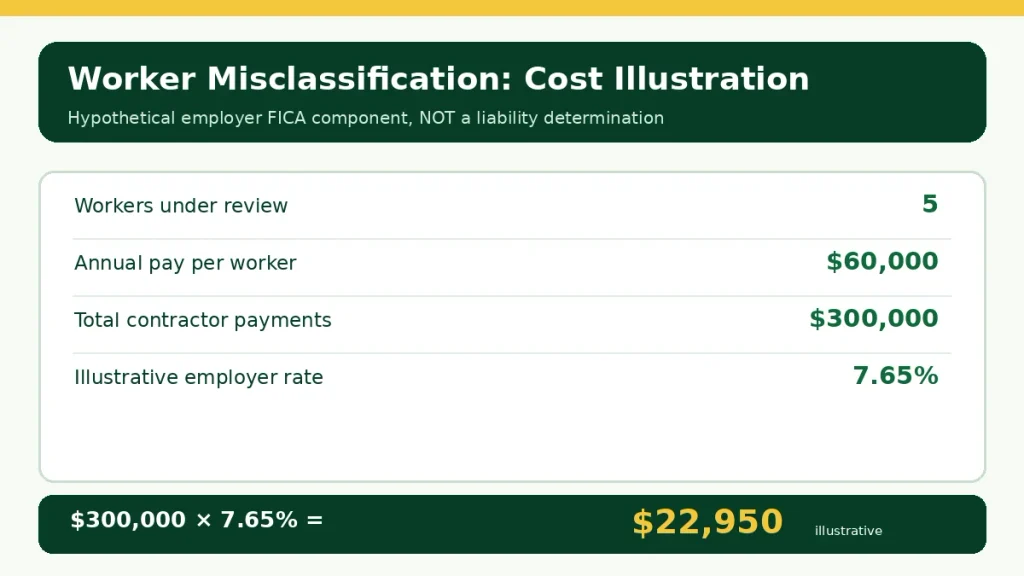
This represents only a simplified illustration of one potential employer tax component, assuming all payments are subject to that illustrative rate.
It is not a determination of actual misclassification liability.
Actual exposure may differ because of Social Security wage limits, the applicable tax years, employment tax relief, payments already made, classification findings, and other factors.
A complete review might also need to evaluate:
- Federal unemployment taxes
- State unemployment contributions
- Workers’ compensation obligations
- Potential wage-and-hour liabilities
- Applicable benefits
- Penalties and interest
- Professional and administrative expenses
These amounts should not be estimated using arbitrary percentages.
A qualified employment attorney and payroll tax professional should assess the potential obligations using the actual facts and applicable law.
Why Timing Matters
Potential exposure may involve more than one tax year or reporting period.
However, lookback periods, enforcement rules, and possible relief differ by jurisdiction and claim.
A business should not simply multiply one year’s estimated costs by an assumed number of years without reviewing those rules.
The purpose of financial modeling is to help management understand realistic exposure, uncertainty, and potential cash requirements.
How to Review Your Independent Contractor Arrangements
A structured contractor review is more useful than assuming every arrangement is compliant because the business has signed paperwork.
Step 1: Create a Contractor Inventory
Identify workers currently treated as independent contractors.
Record the services performed, location, compensation, relationship duration, and relevant business arrangements.
Step 2: Identify Applicable Laws
Determine which federal and state requirements apply.
A business operating across multiple states may need different classification analyses.
Step 3: Evaluate Actual Working Practices
Review how the company and worker operate in practice.
Consider control, independence, work methods, financial arrangements, and other relevant facts.
Step 4: Examine the Work Performed
Determine whether the services are part of the company’s ordinary business activities and whether that factor matters under the applicable test.
Step 5: Review Independent Business Evidence
Examine whether the worker operates an independent enterprise.
Relevant evidence may include business activities, investments, marketing, and customer relationships.
Step 6: Identify Higher-Risk Arrangements
Flag relationships where the facts may conflict with the stated contractor classification.
Do not assume that a single indicator establishes a violation.
Step 7: Consult Qualified Professionals
Have employment counsel and an appropriate tax professional review material concerns.
They can help determine whether reclassification, further documentation, or other steps are appropriate.
Step 8: Evaluate Financial and Operational Implications
If changes are required, assess potential payroll costs, taxes, reporting obligations, and operational effects.
Step 9: Establish an Ongoing Review Process
Classification should be reconsidered when the relationship materially changes.
For example, a worker originally hired for a limited project may gradually assume an ongoing position with different responsibilities and controls.
The original classification decision may no longer reflect the current arrangement.
What If You’re Unsure Whether a Worker Is an Employee?
The IRS provides a formal determination process through Form SS-8.
Businesses and workers may request an IRS determination of worker status for federal employment tax and income tax withholding purposes.
However, this process has limitations and does not determine every question under federal wage law or state law.
The IRS also notes that determinations may take several months.
Business owners can review Form SS-8 and its instructions when considering this option.
Submitting the form is not necessarily the appropriate first step for every disputed relationship.
A company should obtain professional advice about the implications of its circumstances and the available alternatives.
Can a Business Voluntarily Reclassify Independent Contractors?
In some circumstances, yes.
The IRS offers a Voluntary Classification Settlement Program (VCSP) for eligible taxpayers that want to prospectively treat certain workers as employees for federal employment tax purposes.
The program has specific eligibility, reporting, and application requirements.
It may offer partial federal employment tax relief to qualifying participants.
However, the VCSP does not automatically resolve all state-law, wage-and-hour, or other potential liabilities.
Businesses considering prospective reclassification should evaluate:
- Worker classification under each applicable law
- Historical tax and wage exposure
- Eligibility for federal relief programs
- Payroll and benefits administration
- Future employment costs
- Required employee communications
- Documentation and implementation
See the IRS Voluntary Classification Settlement Program for eligibility information.
Professional guidance is important because an incorrectly handled change may create additional complications.
When Should Business Owners Conduct a Worker Classification Review?
A review may be particularly valuable when:
- The company depends heavily on contractors.
- Contractor responsibilities increasingly resemble employee positions.
- Workers are located in multiple states.
- A significant number of contractors perform core business functions.
- The company is preparing for financing or an acquisition.
- A contractor raises concerns about classification.
- The business introduces new staffing or outsourcing arrangements.
- Management cannot explain why particular workers are classified as contractors.
The objective is to identify potential risks before they create unexpected financial consequences.
For businesses preparing for a sale, diligence may also involve reviewing employment agreements, payroll records, and classification practices.
Classification issues that appear minor during normal operations can become important when a buyer examines the company’s liabilities and compliance processes.
The CFO’s Role in Worker Classification Risk Management
Worker classification decisions require legal and tax expertise.
However, a CFO can help management understand the financial consequences and establish appropriate financial controls.
Depending on the engagement, that may include:
- Monitoring contractor expenditures
- Identifying material workforce cost trends
- Coordinating financial information for professional review
- Evaluating potential payroll cost changes
- Forecasting cash requirements
- Assessing financial exposure scenarios
- Supporting budgeting for compliance-related changes
- Preparing financial information for lender or buyer diligence
The CFO should not replace employment counsel or determine legal classification based solely on financial considerations.
Instead, financial leadership helps ensure that significant legal and payroll risks are considered in the company’s planning.
This is particularly important when a business relies on outside workers to support growth.
A lower apparent contractor cost does not necessarily represent a financially sustainable arrangement if the classification is incorrect.
Frequently Asked Questions About Worker Classification
What is worker classification?
Worker classification determines whether someone providing services should be treated as an employee or independent contractor under applicable tax, employment, and state laws.
What is the difference between an employee and an independent contractor?
The distinction depends on the applicable legal test and actual relationship. Relevant factors may include control, financial independence, the nature of the services, and the worker’s operation of an independent business.
Does issuing a 1099 make someone an independent contractor?
No. Form 1099-NEC does not determine worker status. Classification depends on the actual relationship under applicable laws.
What are the IRS worker classification factors?
The IRS generally evaluates behavioral control, financial control, and the type of relationship between the parties.
What is the ABC test?
The ABC test is a classification standard used in certain jurisdictions for specified purposes. A commonly used version examines freedom from control, work outside the hiring business’s usual course, and an independently established business.
Can someone be a contractor under federal law but an employee under state law?
Potentially, yes. Different laws may apply different classification requirements, so a determination under one framework does not automatically control every other framework.
Can an LLC owner still be classified as an employee?
Forming an LLC does not automatically establish independent contractor status. The relationship and applicable laws must be evaluated.
What are the financial risks of worker misclassification?
Potential risks include employment tax liabilities, unpaid wages, unemployment insurance assessments, workers’ compensation issues, penalties, interest, and professional expenses, depending on the circumstances.
What is IRS Form SS-8?
Form SS-8 allows businesses or workers to request an IRS determination of worker status for federal employment tax and income tax withholding purposes.
Should a business automatically reclassify every contractor who performs core services?
No. The appropriate analysis depends on the applicable laws, exemptions, and full working relationship. Core business activities may be especially significant under certain tests, but classification requires a complete review.
Final Thoughts: Worker Classification Is a Financial Risk Worth Addressing Early
Worker classification is not a decision that can be resolved simply by signing an independent contractor agreement.
The appropriate classification depends on the actual working relationship and the federal and state laws that apply.
Businesses should understand how their contractors perform services, whether the arrangements satisfy applicable requirements, and what financial exposure may arise if a classification is incorrect.
From a CFO’s perspective, the most important lesson is straightforward.
A financial risk does not disappear because it has not yet appeared on the balance sheet.
Worker classification should be reviewed before an agency investigation, worker complaint, financing process, or ownership transition brings potential problems to light.
The appropriate response is not to assume every contractor should become an employee.
It is to evaluate the facts, obtain qualified legal and tax guidance, and understand the financial implications of the available options.
If your business needs stronger financial visibility, risk planning, or support evaluating the financial consequences of workforce decisions, experienced financial leadership can help.
Schedule a free CFO strategy call with Business CFO For Hire to discuss your company’s financial priorities.