A fractional CFO is a senior finance executive who works with your company part-time, usually on a monthly retainer, providing the same strategic leadership a full-time CFO would — forecasting, cash flow, financing, and exit planning — at a fraction of the cost. Most growing businesses pay a fractional CFO between $3,000 and $10,000 per month, against $300,000 to $450,000 a year for a full-time hire.
That’s the definition. The rest of this guide covers what the role actually looks like in practice: the work, the cost, how it compares to a controller or a full-time hire, and — honestly — when you don’t need one at all.
Key takeaways
- A fractional CFO handles forward-looking strategy: forecasting, cash flow management, financing, pricing, and exit prep. Bookkeepers and accountants record the past; a CFO plans the future.
- Fractional CFO retainers industry-wide typically run $3,000 to $10,000 per month. A full-time CFO costs $300,000 to $450,000 a year fully burdened.
- The role fits best for businesses between roughly $1 million and $50 million in revenue — enough complexity to need executive-level finance, not enough to justify a full-time executive salary.
- “Fractional CFO” is an unregulated title. Some providers using it are doing genuine CFO work; others are selling repackaged bookkeeping. Knowing the difference matters more than the label.
- A fractional CFO is not the right fix for messy books. That’s a bookkeeping or controller problem, and hiring above it wastes money.
What does a fractional CFO do?
A fractional CFO does the strategic financial work of a chief financial officer — building forecasts, managing cash flow, setting pricing and margin strategy, preparing the company for financing or a sale, and turning monthly numbers into decisions — on a part-time schedule matched to what the business actually needs. The job is forward-looking by design.
In practice, the work of fractional CFO services usually clusters around a handful of core responsibilities. Cash flow forecasting sits at the center: a rolling 13-week model plus a 12-month view, so the owner sees a cash gap 60 days out instead of the week it hits. Around that core sits budgeting and margin analysis, KPI reporting the leadership team actually uses, bank and lender relationships, fundraising or M&A preparation, and pricing decisions backed by real cost data instead of gut feel.
What a fractional CFO doesn’t do, at least not as the main job, is data entry, reconciliations, or tax filing. Those tasks belong to other roles, which is exactly why the next two comparisons matter.
Fractional CFO vs. full-time CFO vs. interim CFO
A fractional CFO works part-time on an ongoing retainer, a full-time CFO is a salaried executive employee, and an interim CFO fills the seat full-time but temporarily, usually between permanent hires. Same skill set, three different engagement models — and the right one depends on how much CFO-level work your business actually generates each month.
| Fractional CFO | Full-time CFO | Interim CFO | |
| Commitment | Part-time, ongoing (a set number of days or hours per month) | Full-time employee, permanent | Full-time, temporary (typically 3–12 months) |
| Typical cost | $3,000–$10,000/month retainer | $300,000–$450,000/year fully burdened | Full-time-equivalent rates for the duration |
| Best fit | $1M–$50M businesses needing executive finance without an executive salary | Companies with enough daily CFO-level workload to fill a seat — often $50M+ or heavy compliance/board demands | Bridging a departure, a transaction, or a crisis until a permanent hire lands |
| Relationship | Long-term strategic partner, scaled to need | Embedded member of the executive team | Stopgap with a defined end date |
For context on why the full-time route costs what it does: according to the U.S. Bureau of Labor Statistics’ Occupational Outlook Handbook, the median annual wage for chief executives was $206,420 in May 2024 — and that’s base wage across all company sizes, before benefits, bonus, and equity push a true CFO hire toward the $300,000–$450,000 fully burdened range growing companies actually face.
Fractional CFO vs. controller vs. bookkeeper: which one do you actually need?
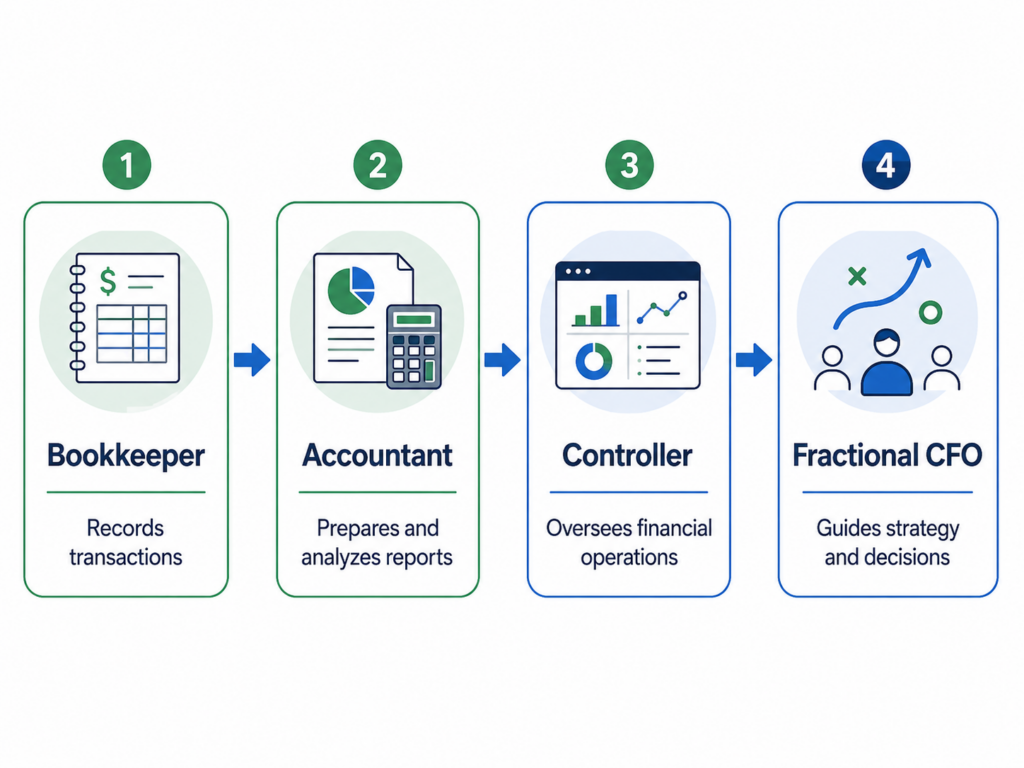
A bookkeeper records transactions, an accountant produces statements and handles taxes, a controller ensures the numbers are accurate and the close runs on time, and a CFO uses those numbers to make forward-looking decisions. Owners who feel “behind on the finances” often can’t tell which rung of that ladder is missing — and hiring the wrong one is expensive in both directions.
| Role | Owns | Looks | Typical trigger |
| Bookkeeper | Daily transaction recording, reconciliations | Backward | Any revenue at all — every business needs clean books |
| Accountant / CPA | Financial statements, tax filing, compliance | Backward | Tax complexity, entity questions, year-end reporting |
| Controller | Accuracy of the numbers, the monthly close, internal controls | Backward and present | Books exist but close late, or nobody trusts the reports |
| Fractional CFO | Strategy, forecasting, financing, pricing, exit prep | Forward | The numbers are trustworthy but nobody’s using them to decide anything |
Here’s the practical test. If your monthly reports arrive late or you don’t trust them, that’s a bookkeeping or fractional controller problem — fix the recording layer first. If the reports are accurate but they sit in a drawer while you make hiring, pricing, and borrowing decisions on instinct, that’s the CFO gap. SCORE, the SBA’s mentoring resource partner, publishes similar guidance on when early-stage companies should move from a bookkeeper to a controller to a CFO, and the ladder logic is the same: each role builds on the one below it, and skipping a rung doesn’t work.
How much does a fractional CFO cost?
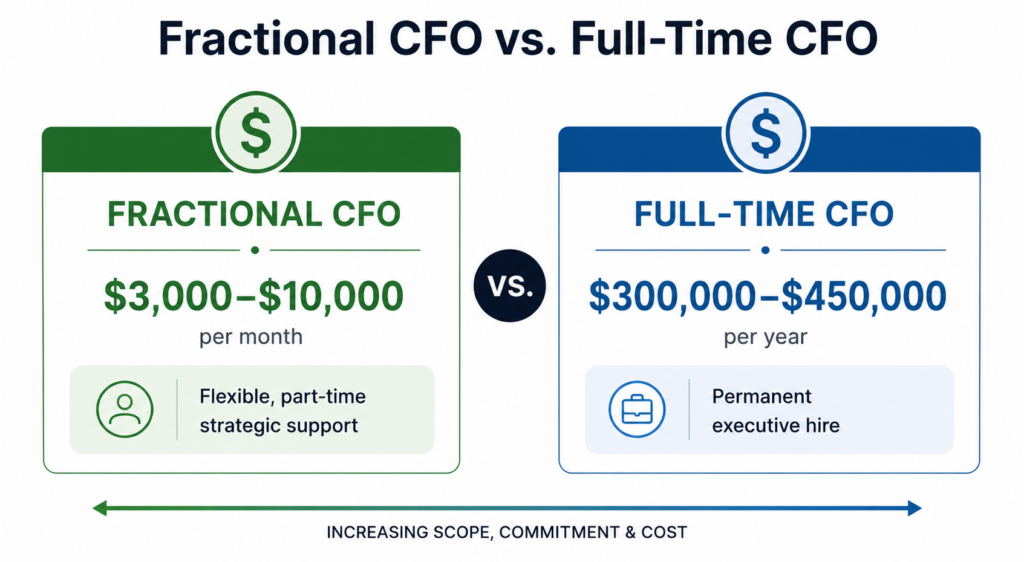
Most growing businesses pay a fractional CFO between $3,000 and $10,000 per month on retainer, depending on company complexity and how many days per month the engagement covers. A full-time CFO, by comparison, costs $300,000 to $450,000 per year once salary, benefits, bonus, and payroll costs are counted.
The retainer model matters as much as the number. A retainer buys a consistent monthly rhythm — the forecast gets updated, the close gets reviewed, the strategy conversation happens — rather than hours billed reactively when something breaks. Where a specific business lands inside the $3,000–$10,000 range comes down to a few drivers: revenue size and entity complexity, whether a financing event or sale is in motion, how much of the reporting foundation already exists, and how involved the CFO needs to be with the bank, the board, or investors.
One more number worth holding onto: the gap between $10,000 a month at the top of the fractional range and roughly $30,000 a month for a full-time hire is the entire reason this model exists. Most $1M–$50M businesses generate real CFO-level questions every month, but not forty hours a week of them.
How a fractional CFO engagement actually works
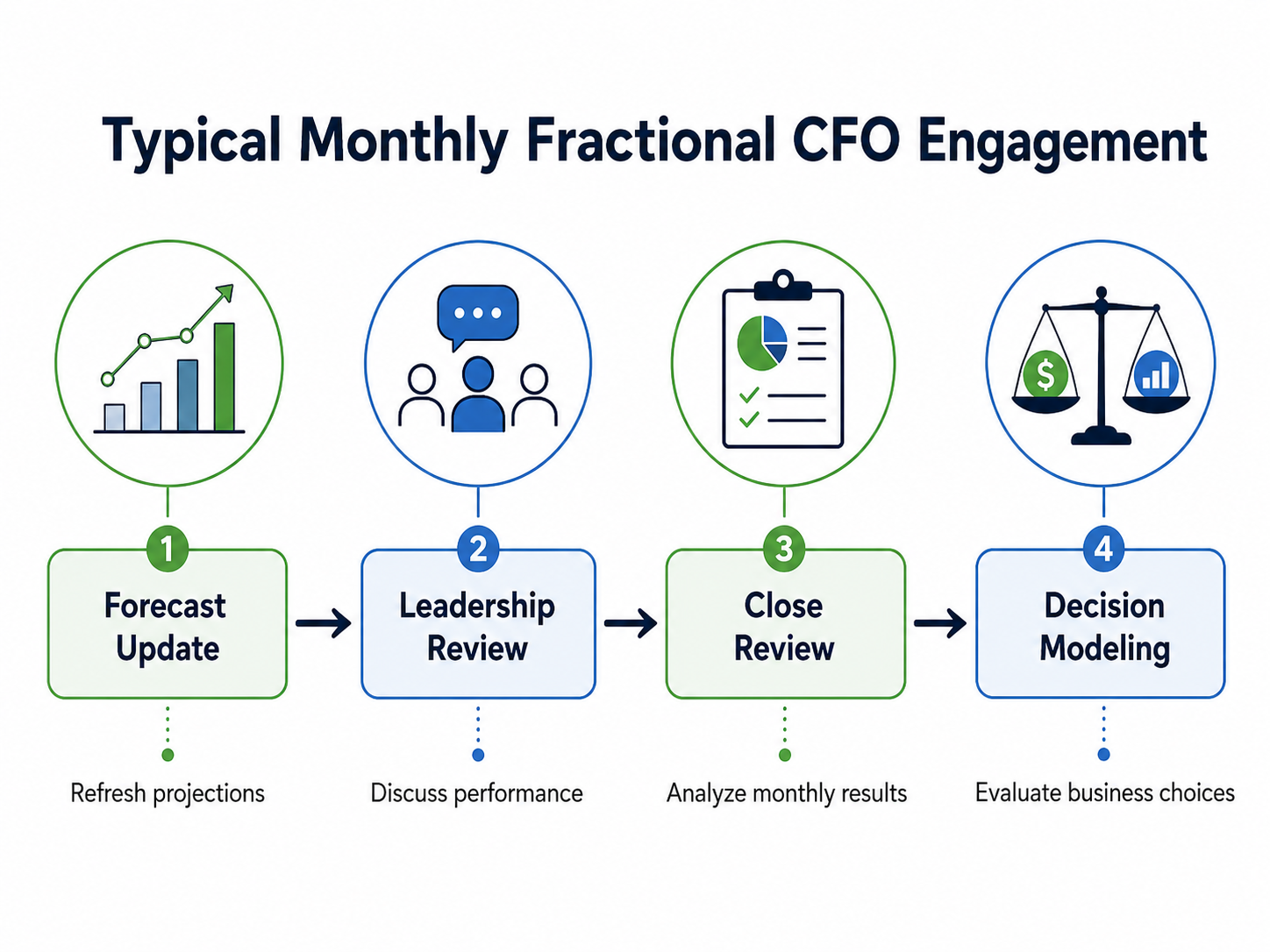
A typical engagement starts with a diagnostic, settles into a monthly rhythm, and scales up or down as the business changes. At Business CFO for Hire, every engagement starts the same way: a free discovery conversation and a GAP Analysis that maps where the finance function stands today against where the business is trying to go. No commitment, and if the honest answer is “you need a controller, not a CFO,” that’s the answer you get.
From there, a normal month looks something like this. The forecast gets updated against actuals. The monthly close gets reviewed with the owner in plain language — what moved, why, and what it means for the next 90 days. Decisions on the table (a hire, an equipment purchase, a credit line draw, a price change) get modeled before the commitment is made instead of after. And when a bigger event arrives — a bank renewal, a fundraise, an acquisition conversation — the fractional CFO runs point on the numbers side of it.
That rhythm compounds. Stan Alhadeff worked with one client, Amerigo Metal Recycling, through more than a decade of that monthly discipline, and the company grew from $8 million to nearly $50 million in sales over the engagement. Clients following the same playbook have identified 20%+ in savings within their first year, and one engagement secured $1.5 million in alternative funding on the strength of financials a lender could actually trust. None of that comes from a single brilliant meeting. It comes from the numbers getting real attention every single month.
If you want to see what that diagnostic looks like for your own business, the free GAP Analysis is the starting point — it tells you what’s working, what’s missing, and in what order to fix it.
When should you hire a fractional CFO?
Most businesses benefit from a fractional CFO once they pass roughly $1 million in revenue and financial decisions start outrunning the owner’s ability to analyze them. Revenue alone isn’t the trigger, though. The clearer signals show up in how decisions are getting made:
- You’re making major calls without models. Hires, equipment, expansion, pricing — decided on gut feel because nobody can build the scenario analysis.
- Cash surprises you even though you’re profitable. Revenue is up and the bank account is tight, and nobody can explain the gap before it happens.
- A financing event is coming. A bank renewal, a raise, or a sale is 6–18 months out, and the financials wouldn’t survive due diligence today.
- You’ve become the finance department. Evenings and weekends go to spreadsheets instead of customers, which is precisely the trap Stan Alhadeff wrote Run the Business, Don’t Become It about.
Two or more of those, and the fractional conversation is worth having. Our full range of services covers the layers underneath the CFO seat too, because the right answer is sometimes a different rung of the ladder.
When a fractional CFO isn’t the right fit
A fractional CFO is the wrong hire when the real problem is messy books, when the business is too small to generate strategic financial questions, or when the owner wants someone to take orders rather than challenge assumptions. This deserves saying plainly, because plenty of firms will happily sell you the engagement anyway.
If revenue is under roughly $1 million and the pain is late invoices and unreconciled accounts, a good bookkeeper and accountant will return far more per dollar. If reports exist but can’t be trusted, a controller fixes that — putting a CFO on top of bad data just produces confident-sounding conclusions from wrong numbers. And if the business has grown to the point where CFO questions genuinely fill a week, every week, the honest recommendation is a full-time hire, and a good fractional CFO will tell you so and help you recruit them.
Not everyone using the title is a fractional CFO
“Fractional CFO” is an unregulated title, and in the last several years it has been stretched to cover everything from true executive-level finance work to rebranded bookkeeping packages. In 30-plus years of financial leadership — and as one of the longest-serving independent fractional CFOs in the US, doing this work since founding Business CFO for Hire in 2011, well before the title was fashionable — the pattern Stan Alhadeff sees most often is owners paying CFO prices for controller work, or controller prices for bookkeeping, without knowing the difference.
The test isn’t the title. It’s the track record and the questions. A real fractional CFO has sat in the CFO chair — Stan has managed companies from startups to over $1 billion in revenue — and their first month with you sounds like strategy: where’s cash going over the next 13 weeks, what’s the margin by product line, what does the bank need to see next year. A rebranded bookkeeper’s first month sounds like data entry with a nicer invoice. Ask for the specific companies they’ve led, the financings they’ve closed, and a forecast model they’ve built for a business your size. The real ones answer in detail. The rest change the subject.
Where a fractional CFO fits in your next 12 months
If your business is somewhere between $1 million and $50 million, the question usually isn’t whether you need CFO-level thinking — the decisions in front of you already require it. The question is whether that thinking comes from you at midnight with a spreadsheet, or from someone who’s done it for three decades and costs a fraction of a full-time executive. That’s what a fractional CFO is, stripped of the buzzwords: the game plan layer on top of the scoreboard your bookkeeping already provides.
Common follow-up questions — on contracts, industries, and how engagements wind down — are covered in our Fractional CFO Q&A. And if you’d rather just talk it through against your own numbers, book a free strategy call with Stan — it starts with the GAP Analysis, and it ends with a straight answer about which role your business actually needs, even if that answer isn’t us.
FAQ
What is a fractional CFO? A fractional CFO is a senior finance executive who works with your company part-time, usually on a monthly retainer, handling forecasting, cash flow, financing, and financial strategy. The model gives growing businesses CFO-level leadership without the $300,000-plus cost of a full-time executive hire.
What does a fractional CFO do? A fractional CFO builds cash flow forecasts, manages budgeting and margins, prepares the company for financing or a sale, and turns monthly financial reports into decisions. The role is forward-looking by design, which separates it from bookkeepers and accountants who record what already happened.
How much does a fractional CFO cost? Most growing businesses pay a fractional CFO between $3,000 and $10,000 per month on retainer. Where a business lands in that range depends on revenue size, complexity, and whether a financing event or sale is in motion, compared with $300,000 to $450,000 a year fully burdened for a full-time CFO.
What is the difference between a fractional CFO and a full-time CFO? A fractional CFO works part-time on an ongoing retainer, while a full-time CFO is a salaried executive employee. The skill set is the same; the difference is commitment and cost, and the right choice depends on whether your business generates forty hours a week of genuine CFO-level work.
What is the difference between a fractional CFO and a controller? A controller owns the accuracy of your numbers — the monthly close, reconciliations, and internal controls — while a fractional CFO uses those numbers to drive strategy, forecasting, and financing decisions. Controllers look backward and present; CFOs look forward. Many growing businesses eventually need both.
When should a business hire a fractional CFO? Most businesses benefit from a fractional CFO once they pass roughly $1 million in revenue and major decisions start being made without financial analysis behind them. Cash flow surprises despite profitability, an upcoming financing event, and the owner drowning in spreadsheets are the other common triggers.
How many hours does a fractional CFO work? A fractional CFO typically works a set number of days or hours per month, scaled to the engagement — often the equivalent of a few days monthly for a stable business, more during a financing event or sale. The retainer model keeps the rhythm consistent rather than purely reactive.

Stan Alhadeff
Founder & Fractional CFO