A financial controller is the senior accounting professional responsible for the accuracy of your company’s financial records, the monthly close, internal controls, and compliance. They own the numbers, making sure your financial statements are correct, on time, and something a bank or investor could trust without a second look.
That’s the short version. The rest of this guide covers what the job actually looks like month to month, how it differs from a bookkeeper and a CFO, and the exact point where a great controller alone stops being enough.
Key takeaways
- A financial controller owns accuracy: the general ledger, the month-end close, internal controls, and compliance with GAAP or your industry’s reporting standards.
- Controllers look backward and present — making sure what already happened is recorded correctly. CFOs look forward and use those numbers to plan what happens next.
- According to the U.S. Bureau of Labor Statistics, the median annual wage for financial managers, the occupational category that includes controllers, was $161,700 in May 2024.
- A controller is the right hire when your books exist but can’t be trusted or don’t close on time. A CFO is the right hire when the books are solid, but nobody’s using them to decide anything.
- Most growing businesses eventually need both, but rarely at the same time; the controller role almost always comes first.
What is a financial controller?
A financial controller is the senior accounting leader responsible for the integrity of a company’s financial records — closing the books accurately each month, maintaining internal controls, and producing financial statements that hold up under audit or lender scrutiny. In most growing businesses, the controller is the highest-ranking accounting professional on the team.
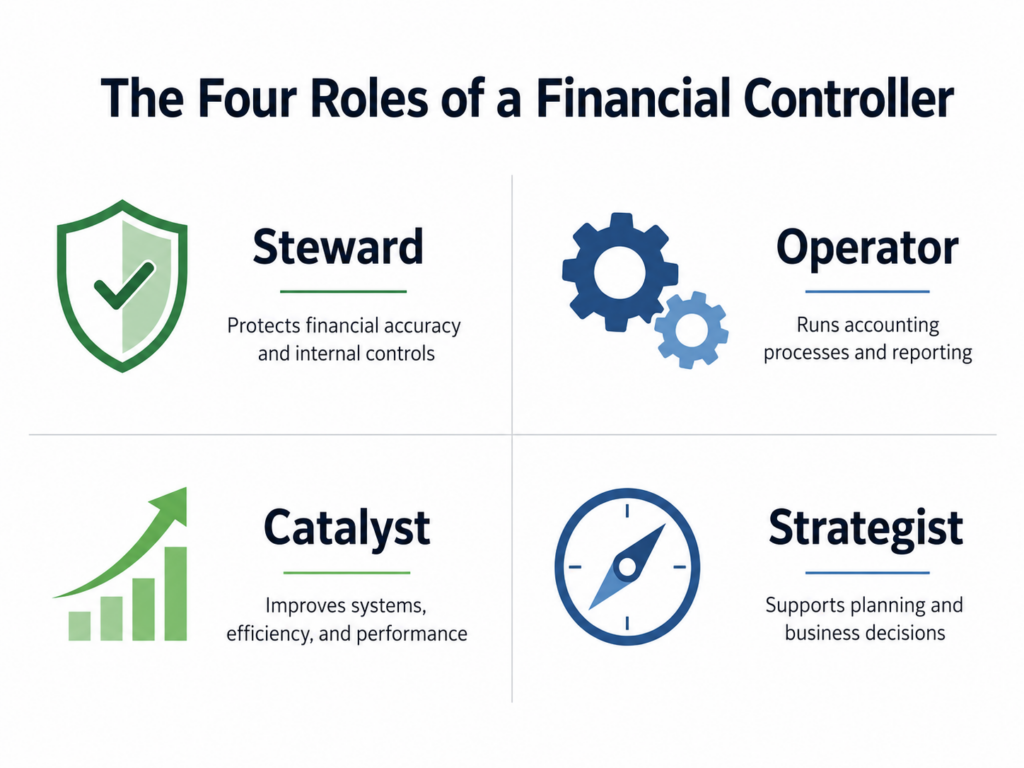
The role sits above a bookkeeper and typically above staff accountants, and below a CFO where one exists. A controller’s mindset runs toward precision, policy, and consistency. Several well-known frameworks describe the modern controller as balancing four roles at once: steward, operator, catalyst, and strategist, a model originally developed jointly by the Institute of Management Accountants and Deloitte. In practice, that means the job exists to make sure nobody, including the owner, gets surprised by a number that turns out to be wrong.
What does a financial controller do day to day?

Most of a financial controller’s time goes toward four things: closing the books, keeping the numbers accurate, protecting the business through internal controls, and getting the company ready for audits, taxes, and lenders. It’s detailed, deadline-driven work, and it’s the foundation everything else in finance depends on.
In practice, that breaks down into a handful of recurring responsibilities. Managing the general ledger and reviewing journal entries so the chart of accounts stays clean. Running the month-end and year-end close — reconciling accounts, catching variances, and explaining why they happened, not just that they happened. Preparing income statements, balance sheets, and other financial reports that comply with GAAP. Overseeing accounts payable, accounts receivable, and payroll so nothing slips. Designing and enforcing internal controls that prevent fraud and errors. Coordinating with external auditors and tax preparers, and managing the debt and compliance calendar so nothing catches the business off guard.
A controller who’s doing the job well isn’t just producing reports; they’re the person who can explain, in plain language, why the numbers moved.
Financial controller vs. bookkeeper vs. accountant: where the controller fits
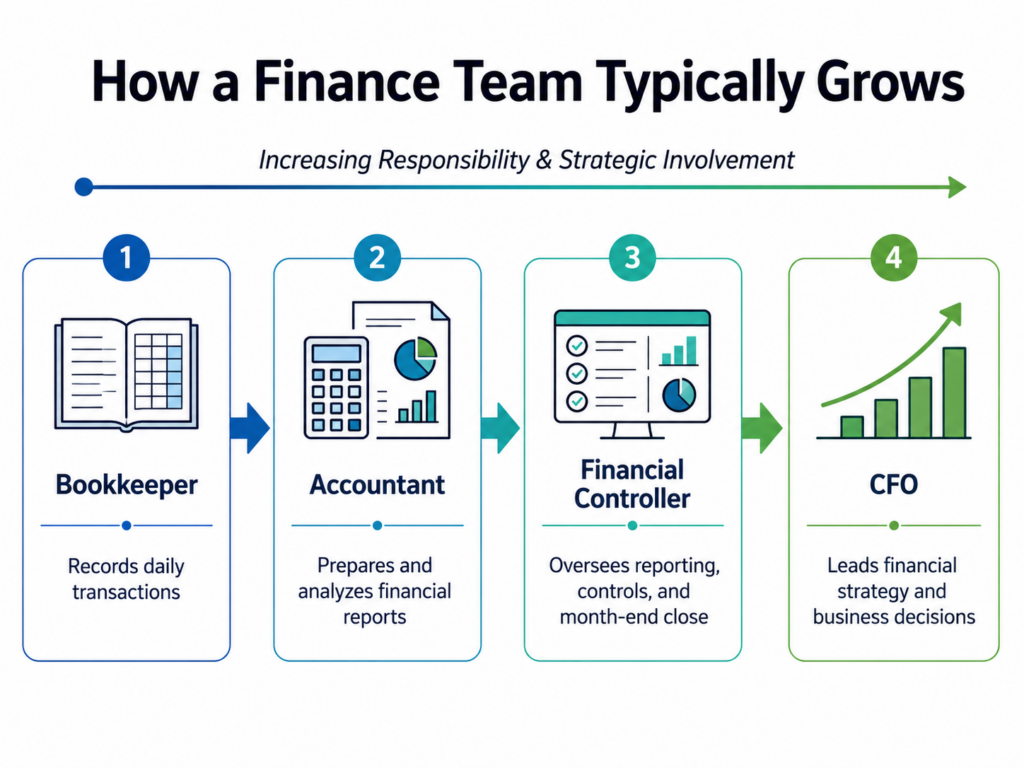
A bookkeeper records transactions, an accountant prepares statements and handles tax filings, and a controller sits above both, responsible for the accuracy of the whole accounting function and the timeliness of the close. Each role builds on the one below it, which is why hiring out of order rarely works.
| Role | Owns | Time horizon | Typical trigger to hire |
| Bookkeeper | Daily transaction recording, reconciliations | Backward | Any revenue at all — every business needs this |
| Accountant / CPA | Financial statements, tax filing | Backward | Tax complexity, year-end reporting |
| Financial controller | Accuracy of the numbers, the close, internal controls | Backward and present | Books exist but close late, or nobody trusts the reports |
A controller can do a bookkeeper’s job in a pinch, but that’s a poor use of a senior accounting professional’s time and usually a sign the business is understaffed underneath them, not that the controller isn’t needed.
Financial controller vs. CFO: the short answer
A controller ensures the numbers are right; a CFO uses those numbers to decide what to do next. Controllers look backward — closing the books, maintaining controls, reporting what happened. A fractional CFO looks forward, forecasting cash, setting pricing and financing strategy, and using the controller’s accurate numbers to guide real decisions.
That distinction is simple to state and genuinely hard to apply in the moment. For the full comparison, including a clear answer on which one to hire first see CFO vs. controller: key differences and who to hire first.
What makes a good financial controller?
Strong controllers combine two things that don’t always come naturally together: precision with the numbers and the ability to explain them clearly to people who aren’t accountants. Most hold a CPA, have five or more years of accounting experience, and are comfortable owning a deadline nobody else in the business fully understands the stakes of.
Technical skill matters: GAAP knowledge, ERP and accounting software fluency, and a sharp eye for a number that doesn’t reconcile. So does judgment: knowing which variance is a rounding issue and which one is the first sign of a real problem. And so does communication. A controller who can only speak in debits and credits will frustrate a leadership team that needs the plain-English version by the next board meeting.
Signs your business needs a financial controller
Most growing businesses hit a point where the founder or a bookkeeper genuinely can’t keep the books airtight anymore, and that’s the signal, not a specific revenue number. A few concrete versions of that moment:
- Your month-end close takes weeks, not days. By the time the numbers are final, they’re too old to act on.
- You don’t fully trust your own financial reports. Something feels off, but nobody can say exactly what or why.
- A lender or investor asked for financials and you needed weeks to get them audit-ready. That’s a controller gap showing up at the worst possible moment.
- Nobody owns internal controls. No one is explicitly responsible for catching errors or fraud before they compound.
Two or more of those, and a controller conversation is overdue. Our accounting services cover the bookkeeping layer underneath the controller role too, in case the real gap sits one rung lower on the ladder.
When a controller isn’t enough anymore
A controller isn’t the right fix when the problem has shifted from “are the numbers accurate” to “what should we do about them.” That’s not a knock on a good controller; it’s a different skill set entirely, and expecting one person to do both jobs well is where a lot of growing businesses quietly stall.
In 30-plus years of CFO work, the pattern Stan Alhadeff sees most often is a business with a genuinely excellent controller who closes the books on time, keeps clean statements, and still can’t tell the owner whether they can afford to hire three more people this quarter. That’s not a controller failure. Reading a balance sheet or income statement accurately and using it to model a hiring decision, a pricing change, or a financing round are two different disciplines. Stan grew one client, Amerigo Metal Recycling, from $8 million to nearly $50 million in revenue over more than a decade, and that growth ran on a controller who kept the numbers airtight and a CFO who used them to make the next call. Neither one replaces the other.
If you’re not sure which side of that line your business is on, our free discovery call includes a GAP Analysis that tells you plainly whether the gap is accuracy, strategy, or both.
How much does a financial controller cost?
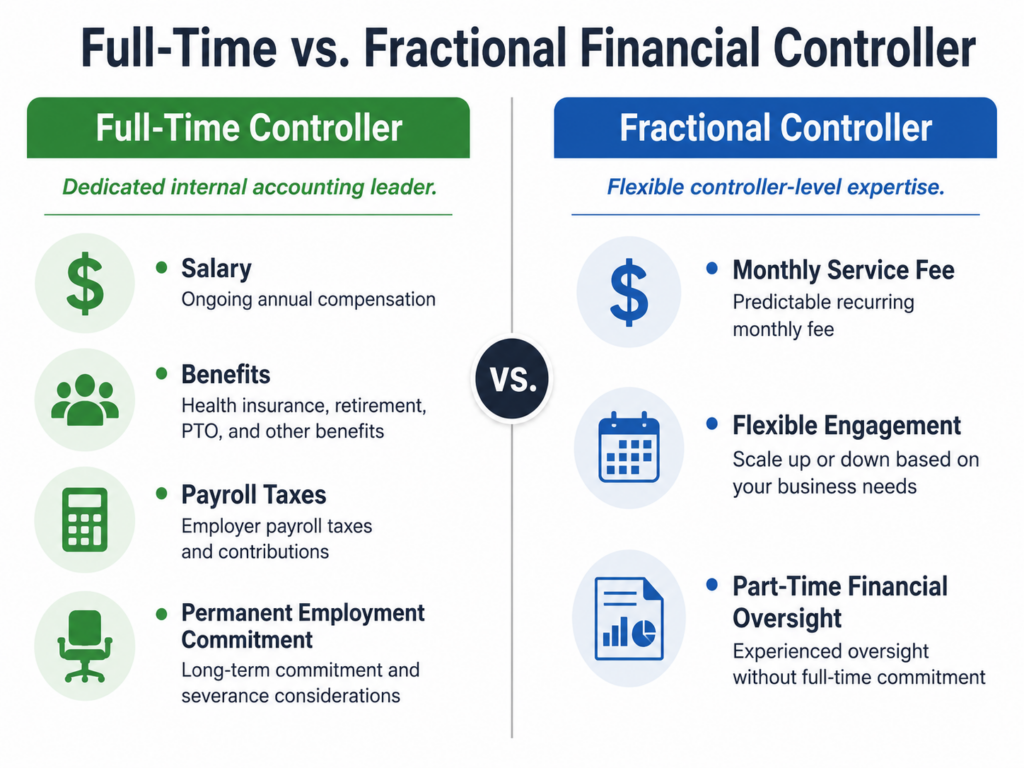
A full-time controller’s compensation typically tracks with the U.S. Bureau of Labor Statistics’ financial managers category — the SOC classification that includes controllers, which reported a median annual wage of $161,700 in May 2024, before benefits and bonus. That’s a meaningful commitment for a business that’s outgrown a bookkeeper but isn’t yet running a large accounting department.
A fractional controller delivers the same accuracy and close discipline on a scaled basis, without the full-time salary. Exact cost depends on transaction volume, entity complexity, and how much cleanup the books need at the start, which is why we scope every engagement individually rather than quoting a flat number that wouldn’t fit most businesses anyway.
Where the controller role fits in your finance function
A financial controller is the accuracy layer every other financial decision in the business rests on. Skip it or understaff it, and even a brilliant strategist is building plans on numbers nobody’s confident in. Get it right, and the controller becomes the reason your reports, your close, and your compliance stop being a source of quiet anxiety.
According to SCORE, the SBA’s nationwide mentoring resource partner, the shift from bookkeeper to controller is a natural stage in a growing company’s finance maturity — one that typically arrives once the volume and complexity of transactions outgrow what founder-led or basic bookkeeping support can handle. Knowing which stage you’re in now is most of the battle. If you’d like a straight read on where your business actually stands, book a free strategy call with Stan — it starts with the GAP Analysis, and it tells you plainly whether you need a controller, a CFO, or both.
FAQ
What does a financial controller do? A financial controller manages a company’s accounting function, owning the month-end close, internal controls, and the accuracy of financial statements. They ensure the numbers are correct, compliant, and ready for lenders, investors, or auditors at any time.
What is the difference between a financial controller and a CFO? A controller ensures the numbers are accurate and the books close on time; a CFO uses those numbers to plan strategy, forecast cash, and guide major decisions. Controllers look backward and present, while CFOs look forward — most growing businesses eventually need both.
What is the difference between a controller and a bookkeeper? A bookkeeper records daily transactions, while a controller oversees the entire accounting function, including internal controls and the accuracy of the close. A controller typically supervises or reviews the bookkeeper’s work rather than doing the data entry themselves.
What skills does a financial controller need? A financial controller needs deep accounting knowledge, usually including a CPA, along with strong internal-controls judgment and the ability to explain financial results in plain language to non-accountants. Five or more years of accounting experience is typical before someone moves into the role.
How much does a financial controller cost? A full-time controller’s compensation typically tracks near the BLS financial managers median of $161,700 a year, before benefits and bonus. A fractional or outsourced controller delivers the same accuracy at a scaled cost that depends on transaction volume and complexity.
When does a small business need a financial controller? A small business typically needs a controller once the month-end close starts taking weeks instead of days, or once the owner stops trusting their own financial reports. A lender or investor request for audit-ready financials is another common trigger.

Stan Alhadeff
Founder & Fractional CFO