Virtual CFO, fractional CFO, and outsourced CFO all describe the same basic idea: senior financial leadership delivered without a full-time hire — but the industry doesn’t agree on where the lines between them sit. Search for a definition of any one term, and you’ll find providers contradicting each other, sometimes describing the exact opposite arrangement under the same label.
That’s not a satisfying answer if you’re trying to evaluate providers, so here’s what each term most commonly implies, why the confusion exists, and which one we use.
Key takeaways
- “Virtual CFO,” “fractional CFO,” and “outsourced CFO” overlap heavily, and different providers define them inconsistently — sometimes contradicting each other directly.
- “Virtual CFO” most consistently refers to remote-only delivery, regardless of the scope of work.
- “Fractional CFO” most consistently refers to a defined, scaled commitment — a set amount of monthly involvement — independent of whether the work happens remotely or in person.
- “Outsourced CFO” is the loosest of the three, sometimes describing light advisory support and sometimes describing something close to a full-time contracted role.
- Business CFO for Hire uses “fractional CFO” because commitment level is what actually matters to a buyer, and our engagements happen to be delivered entirely virtually anyway.
What is a virtual CFO?
A virtual CFO is a CFO who delivers services entirely remotely, using video calls, shared financial tools, and digital communication instead of working on-site. The term describes how the work gets delivered, not necessarily how much work is involved — a virtual CFO can be lightly involved or deeply involved, as long as it all happens remotely.
Because remote work has become the norm across professional services generally, “virtual” has become less of a meaningful distinction than it once was. Most fractional and outsourced CFO relationships today are also delivered virtually, which is part of why the terms blur together so easily.
What is a fractional CFO?
A fractional CFO is a senior finance executive who works with a company part-time, on a defined and ongoing basis — typically a set number of days or hours each month — rather than as a full-time employee. The word “fractional” refers to the portion of a full-time role the engagement represents, not the delivery method.
This is the term with the clearest, most consistent common usage: it describes commitment level. A fractional CFO might work with you entirely remotely or occasionally in person, but the defining feature is that the scope is scaled and ongoing, not a one-off project.
What is an outsourced CFO?
An outsourced CFO is any CFO-level service provided by someone outside the company rather than a direct employee — a broader umbrella term that can include fractional arrangements, project-based work, or even a nearly full-time contracted role. It’s the least precisely used of the three terms.
Some providers use “outsourced CFO” interchangeably with “fractional CFO.” Others use it specifically to mean a more comprehensive, higher-hour engagement than a typical fractional relationship. There’s no dependable convention here, which is exactly why this term causes the most confusion when you’re comparing providers.
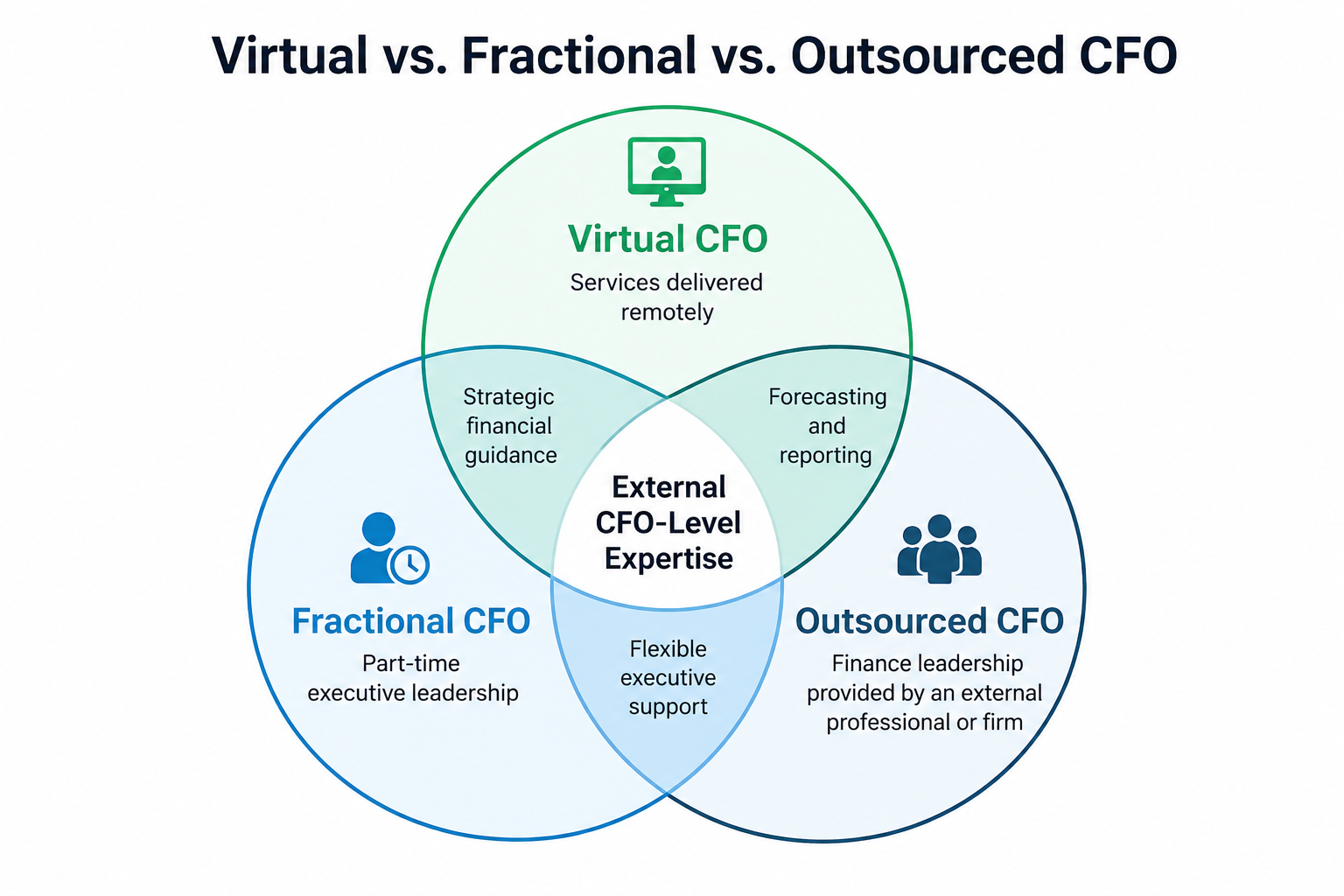
Virtual vs. fractional vs. outsourced CFO: side-by-side comparison
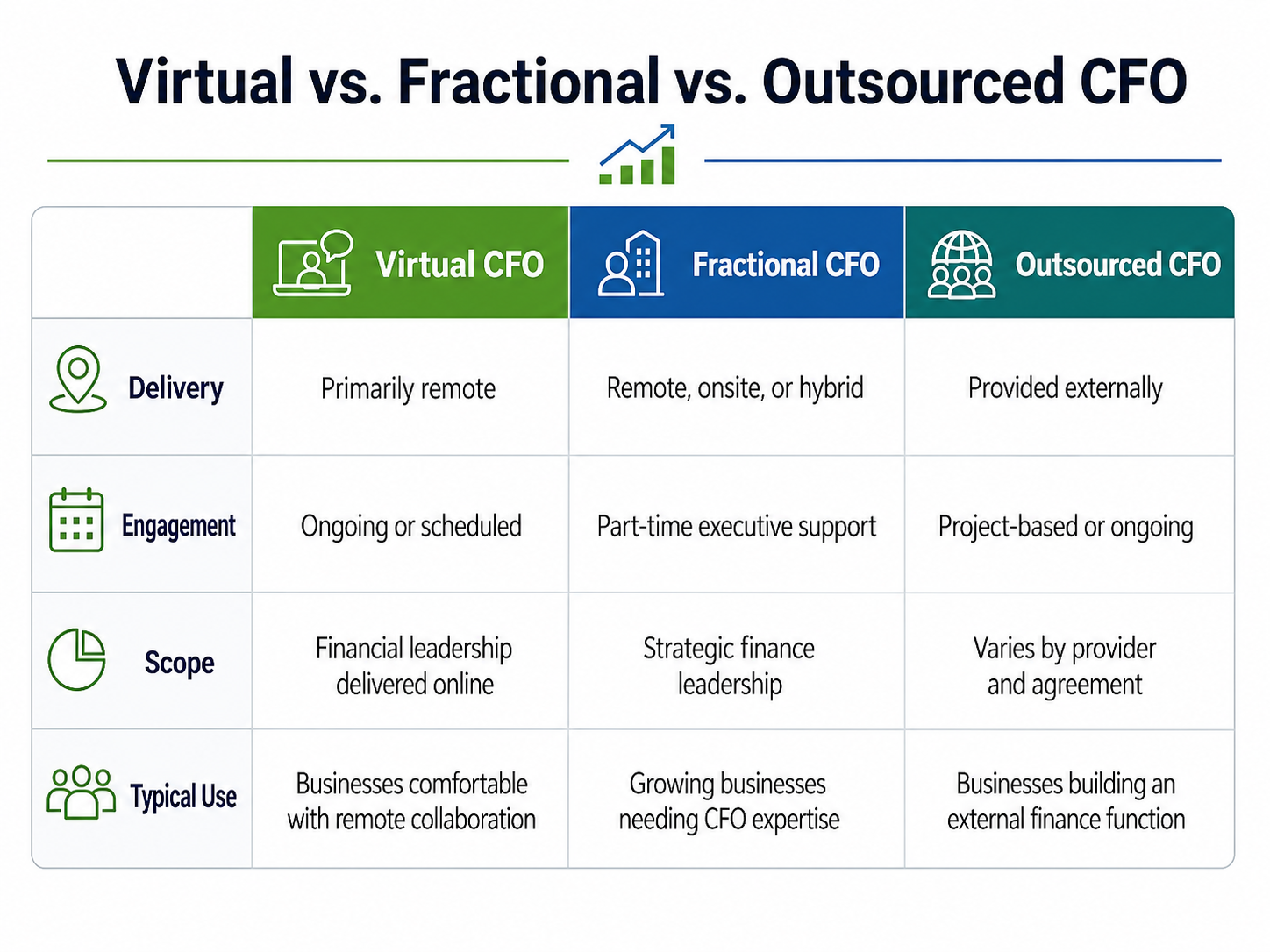
Here’s the most common pattern across the market, though providers use these terms inconsistently enough that the label alone shouldn’t be trusted — always confirm the actual engagement structure.
| Virtual CFO | Fractional CFO | Outsourced CFO | |
| What the term describes | Delivery method (remote) | Commitment level (defined, scaled, ongoing) | Employment structure (non-employee, broadly) |
| Delivery | Always remote | Remote or in-person, provider-dependent | Varies |
| Scope consistency | Fairly consistent usage | Fairly consistent usage | Least consistent — ranges from light advisory to near full-time |
| What to verify before signing | N/A — remote is the defining feature | Confirm the exact monthly hours or days included | Confirm scope and hours explicitly; the term alone tells you the least |
Why these terms get used so inconsistently

These labels didn’t emerge from an agreed industry standard — they emerged independently across dozens of firms, each describing their own service the way that made the most sense to them at the time. A firm built around remote delivery leaned on “virtual.” A firm built around scaled monthly commitment leaned on “fractional.” A firm built around flexible, broadly-scoped contract work leaned on “outsourced.” None of them were wrong, exactly — they just weren’t talking to each other.
The result is a market where the same word can mean different things depending on which website you’re reading, and where two providers using different terms might be offering nearly identical services. That’s frustrating for a buyer trying to compare options, and it’s exactly why the label matters less than the actual engagement details underneath it.
Which term does Business CFO for Hire use, and why?
We use “fractional CFO” because it describes what actually matters when you’re deciding whether this model fits your business: the commitment level, not the delivery channel. A defined, scaled monthly engagement is the thing you’re evaluating — whether that happens over video calls or occasionally in person is a secondary detail.
As it happens, Business CFO for Hire works with every client virtually — we’re based in Atlanta and serve businesses nationwide, without a local office to visit. By some definitions found across the market, that technically makes us a “virtual CFO” too. We don’t lean on that term as our primary label, because it describes the smaller, less important fact about the engagement. What you’re actually buying is fractional CFO services: a defined, ongoing scope of forecasting, financing, and strategic work, scaled to your business and delivered the same way regardless of where you’re located. You can see how that virtual, nationwide model works in practice across the areas we serve.
According to the U.S. Bureau of Labor Statistics, the median annual wage for financial managers — the broader occupational category all of these titles ultimately sit within — was $161,700 in May 2024. The label on the engagement doesn’t change what the role is worth or what it costs to replace with a full-time hire; it only changes how the part-time version of it gets described.
The label matters less than the fit
Whether a provider calls themselves virtual, fractional, or outsourced, the questions worth asking are the same: how many hours or days of involvement does this actually include, is the work delivered remotely or in person, and does the scope match what your business needs right now? Get clear answers to those, and the label becomes a footnote.
If you’d rather skip the terminology entirely and talk about your specific business, book a free strategy call with Stan — it starts with a free discovery call and GAP Analysis, and it ends with a plain description of the actual engagement, not a label.
FAQ
What is a virtual CFO? A virtual CFO is a CFO who delivers services entirely remotely, using video calls and digital tools instead of working on-site. The term describes the delivery method, not the scope or commitment level of the engagement.
What does outsourced CFO mean? Outsourced CFO is a broad umbrella term for any CFO-level service provided by someone outside the company, ranging from light advisory work to a nearly full-time contracted role. It’s the least consistently used of the common CFO-alternative terms.
Is a virtual CFO the same as a fractional CFO? Not exactly, though the terms overlap heavily and are often used interchangeably. “Virtual” most consistently describes remote delivery, while “fractional” most consistently describes a defined, scaled commitment level — a fractional CFO can work virtually or in person.
What is the difference between an outsourced CFO and a fractional CFO? The terms are frequently used interchangeably, but “fractional” typically implies a defined, ongoing monthly scope, while “outsourced” can describe anything from a single project to a nearly full-time contract. Always confirm the actual hours and scope rather than relying on either label alone.

Stan Alhadeff
Founder & Fractional CFO