Quick Answer:
The cost of a bad hire ranges from 30% of the employee’s first-year salary (U.S. Department of Labor) to 200–300% of annual compensation for executive-level roles (SHRM, CareerBuilder). For a CFO or senior finance leader, a bad hire can cost $240,000 or more when accounting for recruitment fees, productivity loss, strategic drift, lender relationship damage, and replacement costs. The hidden costs — missed covenant deadlines, inaccurate models, eroded board confidence — often dwarf the direct expenses.
Table of Contents
- Why “Good Enough” Is Your Most Expensive Finance Decision
- The Data: What the Cost of a Bad Hire Actually Looks Like
- The Bad Hire Cost Formula: How to Calculate Your True Exposure
- The CFO-Specific Cost Multiplier
- Real-World Cost Scenarios: Three Finance Role Mismatches
- The Hidden Costs Competitors Miss
- Red Flags: 8 Signs You’ve Made a Bad Finance Hire
- How to Hire Right the First Time
- Fractional CFO vs. Full-Time vs. Bad Hire: A Cost Comparison
- FAQ: Cost of a Bad Hire
1. Why “Good Enough” Is Your Most Expensive Finance Decision
Every business owner has run this mental calculation at some point: a lower-rate finance resource versus a battle-tested CFO at a premium. On paper, the hourly math looks obvious.
But paper math misses the line item that does the real damage.
It misses the cost of revisiting the same decision two or three times because the first hire couldn’t actually own it. It misses months of suboptimal reporting that quietly erode margin, strain lender relationships, and put bank covenants at risk. It misses the distraction tax on you and your leadership team — hours spent managing around someone rather than moving forward.
Most of all, it misses what the data shows with remarkable consistency: the cost of a bad hire almost always eclipses the cost of getting it right the first time.
This is particularly acute in finance. A wrong hire in operations is expensive. A wrong hire in your CFO seat is existential. They control your numbers, your relationships with lenders and investors, your cash visibility, and — ultimately — your enterprise value.
2. The Data: What the Cost of a Bad Hire Actually Looks Like
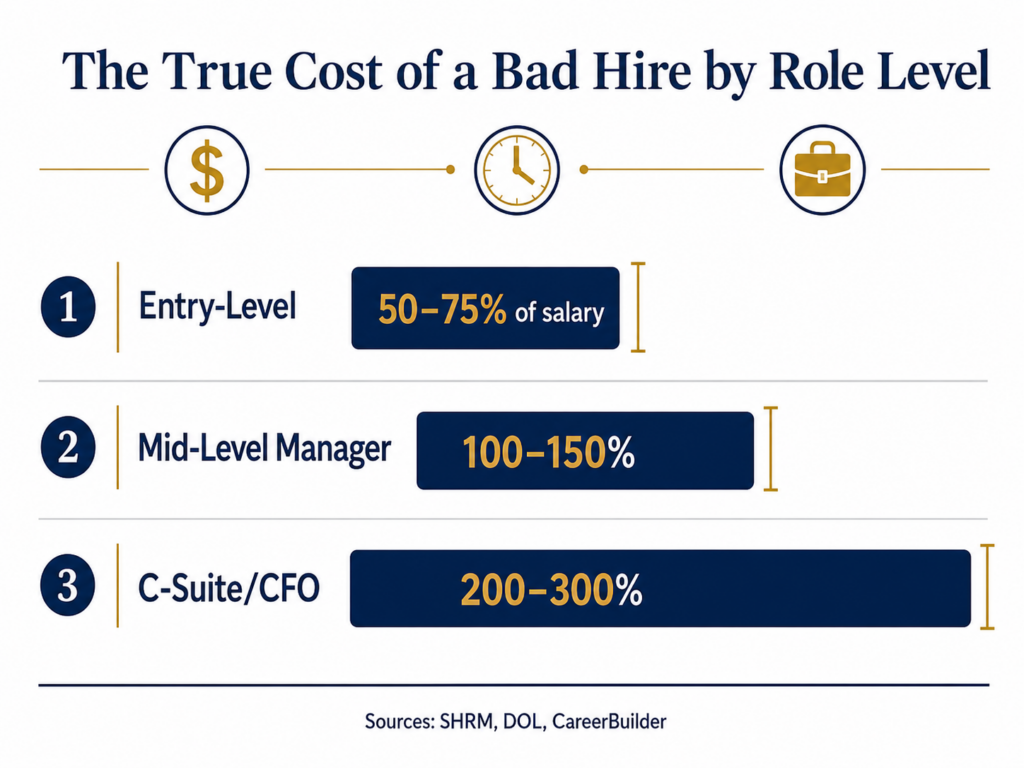
The research is clear and converging:
| Source | Finding |
| U.S. Department of Labor | A bad hire costs at least 30% of the employee’s first-year earnings |
| SHRM Human Capital Benchmarking | Replacing an employee costs 50%–200% of annual salary depending on seniority |
| CareerBuilder (2024) | 74% of employers admit to having made a bad hire; average reported loss = $17,000 per incident |
| CareerBuilder (Executive level) | Executive bad hires average $240,000+ in total losses |
| LinkedIn (2024) | Replacing a bad hire can cost up to 3x the employee’s annual salary when all factors are included |
| Gallup (2025 State of the Global Workplace) | Manager disengagement caused by bad hires costs organizations an estimated $438 billion in lost productivity globally in 2024 |
| SHRM (2025 Benchmarking) | Average baseline cost per new hire: $4,700 — before a bad hire multiplies that figure |
The range by seniority is particularly telling:
- Entry-level roles: 50–75% of annual salary
- Mid-level managers and technical specialists: 100–150%
- C-suite and executive roles (including CFOs): 200–300% or above
For a CFO earning $250,000, that means a bad hire can cost $500,000 to $750,000 when the full picture is accounted for — and that’s before you price in the strategic damage.
3. The Bad Hire Cost Formula: How to Calculate Your True Exposure
Most business owners think of bad hire costs as a single line item. They’re not. They’re a compounding series of financial hits across multiple categories:
True Cost of a Bad Hire =
(Acquisition Costs)
+ (Compensation Paid During Tenure)
+ (Productivity Loss × Duration)
+ (Management Oversight Tax)
+ (Termination & Legal Costs)
+ (Replacement Recruiting Costs)
+ (Ramp-Up Gap: Time to Full Productivity of Replacement)
+ (Strategic & Reputational Damage)
Cost Category Breakdown
| Cost Category | What’s Included | Typical Range |
| Acquisition Costs | Job board fees, agency recruiter fees (15–25% of first-year salary), background checks, interview time | $5,000–$30,000 |
| Compensation Paid | Salary + benefits paid during bad hire’s tenure (often 3–6 months at 50–70% output) | 25–50% of annual salary |
| Productivity Loss | Work performed below standard; errors requiring correction; projects delayed | 30–50% of salary during tenure |
| Management Overhead | Research shows managers spend 17% of their workweek managing underperformers | $10,000–$40,000/year in manager time |
| Team Disruption | Morale damage, peer overload, potential flight risk among top performers | Highly variable; often $20,000–$80,000 |
| Termination Costs | Severance (often 1–6 months at executive level), HR admin, legal review | $10,000–$60,000+ |
| Replacement Recruiting | You start the process over, often paying again for search | $5,000–$50,000+ |
| Ramp-Up Gap | New hire takes 3–6 months to reach full effectiveness (CFOs can take up to 12 months) | Lost opportunity value |
| Strategic Damage | Lender confidence, investor relationships, valuation multiple compression | Unquantified but often the largest cost |
A Practical Example
A $150,000/year finance director proves to be the wrong hire at month four. Here’s the math:
| Line Item | Calculation | Amount |
| Recruiter fee (20% of salary) | $150,000 × 20% | $30,000 |
| Compensation paid (4 months) | $150,000 ÷ 12 × 4 | $50,000 |
| Benefits (30% load) | $50,000 × 30% | $15,000 |
| Productivity gap (60% output) | $50,000 × 40% gap | $20,000 |
| Manager oversight (17% of $120K/yr × 4 months) | $120,000 × 17% ÷ 3 | $6,800 |
| Severance (2 months) | $150,000 ÷ 6 | $25,000 |
| Replacement search | New recruiter engagement | $30,000 |
| Ramp-up gap (6 months at 60% capacity) | Opportunity cost estimate | $30,000 |
| Total Direct + Indirect | $206,800 |
That’s 138% of the annual salary — and it doesn’t include any strategic damage to lender or investor relationships, covenant risk, or the cost of undoing and redoing financial work.
4. The CFO-Specific Cost Multiplier
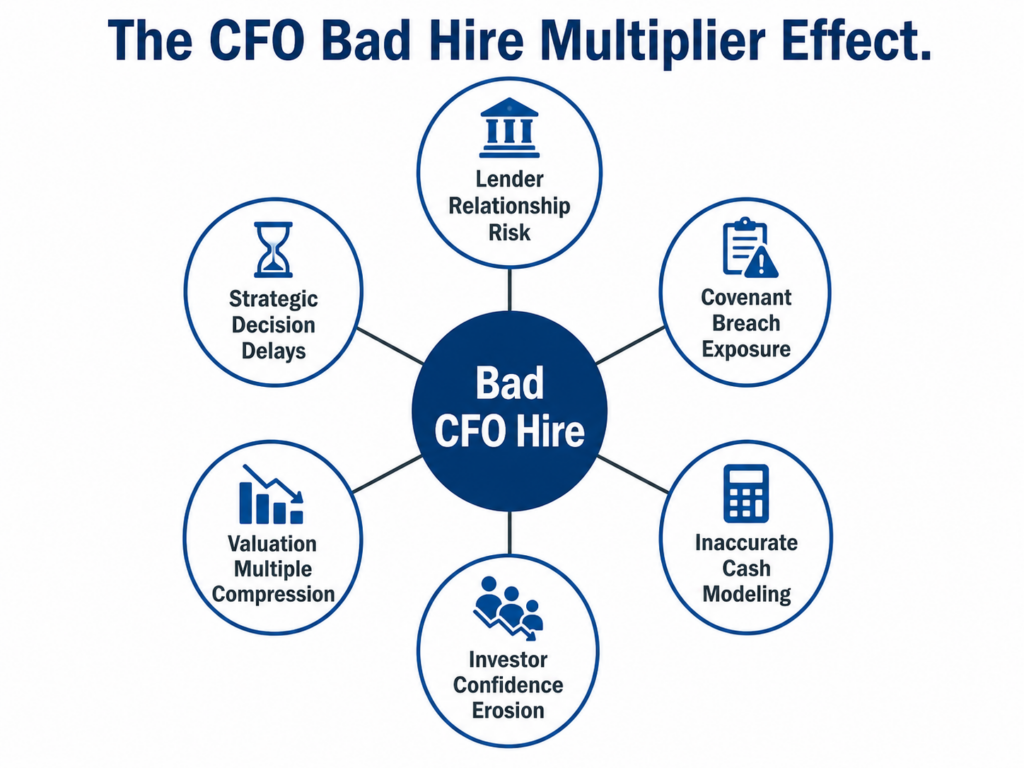
The standard bad hire cost formula underestimates the damage in one specific context: the CFO seat in a $5M–$100M business.
Here’s why the multiplier is different for finance leadership:
1. The CFO controls the information your decisions are based on.
A bad hire in sales underperforms. A bad hire in finance corrupts the inputs that inform every other decision in the company. Flawed cash flow models, inaccurate KPIs, and misrepresented working capital aren’t just their own problem — they cascade into bad strategic choices at the CEO level.
2. CFOs are externally visible in ways most roles are not.
Your CFO is the face of your financial credibility to lenders, investors, acquirers, and sometimes regulators. When CFO turnover is high or reporting quality slips, these stakeholders notice. Loan renewals slow. Valuation multiples compress.
3. CFO searches take longer than most executive searches.
According to KLR Executive Search, CFO searches typically run 3 to 5 months from kickoff to accepted offer — with some taking closer to 6 months. That’s a long runway of leadership gap risk.
4. Global CFO turnover reached 15.1% in 2024 (Russell Reynolds Associates Global CFO Turnover Index), just below the record set in 2023. The average tenure has dropped to 5.8 years, down from 6.2 years. The talent market is tighter, and the costs of a bad hire at this level are rising accordingly.
5. The ramp-up gap is longer for CFOs.
Most CFOs need 6–12 months to reach full strategic effectiveness in a new company. During that period, your replacement is operating at 60–70% capacity — costing you in decision quality, not just hours.
5. Real-World Cost Scenarios: Three Finance Role Mismatches
The bad hire problem in finance rarely comes from hiring an unqualified person. It almost always comes from a mismatch between the seat and the expectations. Here are three patterns seen consistently in mid-market businesses:
Scenario A: The Smart Controller Hired to Play CFO
A $20M manufacturer promotes their controller into a CFO role to save money. The controller is talented, precise, and deeply competent at closing the books.
What the business needed: scenario modeling for a $5M equipment investment, a banking relationship strategy ahead of a credit facility renewal, and KPIs tied to operational throughput — not just financial statements.
What it cost:
- The credit facility renewal came back with tighter covenants because no one prepared a robust financial narrative for the lender
- The equipment investment was delayed 9 months due to inadequate modeling
- Lost contribution margin from the delay: estimated $380,000
The controller wasn’t a bad person. The hire was a bad match.
Scenario B: The Bookkeeper Running Multi-Entity Consolidation
A PE-backed services company promoted their bookkeeper to manage intercompany eliminations across four subsidiaries after an acquisition. The bookkeeper was loyal, hardworking, and handled single-entity accounting well.
What it cost:
- Three months of consolidated financials with errors that took an outside firm 6 weeks to unwind
- Auditors flagged the intercompany accounts during due diligence on a follow-on acquisition
- The acquisition delay cost an estimated $2M in enterprise value at close
Scenario C: The Tax CPA Asked to Lead FP&A
A $35M professional services firm engaged their tax CPA to build operational KPIs and a 13-week cash flow model. The CPA was knowledgeable about compliance and well-regarded in the market.
What it cost:
- The cash flow model was structured around tax period assumptions, not operational timing
- A $900,000 payroll timing gap was missed — caught by the bank, not the company
- The owner spent 3 months rebuilding lender confidence
In each case, the business paid for the mismatch in addition to the original engagement cost. That’s the hidden surcharge on choosing good enough.
6. The Hidden Costs Competitors Miss
Most bad hire cost estimates only count direct and replacement costs. But in the CFO seat, the most expensive damage is often invisible on any invoice:
Covenant Breach Risk
When financial reporting is inconsistent or inaccurate, lenders start asking questions. If they don’t like the answers, covenant amendments, waiver fees, or accelerated repayment schedules follow. A single covenant breach can cost a $20M business $50,000–$200,000 in fees, higher interest rates, and management time — and that’s if the lender stays.
Compressed Valuation Multiple
Enterprise value is a function of EBITDA and the multiple — and multiples are heavily influenced by the quality, consistency, and credibility of your financial reporting. A business with clean, audit-ready financials and a trusted finance leader commands a higher multiple than one where the numbers change every quarter. Even a 0.5x compression on a $5M EBITDA business represents $2.5M in lost enterprise value at exit.
Opportunity Cost of Decisions Not Made
A CFO who can’t build a credible acquisition model, structure a financing package, or lead a due diligence process doesn’t just underperform — they create decision paralysis. Acquisitions that should have closed don’t. Financing that should have been secured isn’t. Margin improvement projects that needed a financial sponsor never launch.
The Supervision Tax
Research confirms that managers spend 17% of their workweek managing underperforming employees. For a CEO or COO at $300,000/year, that’s roughly $51,000 in annual supervision cost — time that cannot be invested in growth, client relationships, or strategy.
7. Red Flags: 8 Signs You’ve Made a Bad Finance Hire
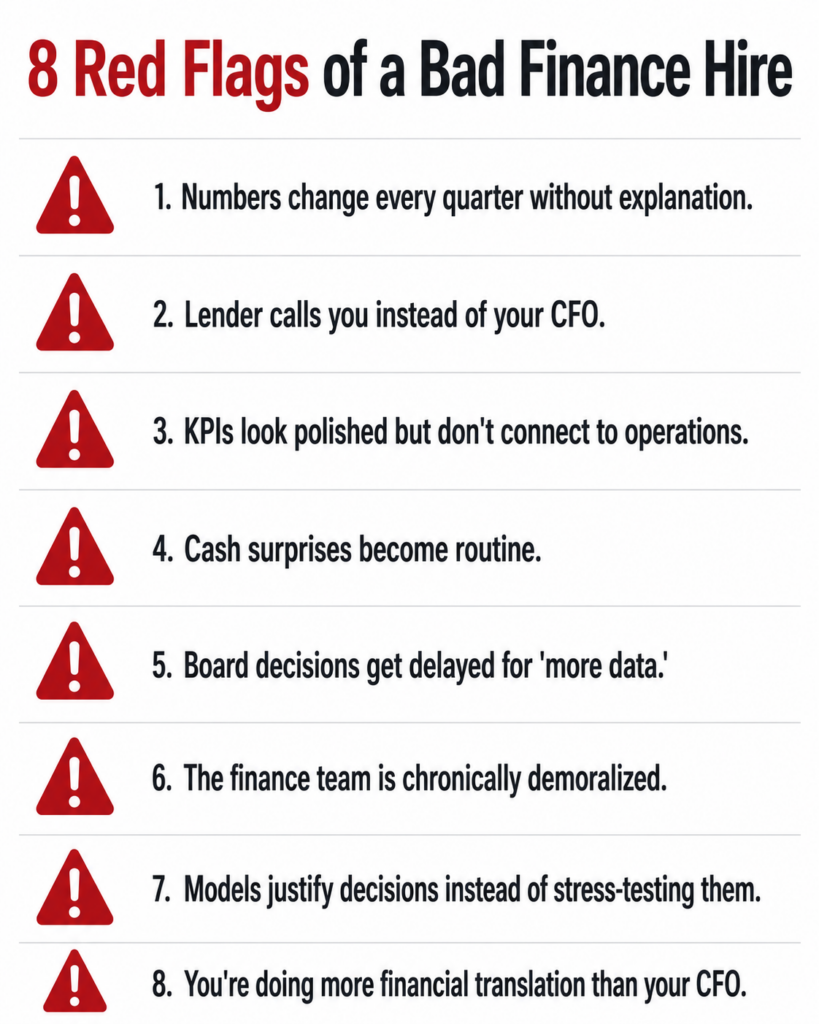
Recognizing a bad finance hire early limits the damage. Here are the signals that should prompt action:
| # | Red Flag | What It Signals |
| 1 | Numbers change every quarter without explanation | Unreliable close process; insufficient controls |
| 2 | Lenders call you instead of your CFO | Your finance leader isn’t managing the relationship |
| 3 | KPIs look polished but don’t connect to operations | Reporting designed to look good, not to drive decisions |
| 4 | Cash surprises become routine | No forward-looking cash visibility; reactive, not proactive |
| 5 | Board decisions are perpetually delayed for “more data” | No decision-ready financial infrastructure |
| 6 | The finance team is chronically demoralized | Leadership and culture failure in the finance function |
| 7 | Models are built to justify decisions, not stress-test them | Integrity gap; dangerous for acquisitions and capital decisions |
| 8 | You’re spending significant time translating finance to your team | Your CFO is not fulfilling the communications role |
Additional behavioral red flags during the hiring process (from SuperCFO and industry research):
- Four or more job changes in 6 years with no clear advancement narrative
- References offered only from peers, never from direct supervisors
- Discount pricing from an “almost-CFO” — often signals awareness of their own limitations
- Inability to articulate a time they pushed back on a CEO and what happened
8. How to Hire Right the First Time
Step 1: Define the Seat Before You Define the Candidate
The most common hiring mistake is writing a job description before defining what success looks like in the role. Ask:
- What decisions will this person own in the first 90 days?
- What does our lender or investor relationship require of this role?
- Are we in growth mode, stabilization, or pre-exit? (Each requires different CFO strengths.)
- Do we need someone to build the finance function from scratch, or to lead a team already in place?
Step 2: Price Decisions, Not Hours
Build a simple model before making your hiring decision:
| Scenario | Cost |
| Bad hire at lower rate (4 months + replacement) | $150,000–$250,000 |
| Fractional CFO at monthly retainer (first year) | $96,000–$180,000 |
| Full-time qualified CFO (year 1, all-in) | $270,000–$400,000 |
| Value of one deal structured by a qualified CFO | $200,000–$2,000,000+ |
| Cost of one covenant breach from weak financial leadership | $50,000–$200,000 |
When you frame it this way, the “expensive” option often isn’t.
Step 3: Interview for Independence, Not Just Competence
The technical skills are table stakes. What moves the needle is harder to evaluate:
- Ask: “Tell me about a time you pushed back on a CEO or board and what happened.”
- Ask: “Walk me through a decision where your model said one thing and the business wanted to do another. What did you do?”
- Ask: “Describe a time you had to deliver bad news about the company’s financial position to a lender or investor.”
These questions reveal whether you’re hiring a trusted counterweight or an expensive yes-person.
Step 4: Verify with Deep Reference Checks
Call references beyond the list provided. Specifically ask:
- “What was the quality of their financial reporting during their tenure?”
- “How did they handle relationships with lenders or investors?”
- “Would you re-hire them in the same role for a similar-sized business?”
Step 5: Make Integrity Non-Negotiable
In the finance seat specifically, you want someone who will protect your financial reputation even more fiercely than your P&L. Markets reward businesses whose numbers can be trusted — and lenders remember the ones where the story changed every quarter.
9. Fractional CFO vs. Full-Time CFO vs. Bad Hire: A Cost Comparison
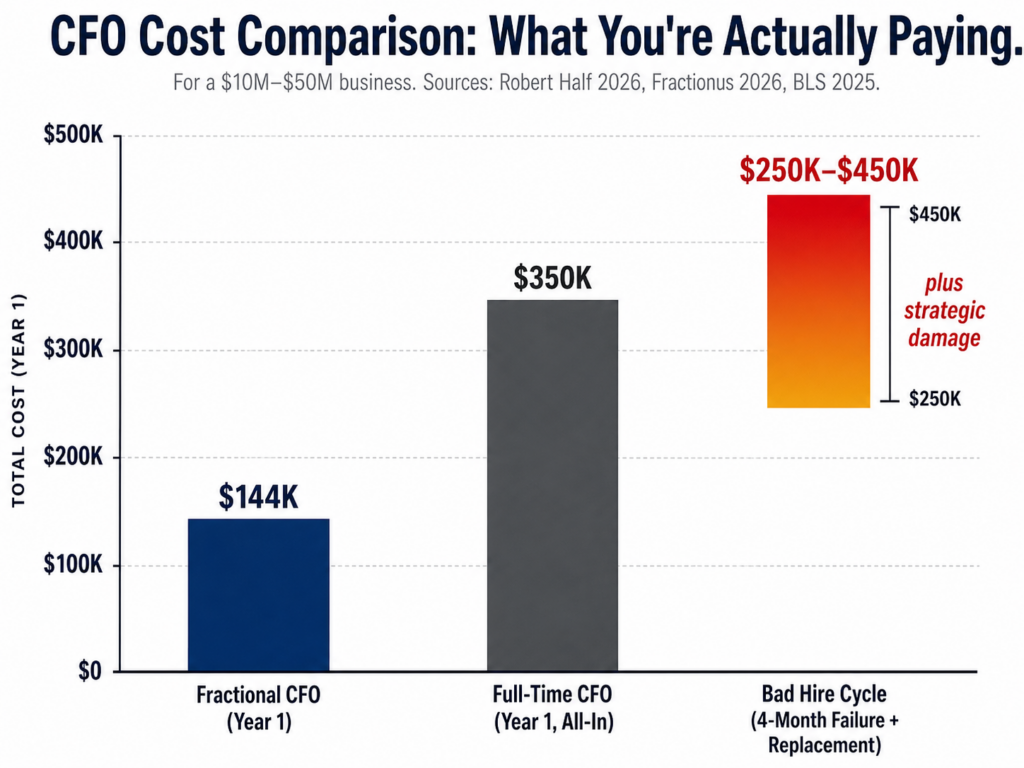
For businesses in the $5M–$100M range, the fractional CFO model has become a compelling alternative — precisely because the cost equation is so different:
| Model | Annual Cost Range | What You Get | Key Risk |
| Bad Hire (Lower-Rate Finance Resource) | $80,000–$150,000 direct + $150,000–$300,000 total damage | Reporting that looks adequate; decisions you’ll revisit | Hidden surcharge compounds over time |
| Fractional CFO | $96,000–$180,000/year ($8K–$15K/month) | Senior-level strategy, 10–20 hrs/week, scalable | Not embedded 40 hours/week |
| Full-Time CFO (All-In) | $270,000–$400,000/year | Full-time embedded leadership | High fixed cost; 3–6 month search; ramp-up gap |
| Interim CFO (Transition) | $200,000–$350,000 annualized | Immediate deployment; no ramp-up | Finite engagement; not relationship-building |
According to CFOHub (2025), demand for fractional CFO services has doubled year-over-year. A 2025 market report notes that businesses working with fractional CFOs often see 10–25% improvement in net profit margins within the first 12 months — a figure that makes the cost equation even clearer.
For most businesses under $50M in revenue, the question isn’t whether you can afford a qualified fractional CFO. The question is whether you can afford not to have one.
10. Case Study: $6 Billion and a Governance Failure
The collapse of 23andMe offers one of the starkest illustrations of what happens when a company fails to put the right people — with the right mandate and independence — in the right seats.
At its peak, 23andMe reached a $6 billion valuation when it went public in 2021. By 2025, the company had filed for Chapter 11 protection. Its share price had fallen more than 95% from its peak. A massive data breach compromised the genetic information of more than six million customers. All independent directors resigned in a single day.
At the heart of the collapse was a structural governance problem: a dual-class share structure gave founder Anne Wojcicki approximately 49% of voting power despite owning roughly 20% of the equity. For nearly two decades, the conditions for robust financial and strategic challenge were systematically absent.
The lesson isn’t that 23andMe lacked ideas. It’s that the company lacked qualified, empowered counterweights with the independence to say no. When finance and governance professionals can’t or won’t push back, the cost of a bad hire shows up years later — usually when it is most expensive to fix.
This is the same dynamic at play in every $10M–$100M business that hires a yes-person in the finance seat instead of a trusted challenger.
11. FAQ: Cost of a Bad Hire
Q: What is the average cost of a bad hire?
The U.S. Department of Labor estimates that the cost of a bad hire is at least 30% of the employee’s first-year salary. SHRM places the range at 50%–200% depending on seniority. For executive and C-suite roles, CareerBuilder research puts the average at $240,000 or more when all costs are factored in.
Q: How do you calculate the cost of a bad hire?
Use this formula:
Total Cost = Acquisition Costs + Compensation Paid + Productivity Gap + Management Overhead + Termination Costs + Replacement Recruiting + Ramp-Up Gap + Strategic Damage
For a finance director earning $150,000/year who leaves at month 4, the total direct and indirect cost typically runs $180,000–$220,000 before any strategic damage is included.
Q: What makes a CFO bad hire different from other bad hires?
The CFO controls the financial information all other decisions are based on. A bad hire in sales underperforms in their lane. A bad hire in the CFO seat corrupts the inputs for every strategic decision in the company — and is visible to your lenders, investors, and potential acquirers. The cascading risk is significantly higher.
Q: How long does it take to recover from a bad CFO hire?
Recovery typically takes 12–18 months. That includes the time to recognize the problem (often 3–6 months), execute a CFO search (3–6 months), and ramp the replacement to full strategic effectiveness (6–12 months). During that window, your business is operating without trusted financial leadership — which is exactly when lenders and investors increase scrutiny.
Q: What are the most common signs of a bad finance hire?
Key indicators include: financial numbers that change without explanation, lenders who call the CEO instead of the CFO, KPIs that look polished but don’t connect to operational reality, routine cash surprises, and the owner spending significant time translating financial information to other leaders. Any of these in the first 90 days warrants a structured review.
Q: Is a fractional CFO a better option than a full-time hire to reduce bad hire risk?
For businesses generating $5M–$50M in revenue, a fractional CFO often delivers a better risk-adjusted outcome. The engagement structure allows you to evaluate performance over 60–90 days before deepening the commitment, reduces fixed cost exposure, and gives you access to a caliber of executive who may not consider full-time roles at your current stage. The fractional CFO market has grown to $5.7 billion globally, growing at 14% annually (Frak Conference, 2024), reflecting how many businesses have reached this conclusion.
Q: How do you avoid making a bad CFO hire?
Define the seat before you define the candidate. Interview explicitly for independence and integrity — not just technical competence. Conduct deep reference checks that include supervisors, not just peers. Structure your evaluation around the decisions the role will need to own in the first 90 days. And model the full cost of a bad hire before you decide that a lower-rate option is saving you money.
Q: What percentage of companies have experienced a bad hire?
According to CareerBuilder’s 2024 survey research, approximately 74% of employers admit to having made at least one bad hire. The same research notes that 23% of companies report up to five bad hires per year — which at even the conservative $17,000 per incident represents $85,000 in annual hiring losses before strategic damage is counted.
The Bottom Line: Run the True Cost
The business case for getting your finance leadership right the first time isn’t philosophical. It’s arithmetic.
When you model the acquisition costs, the compensation paid for subpar output, the management overhead, the lender relationship damage, the strategic decisions that didn’t get made, and the replacement cycle — the “cheaper” option almost never is.
At Business CFO For Hire, the commitment is simple: clear, data-anchored, honest financial leadership — even when the advice is uncomfortable — backed by decades of pattern recognition across industries, cycles, turnarounds, acquisitions, and exits.
That’s not the cheapest hourly proposition on the market.
But run the numbers. When you compare the true cost of good enough against the cost of getting it right the first time, qualified financial leadership is almost always the least expensive option available to you.
Still carrying the hidden cost of a finance hire that isn’t quite right?
Book a free CFO strategy call and let’s talk about what genuinely qualified financial leadership could mean for your margins, your lenders, and your long-term valuation.
Book Your Free CFO Strategy Call →