The SaaS metrics that matter most are ARR/MRR, net revenue retention, gross margin, CAC, LTV, the Rule of 40, and cash runway the core set that any investor, lender, or acquirer will ask about before they ask about anything else. A revenue number alone doesn’t tell that story; these metrics do.
What most guides to this topic miss is that “good” isn’t a fixed target. It shifts depending on who’s asking and why, and that context is what this guide adds.
Key takeaways
- The core SaaS metric set is ARR/MRR, net revenue retention (NRR), gross margin, CAC, LTV, the Rule of 40, and cash runway.
- Net revenue retention above 100% means the business grows from existing customers alone, before a single new sale — it’s often the single number investors check first.
- The Rule of 40 says a healthy SaaS company’s growth rate plus profit margin should add up to 40% or more, but which side of that equation matters more depends entirely on who’s evaluating the business.
- The same metrics get weighed differently by a VC, a bank, and an acquirer; a growth-at-all-costs Rule of 40 that impresses a venture investor can be a red flag to a lender.
- In 30-plus years of CFO work, the pattern Stan Alhadeff sees most often is a SaaS founder optimizing for metrics that impress a VC while quietly heading toward a bank conversation or an exit that rewards a completely different profile.
What are SaaS metrics, and why do they matter more than a P&L alone?
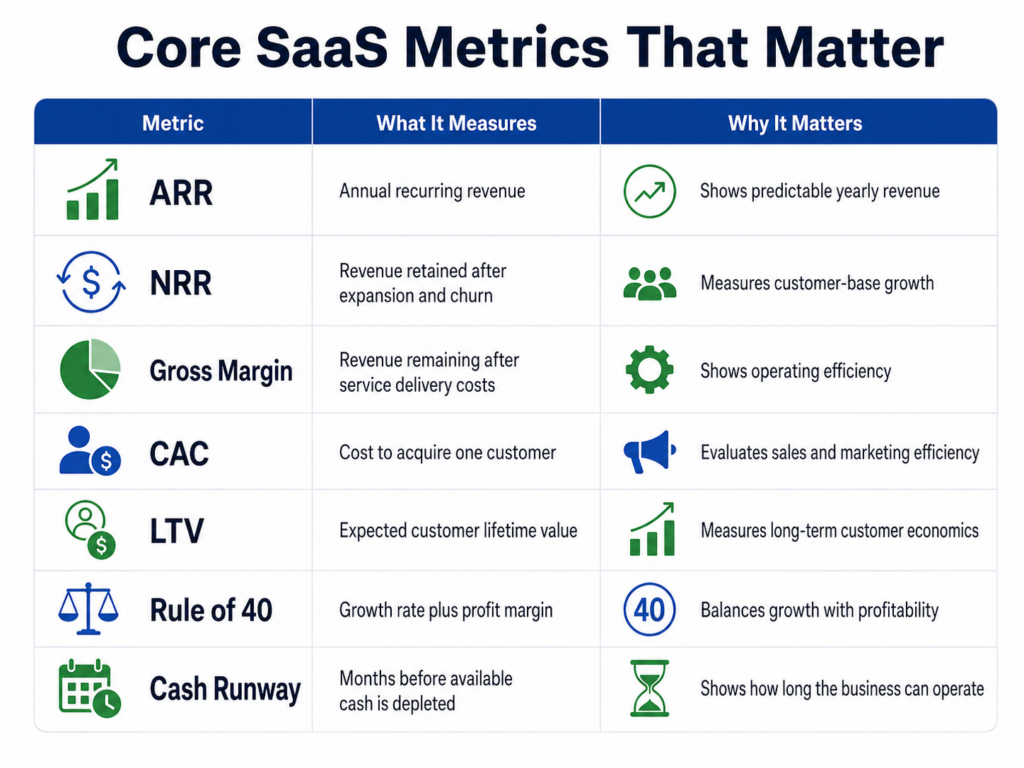
SaaS metrics are the specific, industry-standard measures — recurring revenue, retention, unit economics, efficiency — that capture how a subscription business actually performs, in ways a traditional income statement can’t show on its own. A SaaS company’s P&L can look healthy or troubled in a given month for reasons that have nothing to do with the underlying business quality.
That’s because subscription revenue recognition, deferred revenue, and customer acquisition spend all distort a simple month-to-month profit view. A company investing heavily in sales and marketing this quarter to land customers that will pay for years might show a loss on the P&L while building real, durable value. The metrics below are how you and anyone evaluating the business actually see that.
The core SaaS metrics every growth-stage company should track
Eight metrics cover nearly everything an investor, lender, or acquirer will ask about. Each one measures something the others don’t, which is why tracking just one or two leaves real blind spots.
| Metric | Formula | What “good” looks like |
| ARR / MRR | Sum of recurring subscription revenue, annualized or monthly | Growing consistently, cleanly separated from one-time or services revenue |
| Net Revenue Retention (NRR) | (Starting ARR + expansion − contraction − churned ARR) ÷ Starting ARR | 100%+ is healthy; 110–120%+ is considered best-in-class |
| Gross margin | (Revenue − COGS) ÷ Revenue | Typically 70–80%+ for a mature SaaS business |
| CAC | Total sales and marketing spend ÷ new customers acquired in the period | Meaningful only compared against LTV, not viewed alone |
| LTV : CAC ratio | Customer lifetime value ÷ CAC | Widely referenced target of 3:1 or better |
| CAC payback period | CAC ÷ (monthly revenue per account × gross margin) | Under 12–18 months is generally considered healthy |
| Rule of 40 | Revenue growth rate % + profit margin % | Combined total at or above 40% |
| Cash runway | Cash balance ÷ average monthly net burn | Enough months to reach the next real milestone, not just “some” |
Net revenue retention: the metric that makes investors lean forward
Net revenue retention measures how much revenue you keep and grow from your existing customer base alone, factoring in expansions, downgrades, and churn, expressed as a percentage of where that revenue started. Above 100% means the business would keep growing even with zero new sales — a signal that the product itself creates compounding value.
This is often the first metric a sophisticated evaluator checks, because it answers a question growth rate alone can’t: is this growth durable, or is it masking a leaky bucket underneath? A company adding new logos fast while losing existing ones just as fast can post an impressive top-line number with a genuinely fragile business underneath it. NRR is what exposes that gap.
Rule of 40: growth and profitability in one number
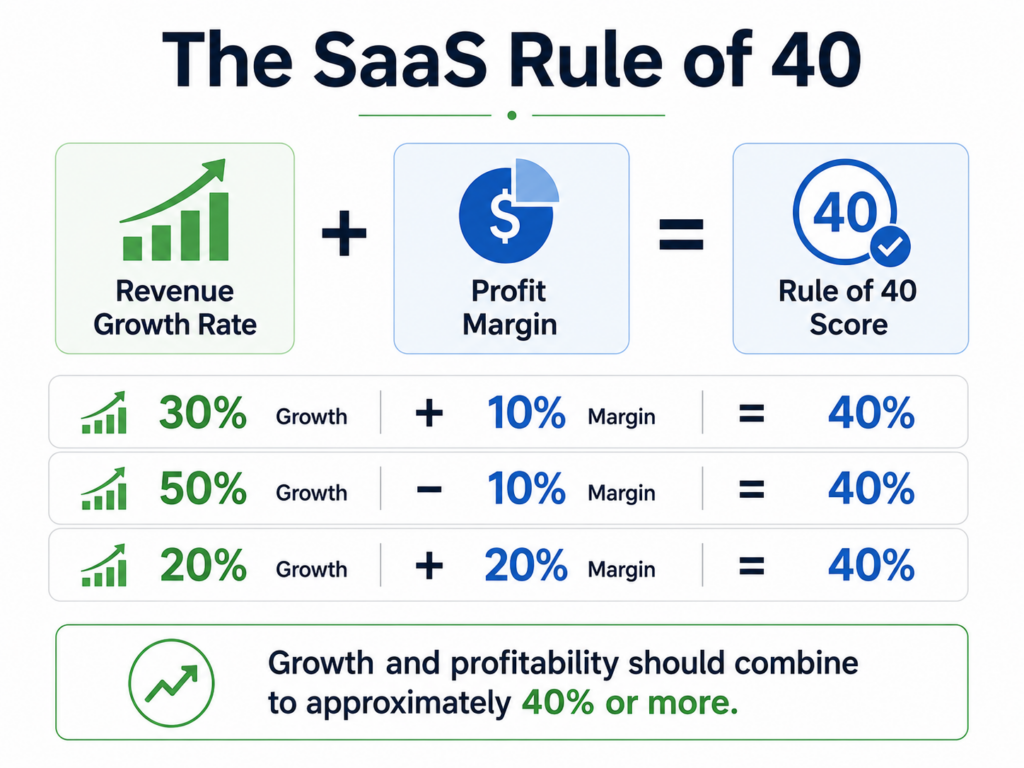
The Rule of 40 states that a healthy SaaS company’s revenue growth rate and profit margin, added together, should equal 40% or more. A company growing 50% a year with a -10% margin passes; a company growing 15% with a 25% margin also passes. The rule treats growth and profitability as substitutes, within reason.
The catch is that “within reason” is doing real work in that sentence. A company hitting 40% almost entirely through growth, with deeply negative margins, reads very differently to different audiences — which is exactly the distinction the next section covers.
SaaS metrics for a bank loan or acquisition vs. a VC raise
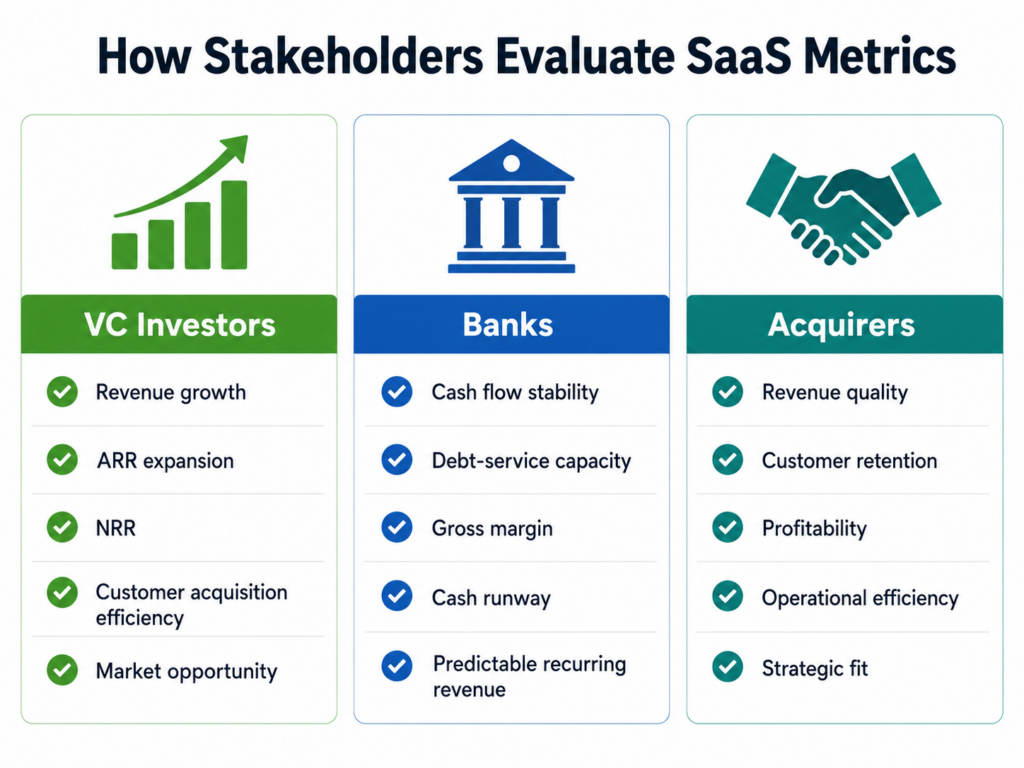
The same metrics get interpreted differently depending on whether you’re raising venture capital, applying for bank financing, or preparing for an acquisition — and getting this wrong is one of the more expensive mistakes a growing SaaS company can make. A venture investor often rewards a growth-heavy Rule of 40, because they’re underwriting a large future outcome and can tolerate near-term losses. A bank underwriting a line of credit reads the same negative margin as risk, full stop, regardless of how fast the top line is moving.
An acquirer, strategic or private equity, tends to weigh gross margin quality, net revenue retention, and customer concentration most heavily, because they’re buying a cash-generating asset, not a growth story with years to prove itself. For SaaS CFO work specifically, this is one of the most common conversations we have with founders: the metric profile that would excite a Series B investor can actively work against a company mid-diligence for a sale, or sitting across from a lender who wants to see the business stand on its own.
The mistake growing SaaS companies make with these metrics
In 30-plus years of CFO work, the pattern Stan Alhadeff sees most often is a founder building the business around metrics tuned for a financing path they haven’t actually committed to. A company burning cash to juice growth for a VC raise that never happens, then needing a bank line six months later, walks into that conversation with exactly the numbers a lender doesn’t want to see.
The fix isn’t picking one metric profile and ignoring the rest — it’s knowing which financing path is actually most likely for your business in the next 12 to 18 months, and building toward those specific numbers deliberately rather than defaulting to whatever a generic SaaS metrics guide told you to optimize. If you’re not sure which path your numbers currently support, our free discovery call includes a GAP Analysis that shows you plainly.
How to actually track these metrics
Tracking these metrics accurately starts with clean, department-coded accounting — every dollar of sales and marketing spend, every customer contract, tagged consistently in the general ledger — because none of these formulas work on messy or inconsistently categorized data. A CAC calculation built on a general ledger that doesn’t separate sales and marketing spend from the rest of operating expenses isn’t a useful number; it’s a guess with a formula attached.
This is where accounting services and CFO-level metric tracking depend on each other directly. The metrics are only as good as the books underneath them, and a monthly close that isn’t structured to support this level of detail will quietly produce wrong numbers that look precise.
Building toward the right numbers, not just any numbers
The SaaS metrics that matter aren’t a fixed checklist to hit — they’re a moving target that depends on where your business is headed and who you’re trying to convince. Building toward the wrong profile, even successfully, can leave you worse off than building toward no clear profile at all.
If you want a straight read on which financing path your current metrics actually support, book a free strategy call with Stan — it starts with the GAP Analysis, and it ends with a specific answer for your business, not a generic metrics checklist.
FAQ
What are the most important SaaS metrics? The most important SaaS metrics are ARR/MRR, net revenue retention, gross margin, CAC, LTV, the Rule of 40, and cash runway. Together they capture recurring revenue health, customer retention, unit economics, and financial sustainability in a way a standard P&L can’t.
What is a good net revenue retention rate? A net revenue retention rate above 100% is considered healthy, meaning the business grows from existing customers alone before adding new ones. Rates of 110% to 120% or higher are generally considered best-in-class among SaaS companies.
What is the Rule of 40 in SaaS? The Rule of 40 states that a healthy SaaS company’s revenue growth rate and profit margin should add up to 40% or more when combined. A company can pass the rule through fast growth, strong profitability, or some balance of both.
What is a good LTV to CAC ratio? A widely referenced target for a healthy SaaS business is an LTV to CAC ratio of 3:1 or better, meaning each customer generates at least three times what it cost to acquire them. Ratios below that suggest acquisition costs may be too high relative to the value each customer brings.
How do you track SaaS metrics accurately? Accurate SaaS metric tracking starts with clean, consistently coded accounting — sales and marketing spend, customer contracts, and revenue recognition all need to be categorized correctly in the general ledger. Metrics built on inconsistent bookkeeping will look precise while actually being wrong.

Stan Alhadeff
Founder & Fractional CFO