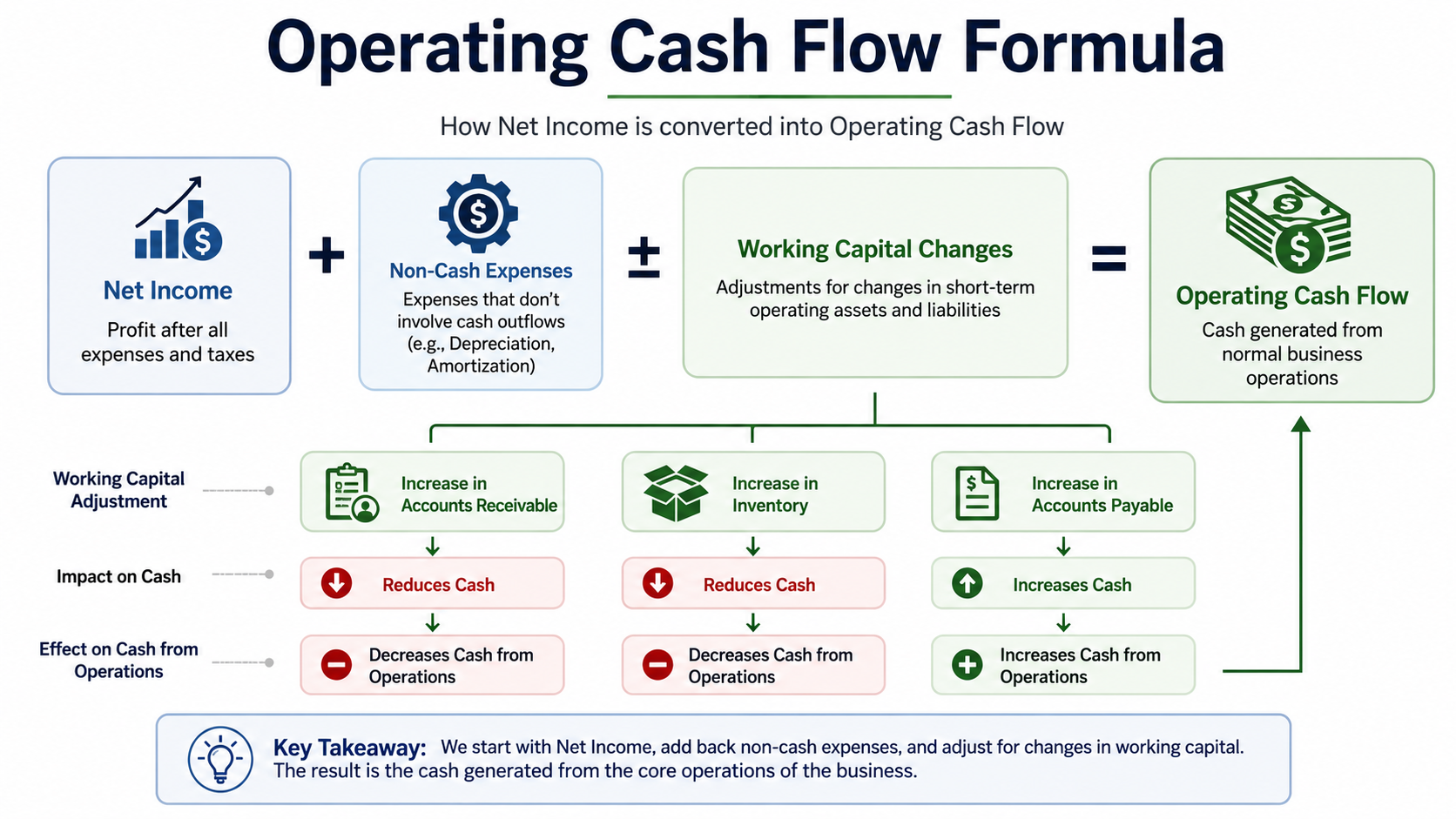
The operating cash flow formula shows how much cash your core business generated during a period after adjusting profit for non-cash items and working-capital movements. Under the common indirect method, the simplified equation is:
Operating cash flow = Net income + Non-cash expenses − Increase in net operating working capital
That’s the formula. The useful part is understanding why your answer changed.
A business can report a healthy profit and still struggle to make payroll because customers haven’t paid yet, inventory absorbed cash, or bills came due faster than expected. Operating cash flow, or OCF, exposes those differences.
Key takeaways
- OCF measures cash generated or consumed by core operations, not your total bank balance.
- The indirect OCF formula starts with net income, adds back non-cash expenses and adjusts for working capital.
- Higher receivables and inventory normally reduce OCF; higher operating payables normally increase it.
- Strong OCF doesn’t automatically mean the company has plenty of cash after equipment purchases, debt payments or owner distributions.
- Improving OCF usually means fixing the operating system behind the number, not pushing payments into next month.
What is operating cash flow?
Operating cash flow is the net cash generated by the normal activities that produce and deliver your company’s products or services. It separates operating cash generation from investing activities, such as buying equipment, and financing activities, such as borrowing money or raising capital.
You’ll usually see it on the cash flow statement as net cash provided by operating activities, cash flow from operations, or similar wording.
That distinction matters.
Suppose your company borrows $500,000 in June. Your bank balance jumps, but your operations did not suddenly become $500,000 better. The borrowing belongs to financing cash flow.
The reverse can happen too. A company can generate strong operating cash but spend heavily on new equipment. Cash falls even though the underlying operation produced cash.
This is why we treat OCF as an operating signal, not a synonym for “cash in the bank.”
The SEC describes the cash flow statement as important for understanding a company’s ability to generate future cash, meet obligations and understand differences between reported income and actual receipts and payments.
What is the operating cash flow formula?
The operating cash flow formula under the indirect method starts with net income, adds back expenses that didn’t consume cash, and adjusts for changes in operating working capital. The direct method reaches the same operating cash total by subtracting actual operating cash payments from operating cash receipts.
Indirect method formula
The short version is:
OCF = Net income + Non-cash expenses − Increase in net operating working capital
A more useful owner-level version looks like this:
OCF = Net income + Depreciation and other non-cash expenses − Increase in A/R − Increase in inventory − Increase in other operating current assets + Increase in A/P + Increase in accrued operating liabilities
The exact accounts depend on your business.
A professional-services company may care heavily about accounts receivable and accrued payroll. A distributor may have large inventory swings. A contractor may have receivables, payables, retainage, customer deposits, and other timing issues that require closer review.
The basic cash logic is consistent. An increase in an operating current asset generally uses cash. An increase in an operating current liability generally preserves cash during that period.
| Change | Typical OCF effect | Why |
| Accounts receivable increases | Decreases OCF | You recorded revenue that hasn’t been collected |
| Accounts receivable decreases | Increases OCF | Customers paid down amounts owed |
| Inventory increases | Decreases OCF | Cash was used to acquire inventory |
| Inventory decreases | Increases OCF | Less cash remains tied up in stock |
| Accounts payable increases | Increases OCF | Supplier payments were deferred |
| Accounts payable decreases | Decreases OCF | Cash was used to pay suppliers |
| Accrued expenses increase | Increases OCF | Expense was recognized before cash left |
| Accrued expenses decrease | Decreases OCF | Previously accrued obligations were paid |
Direct method formula
The direct operating cash flow formula is more intuitive:
OCF = Operating cash receipts − Operating cash payments
For a simple business:
OCF = Cash collected from customers − Cash paid for operating costs
The direct method shows actual categories of cash received and paid rather than beginning with accounting profit.
FASB’s Statement 95 encourages reporting major classes of operating cash receipts and payments directly, while the SEC has noted that nearly all U.S. issuers still use the indirect method.
Which formula should you use?
For management analysis, we usually want both views of the same problem.
The indirect method tells you why profit and cash don’t match. That’s valuable because it exposes receivables, inventory, payables and non-cash charges.
The direct view answers a more visceral question: how much operating cash actually came in, and where did it go?
If your accountant hands you only an indirect cash flow statement, don’t stop at the bottom-line OCF number. Look at the working-capital adjustments. That’s often where the operational story is hiding.
Operating cash flow formula example
A worked OCF calculation starts with net income and then reverses non-cash expenses and cash-timing differences. For example, if a company earns $180,000, records $40,000 of depreciation, and has several working-capital changes, those movements can push actual operating cash above or below the reported profit.
Assume a growing company reports:
| Item | OCF adjustment |
| Net income | $180,000 |
| Depreciation | +$40,000 |
| Increase in accounts receivable | −$35,000 |
| Increase in inventory | −$15,000 |
| Increase in accounts payable | +$20,000 |
| Decrease in accrued expenses | −$5,000 |
| Operating cash flow | $185,000 |
The calculation is:
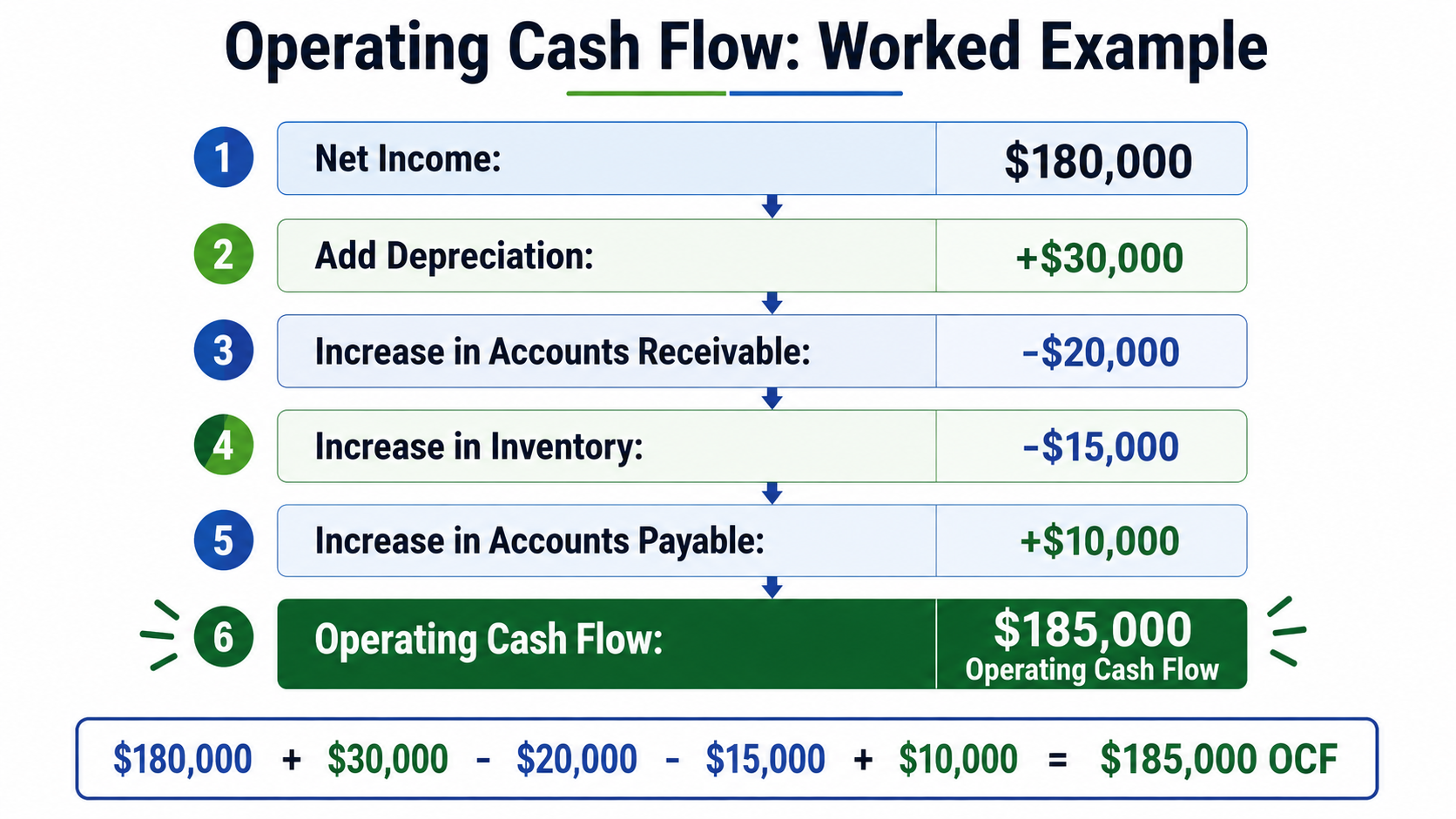
$180,000 + $40,000 − $35,000 − $15,000 + $20,000 − $5,000 = $185,000
The company earned $180,000 but generated $185,000 of operating cash.
That $5,000 difference isn’t automatically good news.
Accounts payable increased by $20,000. If that happened because the company negotiated sensible 45-day terms instead of paying every vendor in 15 days, fine.
If invoices are simply sitting unpaid because cash is tight, the same mathematical improvement has a very different meaning.
A cash-flow number without the operating explanation behind it can mislead you.
That’s the perspective we care about as CFOs.
How working capital changes operating cash flow
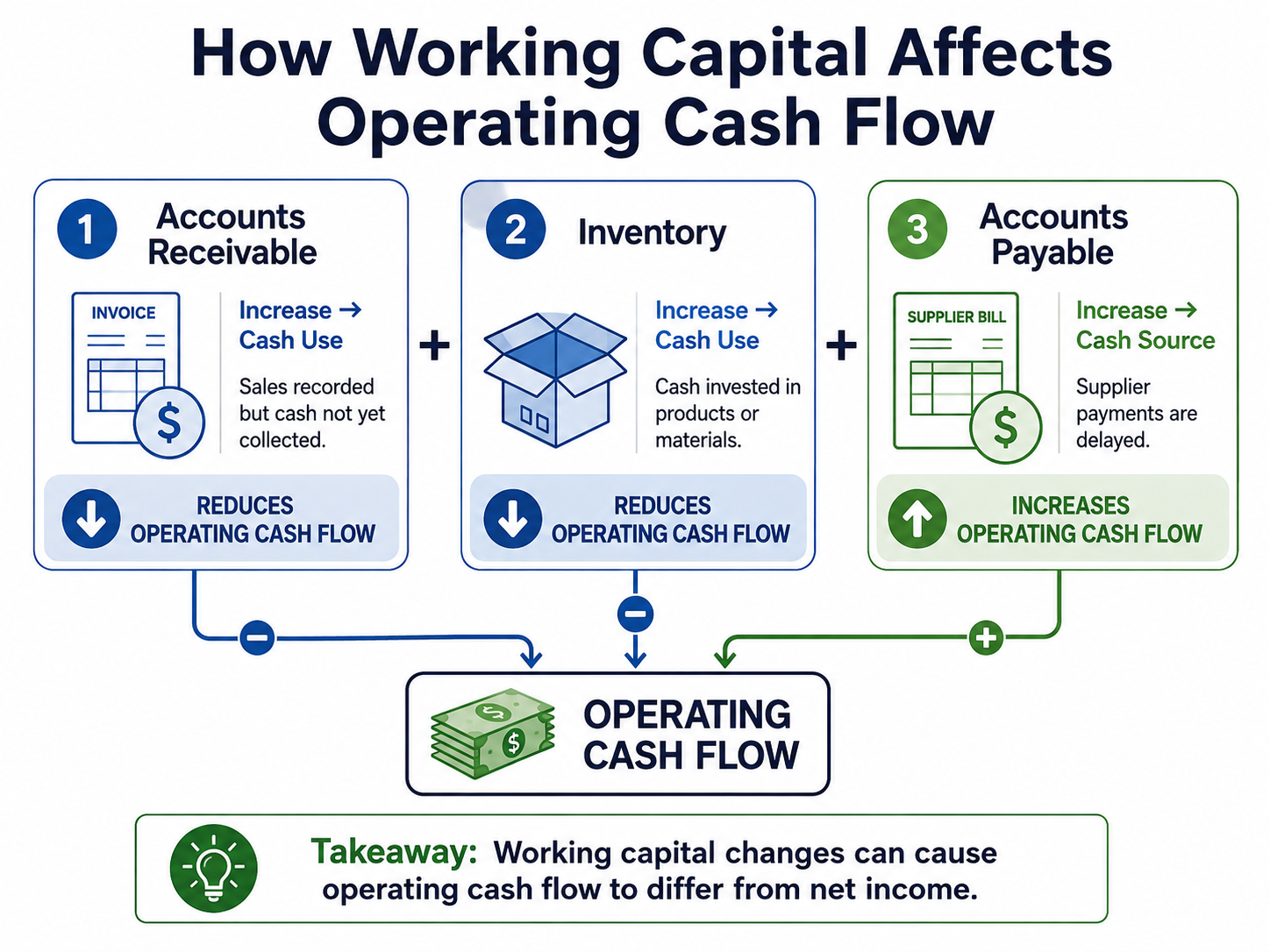
Working capital changes OCF because accounting recognizes revenue and expenses at different times from the related cash collections and payments. Receivables, inventory, and other operating assets can absorb cash, while payables and accrued operating liabilities can temporarily provide cash by delaying when money leaves the business.
Consider a $6 million company that lands a large new customer.
Sales jump. The income statement looks better.
But the new customer pays in 60 days instead of 30.
The company may need to fund another month of payroll, materials, and overhead before collecting the cash connected to those sales. Revenue increased, yet cash conversion weakened.
That’s why growth can put pressure on cash.
Receivables deserve particular attention. If A/R keeps growing faster than sales, your company may be financing customers without deliberately choosing to do so.
Inventory creates the same problem in product businesses. Buying six months of stock may protect against shortages, but the cash leaves long before the inventory becomes a collected sale.
Payables work in the opposite direction. Longer supplier terms can help match cash outflows to customer collections, but habitually paying late is not a durable OCF strategy.
The goal isn’t to maximize every liability and minimize every asset. The goal is to manage the cash conversion cycle deliberately.
What is the difference between operating cash flow and net income?
Net income measures accounting profit, while operating cash flow measures cash generated by core operations. OCF adjusts net income for non-cash items and timing differences such as receivables, inventory, and payables, so a profitable company can report weak OCF, and a company with modest profit can generate stronger operating cash.
Say your company invoices $200,000 on December 20.
Under accrual accounting, that revenue may appear in December’s income statement even if the customer doesn’t pay until February.
Your profit can rise in December.
Your cash doesn’t.
Depreciation creates the opposite type of difference. It lowers accounting profit during the period without requiring an equivalent current-period cash payment, which is why depreciation and other qualifying non-cash expenses are added back in the indirect calculation.
This is the practical rule:
Profit tells you if the economics worked. OCF tells you whether those economics converted into operating cash during the period.
You need both.
For owners who need more than historical bookkeeping, fractional CFO services can connect those financial statements to forecasting, cash planning and operating decisions rather than treating the reports as an endpoint.
Operating cash flow vs. free cash flow
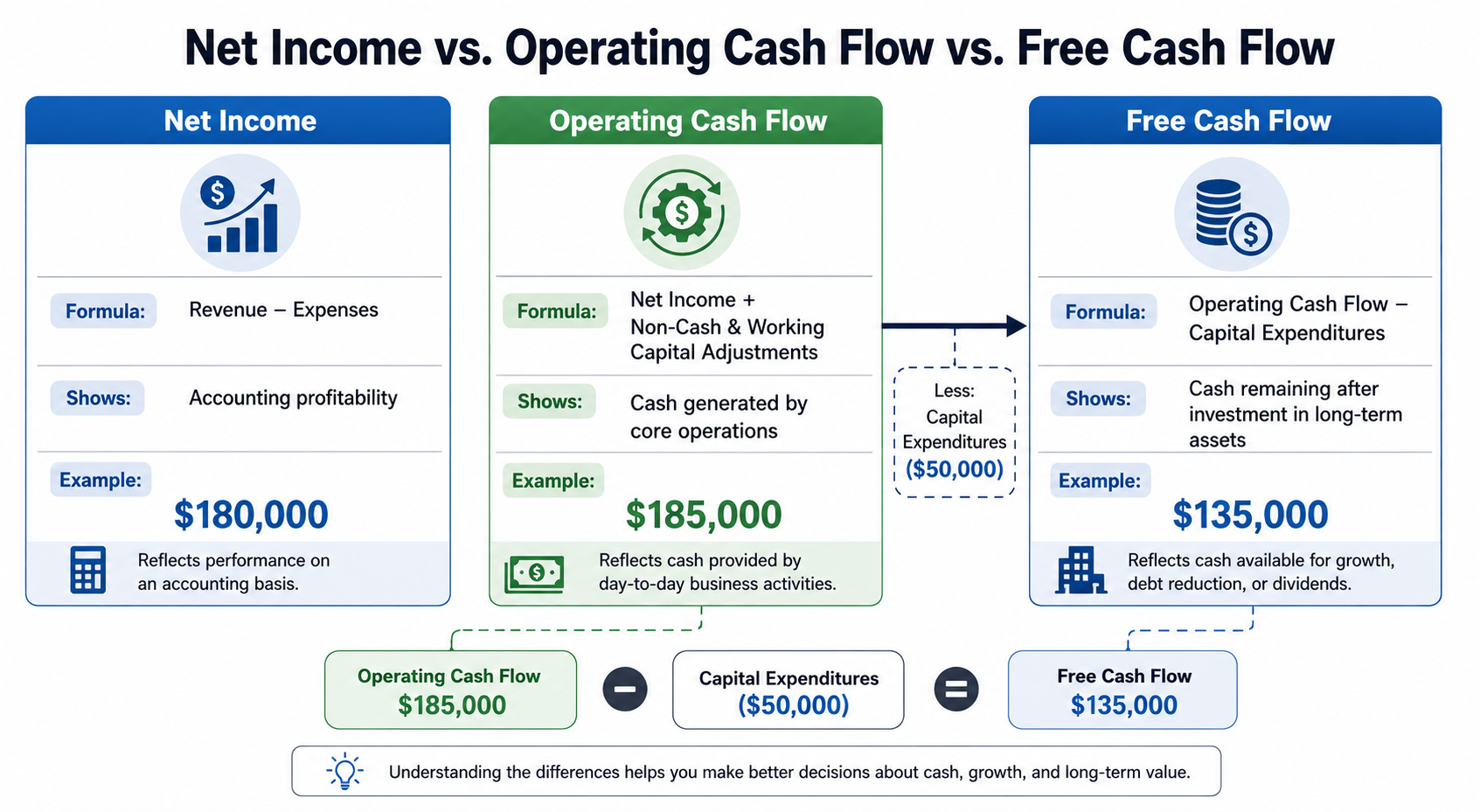
Operating cash flow measures cash generated by core business operations, while free cash flow goes one step further by subtracting capital expenditures. A company can therefore report healthy OCF but much lower free cash flow when maintaining or expanding the business requires significant spending on equipment or other long-term assets.
The simplified relationship is:
Free cash flow = Operating cash flow − Capital expenditures
Suppose the company in our earlier example generated $185,000 in OCF but spent $125,000 replacing equipment.
Its simplified free cash flow would be:
$185,000 − $125,000 = $60,000
Nothing was wrong with the OCF calculation. It simply answered a narrower question.
Financing creates another distinction.
Business CFO for Hire reports that one engagement secured $1.5 million in alternative funding. That funding can strengthen liquidity, but the financing itself doesn’t represent operating cash flow because operating and financing activities are separate categories.
Owners get into trouble when they collapse all these numbers into one idea called “cash flow.”
Separate them.
OCF tells you what operations produced. Free cash flow accounts for capital investment. Financing cash flow tells you how borrowing, repayment or other financing activities affected cash.
What is a good operating cash flow?
There is no universal dollar amount that qualifies as good operating cash flow. A useful OCF level is positive, repeatable, and sufficient for the needs of the specific business, but owners should judge it against revenue, obligations, capital requirements, seasonality and the company’s historical trend rather than a generic benchmark.
A $300,000 annual OCF figure could be excellent for one business and dangerously thin for another.
Start with trend.
Is OCF rising as revenue rises?
Then compare profit to cash conversion.
If net income keeps climbing while OCF falls, find the gap. Receivables may be stretching. Inventory may be accumulating. Supplier payments may have accelerated.
Next, check what comes after OCF.
A capital-heavy company can generate positive operating cash and still face tight liquidity after equipment purchases and debt service.
A seasonal company may have a weak quarter followed by a strong one. One isolated period tells you less than a rolling view.
The number matters. The pattern matters more.
How do you improve operating cash flow?
You improve operating cash flow by changing the operating drivers behind cash collection and cash spending: collect receivables faster, protect margin, control operating costs, reduce unnecessary inventory, and negotiate sensible supplier terms. The best improvements create repeatable cash conversion rather than shifting today’s payment into next month.
| OCF lever | Management action | What to watch |
| Accounts receivable | Invoice faster, tighten follow-up, resolve disputes early | Don’t chase revenue from customers who consistently pay late |
| Pricing and margin | Review underpriced work and gross margin leakage | Revenue growth with weak margin can increase cash pressure |
| Inventory | Reduce slow-moving or excess stock | Don’t cut inventory so far that operations suffer |
| Operating expenses | Remove cash costs that aren’t producing enough value | Separate recurring savings from one-time cuts |
| Supplier terms | Align payment timing with the operating cycle | Don’t damage key supplier relationships |
| Forecasting | Use a rolling cash forecast to see pressure before it hits | Historical OCF alone cannot show next month’s shortfall |
Cost reduction deserves precision.
Business CFO for Hire has reported engagements where clients identified 20%+ in savings within the first year. Savings improve OCF only when they reduce actual future cash outflows. An accounting reclassification or one-time credit can make a report look better without fixing the recurring cost structure.
Collections can produce an even faster change.
If a $4 million service business cuts average collection time, it doesn’t need higher revenue for the first cash benefit to appear. It converts existing receivables into cash sooner.
Inventory-heavy businesses have a different lever. Cash may be sitting on shelves.
These are operating decisions with financial consequences. That’s where a CFO view differs from simply reading the statement after month-end.
If you aren’t sure which working-capital account is creating the problem, every Business CFO for Hire engagement begins with a free discovery and GAP Analysis. A free CFO strategy call can help determine whether the issue is reporting, collections, margins, forecasting or a broader finance problem.
When operating cash flow can give you the wrong impression
OCF becomes misleading when you judge the total without examining why it changed. Delayed vendor payments can temporarily raise OCF, falling inventory can release cash that won’t repeat, and a one-period working-capital swing can make operating performance look stronger or weaker than the underlying economics really are.
Take accounts payable.
If A/P rises by $150,000, OCF improves by the same amount relative to what it otherwise would have been.
Did the company negotiate better terms?
Good.
Did it simply stop paying bills on time?
Different story.
The same issue appears when inventory falls. A planned reduction of obsolete stock can be healthy. An inventory decline caused by an inability to restock may be a warning.
Negative OCF also needs context.
A growing company can consume operating cash temporarily when receivables and inventory expand ahead of collections. That doesn’t automatically make the growth bad.
Persistent negative OCF with no clear path to cash conversion is another matter.
This is why a competent monthly close should connect the income statement, balance sheet and cash flow statement. If the reports don’t reconcile cleanly or management can’t explain the large movements, fractional controller support may be the more immediate need before higher-level forecasting can be trusted.
Turn the operating cash flow formula into a management metric
The operating cash flow formula is simple enough to memorize. Managing what sits behind it is harder.
Don’t stop after calculating the number.
Reconcile OCF to profit. Identify the two or three working-capital accounts that caused the biggest movement. Decide whether each movement is structural, temporary or a warning. Then connect those findings to your next 13-week cash forecast and operating plan.
That is how financial reporting becomes useful.
Stan Alhadeff brings more than 30 years of financial leadership experience to Business CFO for Hire, including work with companies ranging from startups to businesses exceeding $1 billion in revenue. The point of that experience isn’t to produce another report. It’s to help an owner make the next decision with better numbers.
You can also review additional financial planning and management resources in the Business CFO for Hire Knowledge Center or see examples of the firm’s work in its case studies.
If your income statement says the business is doing well, but the bank account keeps telling you something different, book a free CFO strategy call. The next step is to find exactly where profit is failing to turn into cash.
FAQ
What is the operating cash flow formula?
The operating cash flow formula under the indirect method is net income plus non-cash expenses minus increases in net operating working capital. In practice, increases in receivables and inventory usually reduce OCF, while increases in operating payables and accrued liabilities usually increase it. The direct method instead subtracts operating cash payments from operating cash receipts.
How do you calculate operating cash flow from net income?
Start with net income, add back qualifying non-cash expenses, then adjust for changes in operating assets and liabilities. Add depreciation and similar non-cash charges, subtract increases in receivables or inventory, and add increases in operating payables or accrued liabilities. The result is net cash generated or consumed by operating activities.
What is the difference between operating cash flow and net income?
Net income measures accounting profit, while operating cash flow measures the cash generated by core business activities during the period. OCF adjusts profit for non-cash expenses and timing differences involving accounts receivable, inventory, accounts payable and similar accounts. This is why a profitable company can still experience weak operating cash flow.
What is the difference between operating cash flow and free cash flow?
Operating cash flow measures cash produced by normal operations, while free cash flow generally subtracts capital expenditures from operating cash flow. OCF therefore does not show the full effect of spending on equipment or other long-term assets. A company can report strong OCF while producing much less free cash flow.
Can operating cash flow be negative?
Yes, operating cash flow can be negative when core operations consume more cash than they generate during a period. A temporary negative figure can occur during rapid growth or a working-capital build, but repeated negative OCF deserves closer review of profitability, collections, inventory, operating costs, and the company’s ability to fund continuing operations.
What is a good operating cash flow?
A good operating cash flow is positive, repeatable, and sufficient for the needs of the specific business, but there is no universal dollar target. Owners should compare OCF with prior periods, revenue, profit, short-term obligations, capital requirements and seasonality. The trend and the reason for changes are usually more useful than one isolated number.
How can a business improve operating cash flow?
A business can improve operating cash flow by collecting receivables faster, protecting margins, controlling cash operating costs, reducing excess inventory and negotiating sensible supplier terms. Lasting improvement comes from fixing the operating cycle itself. Simply delaying bills can raise OCF temporarily, but it doesn’t correct weak economics or poor cash conversion.