A cash flow statement shows how cash actually moved through your business over a period of time, broken into three sections: operating, investing, and financing activities. Reading one means working through each section to see where cash came from and where it went, then checking whether the total change in cash matches what your bank account actually shows.
That’s the short version. The rest of this guide walks through a complete, real example line by line, plus what a CFO actually looks for once you can follow the mechanics.
Key takeaways
- A cash flow statement has three sections: operating activities, investing activities, and financing activities, each showing a different source of cash movement.
- Most real-world cash flow statements use the indirect method, which starts from net income and adjusts for non-cash items — different from the direct method often used for forecasting.
- The most useful skill isn’t reading the total number. It’s checking whether operating activities alone generate enough cash to run the business, without leaning on debt or financing to make up the difference.
- A cash flow statement is different from a cash flow forecast — one reports what already happened, the other predicts what’s coming.
- Most small businesses generate this statement automatically through accounting software like QuickBooks, but knowing how to read it is what turns the report into a decision-making tool.
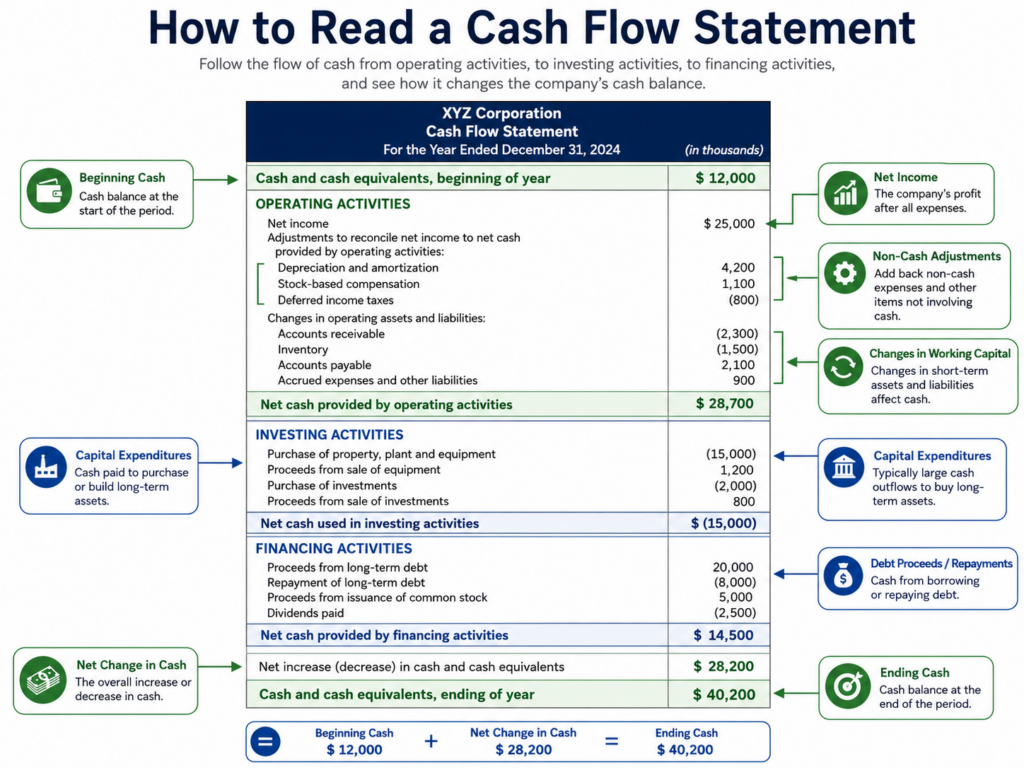
What is a cash flow statement?
A cash flow statement is a financial report that shows the cash a business generated and spent over a specific period, organized into operating, investing, and financing activities. It’s one of the three core financial statements, alongside the income statement and balance sheet, and it’s the only one of the three built entirely on cash movement rather than accounting accruals.
That distinction matters more than it sounds. A business can report solid profit on its income statement and still show a cash flow statement with a shrinking bank balance, because profit and cash movement aren’t the same thing. The cash flow statement is what tells you which one is actually happening.
The three sections of a cash flow statement
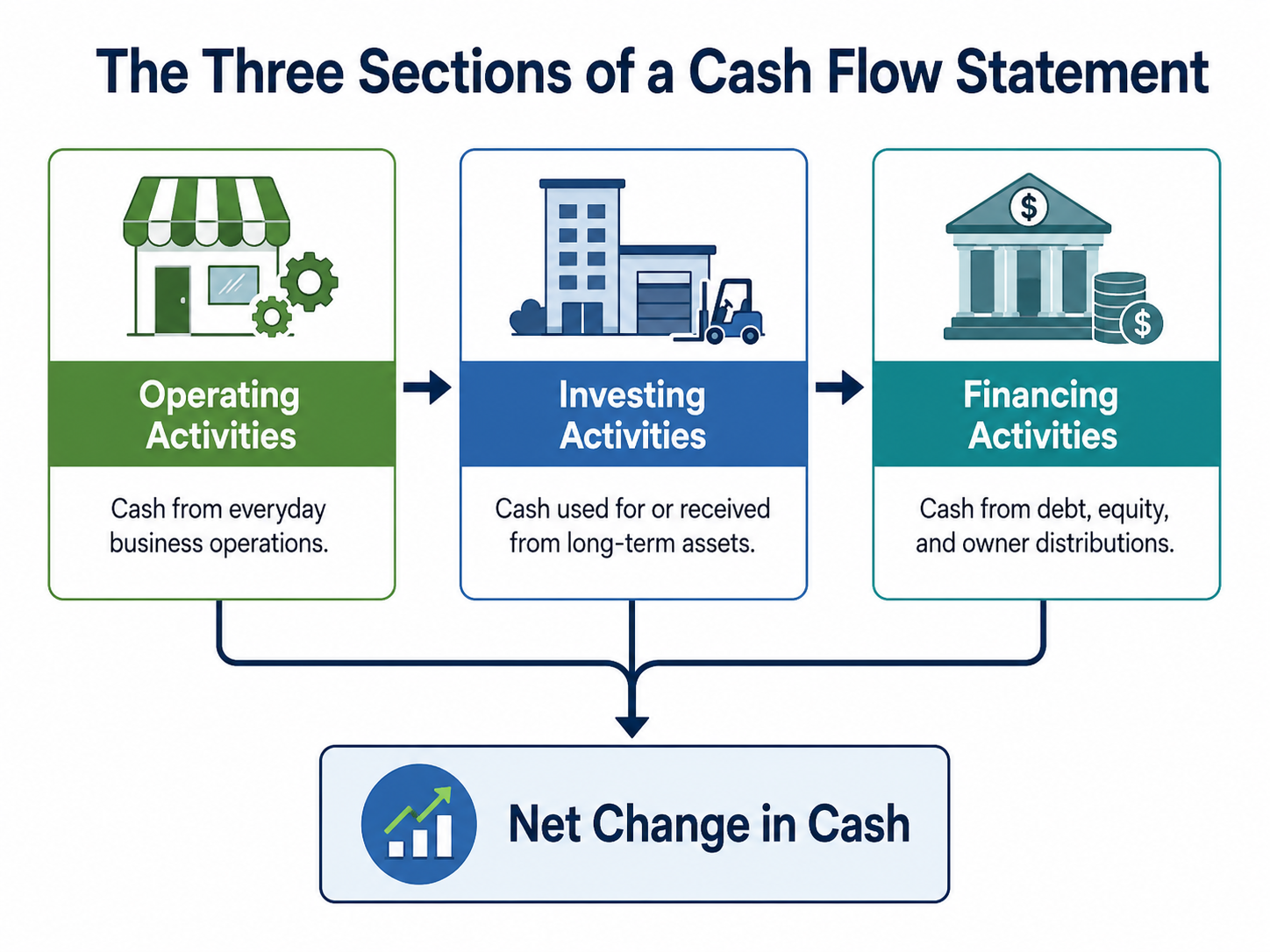
Every cash flow statement breaks into three sections, and each one answers a different question about where the cash came from or went.
Operating activities show the cash generated or used by the core business — collecting from customers, paying employees and vendors, and the day-to-day cash engine of the company. This is the section most CFOs check first, because it shows whether the business itself, apart from any financing or investment, actually produces cash.
Investing activities show cash spent on or received from long-term assets — buying equipment, purchasing property, or selling off old assets. A growing business often shows negative investing cash flow, and that’s not automatically a bad sign; it usually means the business is reinvesting in its own capacity.
Financing activities show cash movement tied to debt and ownership — loan proceeds, loan repayments, and owner distributions or investor contributions. This section reveals how the business is funding itself from the outside, separate from what it earns.
Direct vs. indirect method: which will you actually see?
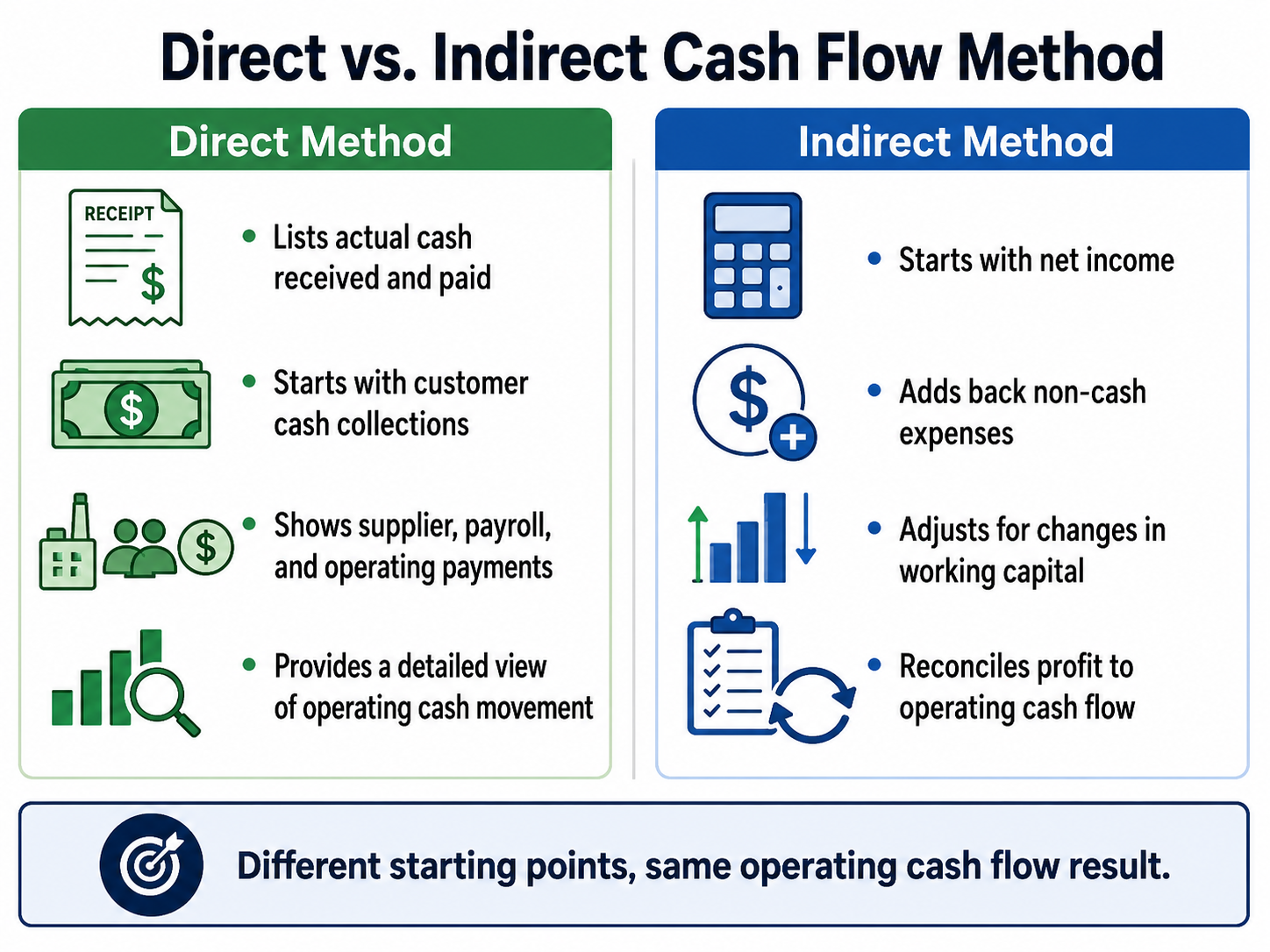
Most cash flow statements you’ll encounter use the indirect method, which starts with net income from the income statement and adjusts it for non-cash items like depreciation and changes in receivables, inventory, and payables. The direct method, which lists actual cash receipts and payments directly, is more intuitive but far less common in statements businesses actually issue.
This is worth knowing before you open a real statement, because the indirect method’s starting point — net income, not a cash total — confuses people expecting to see straightforward inflows and outflows right away. The adjustments underneath net income are where the real information lives.
How to read a cash flow statement, step by step

Work through a cash flow statement in this order: confirm the beginning cash balance, review each of the three sections to see whether it added or used cash, check that the three sections sum correctly to the net change in cash, and confirm that beginning cash plus the net change equals the ending cash balance shown. That sequence catches errors and builds the full picture before you try to interpret anything.
Once the math checks out, read each section’s individual line items, not just the section totals. A single large one-time item — an asset sale, a big loan payoff — can make an otherwise weak or strong period look different from its underlying trend. The line items are where that gets caught.
A full example: reading a distribution company’s cash flow statement
Numbers make the mechanics real. Here’s a complete statement of cash flows for a hypothetical $9 million regional distribution company, using the indirect method — the version you’re most likely to actually encounter.
| Line item | Amount | What it means |
| Operating activities | ||
| Net income | $420,000 | Starting point: profit from the income statement |
| + Depreciation and amortization | $180,000 | Added back — a non-cash expense that reduced net income but didn’t use cash |
| + Decrease in accounts receivable | $95,000 | Customers paid down what they owed — cash came in |
| − Increase in inventory | ($210,000) | More cash tied up in stock on the shelf |
| + Increase in accounts payable | $130,000 | Cash preserved by taking longer to pay vendors |
| Net cash from operating activities | $615,000 | The core business generated over $600K in real cash |
| Investing activities | ||
| Purchase of warehouse equipment | ($340,000) | Cash spent expanding capacity |
| Net cash used in investing activities | ($340,000) | Negative here, and reasonably so — reinvestment, not distress |
| Financing activities | ||
| Proceeds from bank term loan | $200,000 | New borrowing brought cash in |
| Repayment of long-term debt | ($150,000) | Cash used to pay down existing debt |
| Owner distributions | ($95,000) | Cash paid out to ownership |
| Net cash used in financing activities | ($45,000) | Slightly cash-negative overall |
| Net increase in cash | $230,000 | $615,000 − $340,000 − $45,000 |
| Cash at beginning of period | $310,000 | Starting bank position |
| Cash at end of period | $540,000 | Confirms against the actual bank balance |
Read top to bottom; this tells a coherent story: the core business threw off $615,000 in real cash, enough to fund a $340,000 equipment purchase and still pay down debt and distribute money to ownership, ending the year with more cash than it started. That’s a business funding its own growth from operations, not from financing.
What to look for once you can read the numbers
The single most useful check is whether operating cash flow alone is positive and large enough to cover the business’s real obligations, without depending on new financing to fill the gap. A business that consistently needs new loans just to keep operating cash flow positive is telling you something the income statement alone won’t show.
In 30-plus years of CFO work, the pattern Stan Alhadeff sees most often is an owner who checks the bottom-line “net increase in cash” number and stops there, missing that the increase came almost entirely from a new loan while operating activities were actually negative. That’s a very different business than one growing its cash position through real operations, even if the final number on both statements looks identical. Look at all three sections separately before you trust the total.
How to prepare a cash flow statement
Most small businesses don’t build a cash flow statement by hand — accounting software like QuickBooks generates it automatically from the general ledger, using the indirect method by pulling net income and calculating the balance sheet changes that feed the adjustments. Preparing one manually means starting with net income, then working through the same adjustments shown in the example above: adding back non-cash expenses, and adjusting for the change in each working capital account between two periods.
The real preparation work isn’t the math — it’s making sure the underlying books are accurate first. A cash flow statement built on sloppy accounting services work will balance perfectly and still be wrong, because it’s only as reliable as the general ledger feeding it. If you want a forward-looking version of this exercise instead of a historical one, that’s a cash flow forecast, which follows different logic built around projecting rather than reporting.
The mistakes people make reading a cash flow statement
The most common mistake is treating the “net increase in cash” figure as the whole story, when the section it came from matters more than the total. A close second: assuming negative cash flow always signals trouble, when negative investing cash flow from real equipment purchases is often exactly what a healthy, growing business should show.
The third mistake is reading one period in isolation. A single quarter’s cash flow statement can look alarming or great almost by accident — a big one-time purchase, a loan that happened to close that month. The trend across several periods tells you far more than any single snapshot. If your business is preparing for a bank conversation or a sale, our free discovery call includes a GAP Analysis that looks at exactly this kind of pattern before a lender or buyer does.
Turning the statement into a decision
A cash flow statement you can read but don’t act on is just an interesting document. The value shows up when the operating-activities trend informs a real decision — whether to take on debt, whether the business can fund its own growth, whether a distribution is actually sustainable.
For more on how this statement fits with the other two, income statement vs. balance sheet vs. cash flow statement walks through how all three connect. And if you’d rather have someone read these with you every month than work through them alone, book a free strategy call with Stan — it starts with a straight look at what your own numbers are actually telling you.
FAQ
What is a cash flow statement? A cash flow statement is a financial report showing the cash a business generated and spent over a specific period, organized into operating, investing, and financing activities. Unlike the income statement, it’s built entirely on cash movement rather than accounting accruals.
What are the three sections of a cash flow statement? The three sections are operating activities (cash from core business operations), investing activities (cash spent on or received from long-term assets), and financing activities (cash tied to debt and ownership). Each section answers a different question about where cash came from or went.
What is the difference between the direct and indirect method? The direct method lists actual cash receipts and payments directly, while the indirect method starts from net income and adjusts for non-cash items and working capital changes. Most real-world cash flow statements use the indirect method, even though the direct method is more intuitive to read.
How do you prepare a cash flow statement? Most businesses generate a cash flow statement automatically through accounting software, which builds it from the general ledger using the indirect method. Manual preparation starts with net income and adjusts for non-cash expenses and changes in receivables, inventory, and payables.
What does negative cash flow from investing activities mean? Negative investing cash flow usually means the business purchased equipment, property, or other long-term assets, which isn’t automatically a bad sign. For a growing business, negative investing cash flow paired with strong operating cash flow often signals healthy reinvestment rather than distress.

Stan Alhadeff
Founder & Fractional CFO