Most businesses should keep 3 to 6 months of operating expenses in cash reserves, though the right number depends heavily on your industry, revenue predictability, and access to credit. Here’s the part most advice on this topic leaves out: according to the JPMorgan Chase Institute’s analysis of 597,000 small business bank accounts, the median small business actually holds only about 27 days of cash buffer, a fraction of that 3–6 month target.
Key takeaways
That gap matters. It means the standard advice and the typical reality are two very different numbers, and understanding both helps you figure out where your business actually stands.
- The standard rule of thumb is 3 to 6 months of operating expenses in reserve, but the JPMorgan Chase Institute found the median small business actually holds only about 27 cash buffer days.
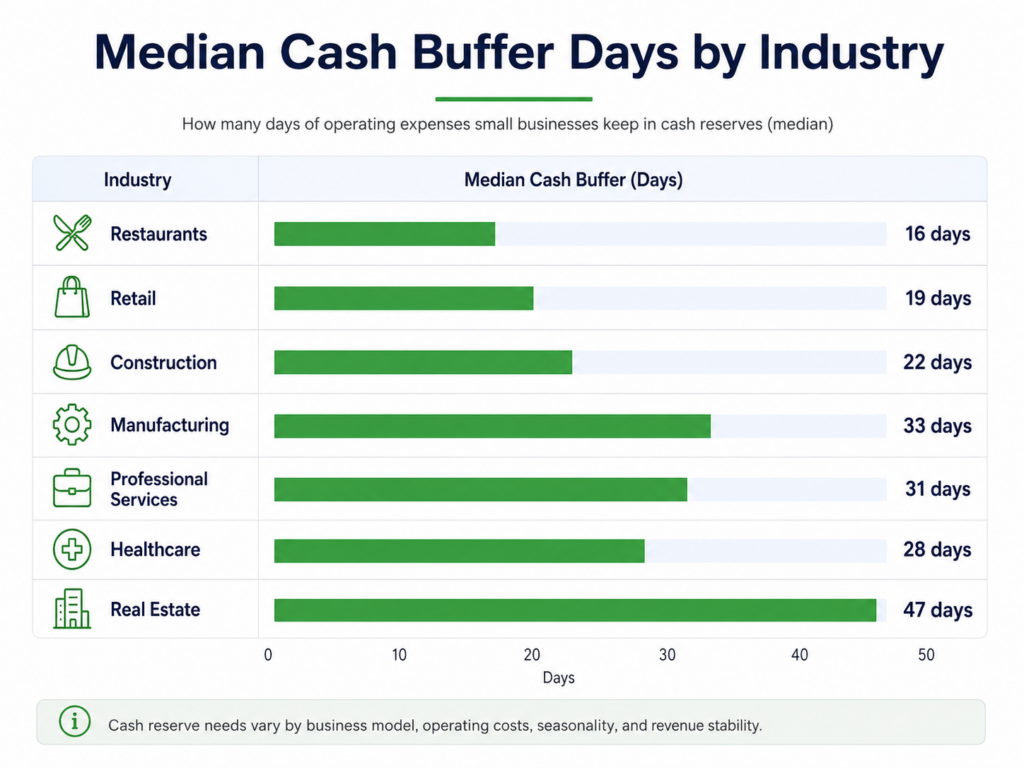
- Cash buffer days vary sharply by industry; restaurants hold a median of 16 days, while real estate businesses hold a median of 47, according to the same research.
- The right target for your business depends on revenue predictability, seasonality, customer payment terms, and how quickly you could access credit if you needed it.
- A cash reserve isn’t just insurance against a bad month; it’s what lets you take advantage of an opportunity without scrambling for financing on a deadline.
- More cash isn’t automatically better. Cash sitting idle beyond a reasonable reserve is cash that isn’t funding growth or earning a return anywhere else.
How much cash should a business have on hand?
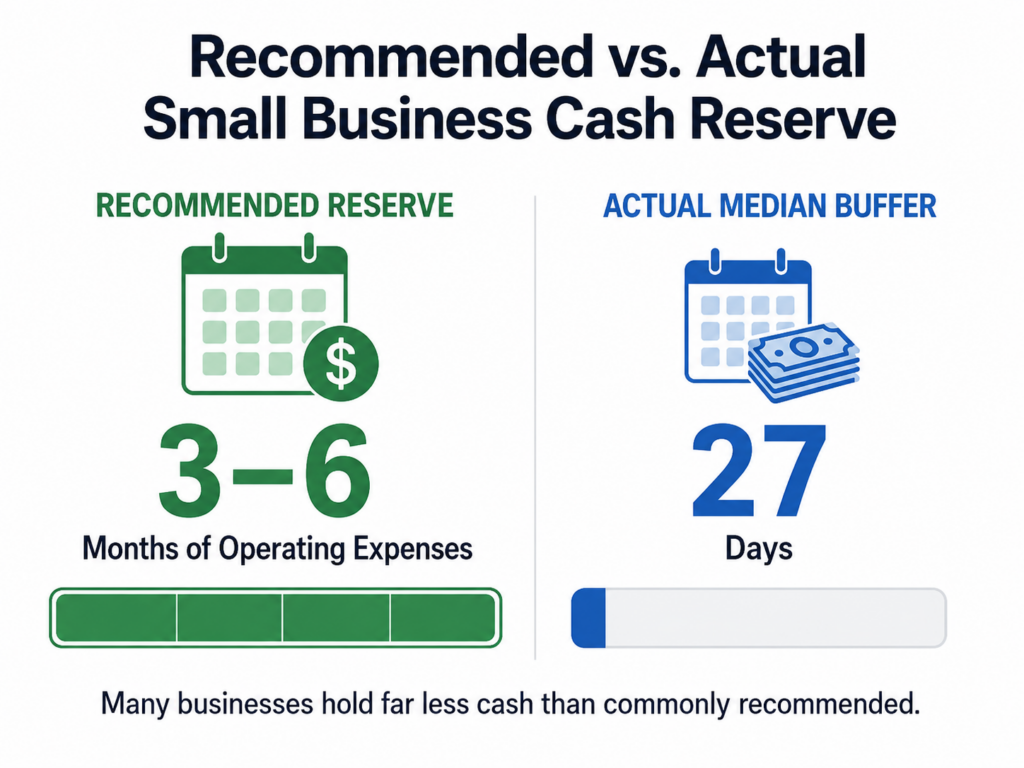
Most financial advisors recommend keeping enough cash to cover 3 to 6 months of operating expenses, calculated by taking your average monthly expenses and multiplying by the number of months of coverage you want. A business spending $140,000 a month would target $420,000 for a 3-month reserve or $840,000 for a 6-month reserve.
An alternative approach ties the target to revenue instead of expenses, roughly 10% to 30% of annual revenue, which can be a faster gut-check for businesses without a clean expense breakdown handy. Both methods land in a similar place for most steady-margin businesses; the expense-based method is generally more precise, since it’s tied directly to what actually has to get paid every month regardless of how sales are going.
Cash reserve benchmarks by industry
There’s no single right number, because cash reserve needs vary sharply by industry and the data backs that up clearly. The JPMorgan Chase Institute’s research on cash buffer days, drawn from over 470 million transactions across 597,000 small businesses, found real, meaningful differences by sector.
| Industry pattern | Median cash buffer days |
| Restaurants | 16 days |
| Labor-intensive services (personal services, repair) | 23 days |
| All small businesses (overall median) | 27 days |
| Capital-intensive industries (high-tech manufacturing) | 38 days |
| Real estate | 47 days |
A “cash buffer day” measures how many days of typical outflows a business could cover from its cash balance alone. Source: JPMorgan Chase Institute, “Cash is King: Flows, Balances, and Buffer Days,” 2016, still the most comprehensive study of its kind and the source underlying most current industry benchmarks on this topic.
The pattern makes sense once you see it: labor-intensive businesses with thin margins and constant payroll, like restaurants, run the leanest buffers. Capital-intensive and real estate businesses, with less frequent but larger cash movements, tend to carry more. If your business sits closer to the restaurant end of that spectrum, a 3–6 month target isn’t unreasonable — it’s a meaningfully bigger stretch from where the typical business in that category actually sits today.
How to calculate your own cash reserve target

Calculate your target by taking your average monthly operating expenses rent, payroll, recurring vendor costs, debt payments and multiplying by the number of months of coverage that fits your risk tolerance and industry. Pull the expense figure from a recent income statement or your cash flow forecast rather than estimating it, since a rough guess here undermines the whole exercise.
From there, adjust the number of months up or down based on your specific situation. Seasonal businesses, businesses with long customer payment terms, or newer businesses without an established credit relationship should lean toward the higher end, or beyond it. Businesses with steady, predictable revenue and strong access to a line of credit can reasonably run leaner, since credit access itself functions as a form of buffer.
Why the generic 3–6 month rule doesn’t fit every business
The 3–6 month rule is a reasonable starting point, not a number that fits every business equally, because revenue predictability and payment timing vary too much to average into one figure. A business collecting cash on delivery has fundamentally different reserve needs than one carrying net-60 or net-90 terms with its largest customers, even at identical revenue.
In 30-plus years of CFO work, the pattern Stan Alhadeff sees most often is an owner targeting a generic reserve number without ever calculating their own cash conversion cycle first the actual gap between paying suppliers and collecting from customers. A business with a long cycle needs a bigger buffer to bridge that gap; a business with a short one can often run leaner and redirect the difference toward growth.
What happens when a business doesn’t have enough
A business without an adequate cash reserve has to react to every disruption a slow month, a late-paying customer, an equipment failure with borrowing, delayed payments to its own vendors, or missed payroll, instead of simply covering it. According to the Federal Reserve’s 2024 Small Business Credit Survey, 51% of small employer firms cited uneven cash flow as a financial challenge in the prior year, which is close to a coin flip across the entire small business population.
The cost isn’t always dramatic. Sometimes it’s smaller and constant, declining a good hire, delaying equipment that would improve margins, or turning down a bulk-purchase discount because the cash isn’t free to commit. A thin reserve doesn’t just risk a crisis; it quietly limits which decisions are even on the table. If you want a clear picture of where your own reserve stands against your actual cash flow pattern, our free discovery call includes a GAP Analysis that shows you plainly.
Where to actually keep your cash reserve
Keep your cash reserve in a separate, highly liquid account a business savings or money market account distinct from your operating account, so it’s accessible within a day or two but not sitting in the same pool you draw from for daily expenses. The separation matters as much as the account type; reserves that live in the operating account tend to get spent gradually without anyone quite deciding to spend them.
Liquidity should come before yield. A cash reserve isn’t an investment portfolio, and chasing a slightly higher return by locking funds into something less liquid defeats the entire purpose of holding a reserve in the first place. The money needs to be there the day you actually need it, not available in 90 days.
When more cash isn’t actually better
A cash reserve well beyond what your business realistically needs isn’t free security; it’s opportunity cost, sitting idle instead of funding growth, paying down higher-interest debt, or earning a return somewhere else. Overcapitalization is a real, if less discussed, mistake alongside undercapitalization.
The right reserve is the one sized to your actual risk, not the largest number you can comfortably accumulate. Stan Alhadeff worked with one client, Amerigo Metal Recycling, through more than a decade of growth from $8 million to nearly $50 million in revenue, and part of that growth came from deploying cash deliberately rather than letting it accumulate past the point it was actually protecting the business.
Getting the number right for your business
The right cash reserve isn’t a number you copy from a blog post; it’s a calculation based on your actual expenses, your industry’s real patterns, and how quickly you could access credit if you needed it. Most businesses land somewhere between the JPMorgan Chase Institute’s observed 27-day median and the commonly recommended 3–6 month target, and where you should sit inside that range depends on specifics only your own numbers can answer.
If you’d like a straight read on where your reserve stands and what target actually fits your business, book a free strategy call with Stan. It starts with the GAP Analysis, and it ends with a real number, not a generic rule of thumb.
FAQ
How much cash should a business have on hand? Most businesses should target 3 to 6 months of operating expenses in reserve, though the actual median small business holds only about 27 days of cash buffer, according to JPMorgan Chase Institute research. The right target depends on your industry, revenue predictability, and access to credit.
How many months of expenses should a business keep in reserve? Most financial advisors recommend 3 to 6 months of operating expenses, calculated by multiplying average monthly expenses by the number of months of coverage desired. Seasonal or unpredictable-revenue businesses should lean toward the higher end of that range.
What is a cash buffer? A cash buffer is the number of days a business could cover its typical outflows using only its current cash balance, with no additional cash coming in. It’s a way of measuring reserve adequacy in days rather than dollars, making it easier to compare across businesses of different sizes.
Where should a business keep its cash reserves? A business should keep cash reserves in a separate, highly liquid account, such as a business savings or money market account, distinct from the operating account used for daily expenses. Liquidity matters more than yield, since the reserve needs to be accessible quickly when it’s actually needed.
Can a business have too much cash? Yes. Cash held well beyond what a business realistically needs represents an opportunity cost, sitting idle instead of funding growth, paying down debt, or earning a return elsewhere. The goal is a reserve sized to actual risk, not the largest amount a business can accumulate.

Stan Alhadeff
Founder & Fractional CFO