Across the fractional CFO market, hourly rates typically run $175 to $450 an hour, depending on the CFO’s experience level and the complexity of the work. That’s the going rate you’ll see quoted, but for anything beyond a single, bounded project, it’s usually not how the engagement should be priced at all, and this guide explains why.
Key takeaways
- Fractional CFO hourly rates generally fall between $175 and $450 an hour, with specialized or senior-level CFOs commanding more.
- Rate depends mainly on experience tier, specialization, and — even in a remote-first market — geography, with major-market CFOs often charging a premium.
- Hourly billing makes sense for a single, bounded task: a gut-check call, a one-time model, or a narrow project with a clear endpoint.
- For an ongoing relationship, hourly billing quietly works against the client — it rewards slower work and doesn’t build the kind of sustained, monthly discipline that actually catches problems early.
- Business CFO for Hire prices engagements on a monthly retainer, typically $3,000 to $10,000 a month, because that structure aligns incentives around the whole relationship instead of the clock.
What is the typical fractional CFO hourly rate?
Fractional CFO hourly rates typically range from $175 to $450 an hour across the market, with the wide spread reflecting real differences in experience, specialization, and scope rather than one standard price. A CFO early in their fractional career, handling straightforward reporting and modeling work, tends to sit at the lower end. A CFO with 15-plus years of experience, particularly one with fundraising, M&A, or turnaround expertise, commands the upper end and sometimes beyond it.
That range is broad enough that “the hourly rate” isn’t really a useful single number to budget against. What matters more is what you’re actually paying for at each tier, and how many hours the engagement genuinely requires — which is exactly where hourly pricing starts to get complicated.
What drives the rate within that range?
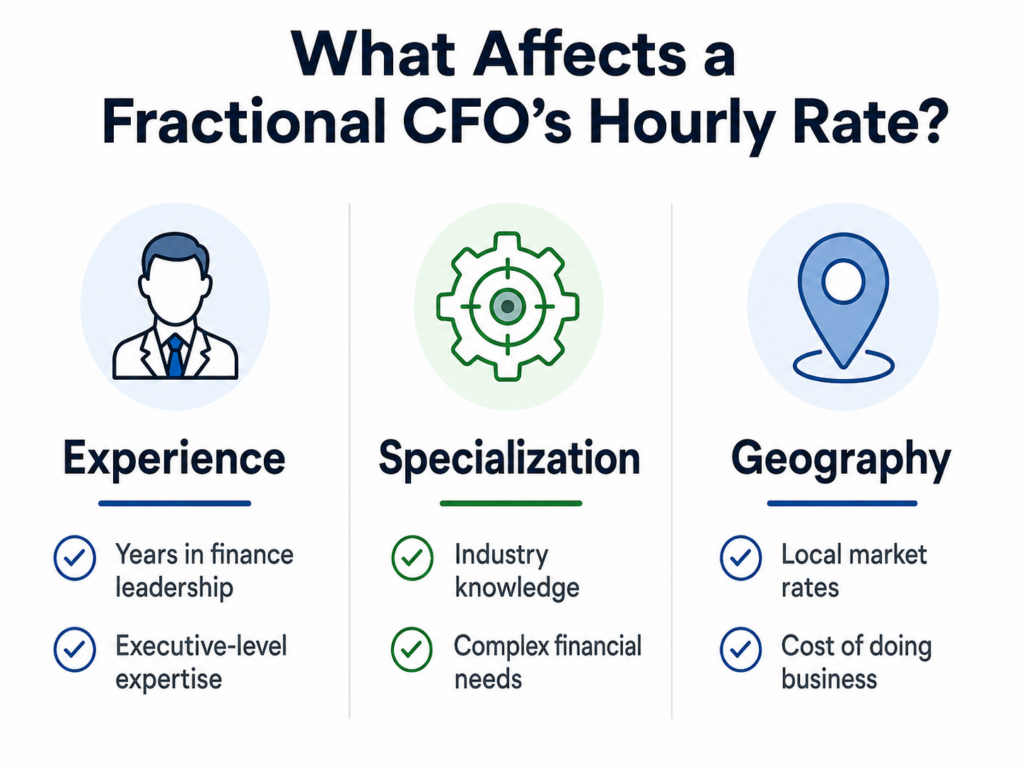
Three factors do most of the work in setting where a specific CFO’s hourly rate lands: experience level, specialization, and — despite remote work being the norm now — geography. A junior or generalist fractional CFO charges meaningfully less than one with a specific, in-demand skill set like SaaS metrics, M&A due diligence, or turnaround work.
| Factor | How it moves the rate |
| Experience level | Newer fractional CFOs sit at the lower end of the range; CFOs with 15+ years and executive track records sit at the top |
| Specialization | Generalist financial reporting and forecasting work costs less than fundraising, M&A, or industry-specific expertise (SaaS metrics, deferred revenue, government contracting) |
| Geography | CFOs based in major markets (San Francisco, New York, Boston) often charge a premium over similar experience levels elsewhere, even for remote engagements |
Specialization tends to matter more than the other two combined. A generalist CFO at 20 years of experience and a specialist CFO at 10 years of M&A-specific experience can land at similar rates, because the market prices scarcity of the specific skill, not just tenure.
Hourly rate vs. monthly retainer: which is the better deal?
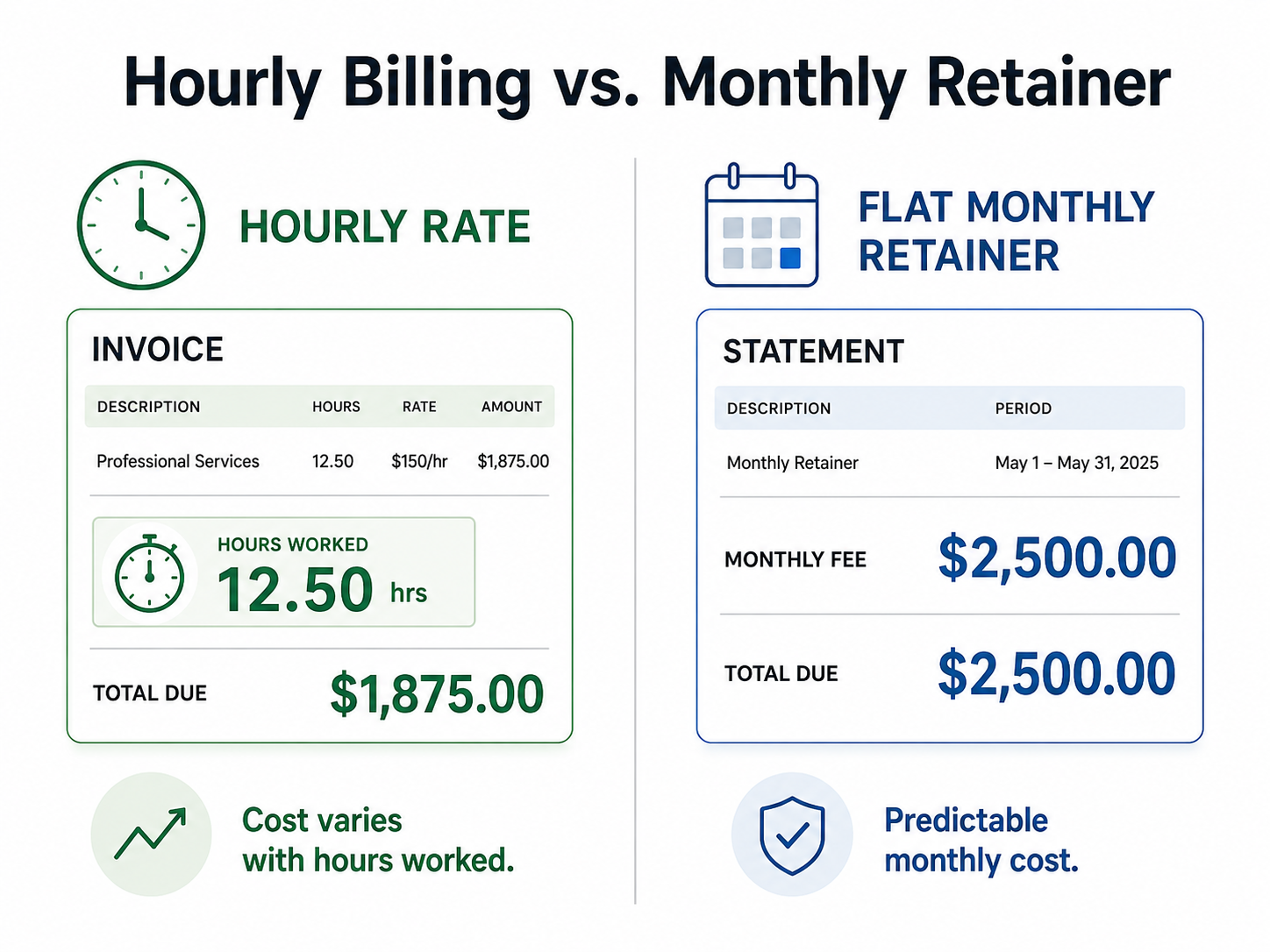
A monthly retainer is usually the better structure for an ongoing relationship, because it prices the whole engagement rather than individual hours, which keeps both sides focused on outcomes instead of the clock. Most serious, ongoing fractional CFO relationships — including ours — run on a retainer for exactly this reason.
The math looks appealing on paper for hourly billing: pay only for the hours you use, nothing more. In practice, it creates a subtle misalignment. An hourly-billed CFO has a mild incentive to let tasks take the time they take, since more hours means more revenue for them. A retainer-billed CFO has the opposite incentive: solve the problem efficiently, because the fee doesn’t change either way. That’s not a claim that hourly CFOs are dishonest — it’s just how incentive structures work, and it’s worth knowing before you pick one.
When hourly billing actually makes sense
Hourly billing genuinely fits a single, bounded task with a clear start and end — a one-time financial model, a gut-check call before a decision, or a narrow project like preparing one specific report for a lender. If the engagement has a defined scope and you don’t expect to need the CFO again next month, paying by the hour is a reasonable, low-commitment way to get it done.
It’s a poor fit the moment the relationship becomes ongoing. If you’re calling on the same CFO every month for forecasting, close review, and strategic input, you’ve effectively built a retainer relationship anyway — you’re just paying for it in the most expensive, least predictable way possible.
When hourly billing works against you
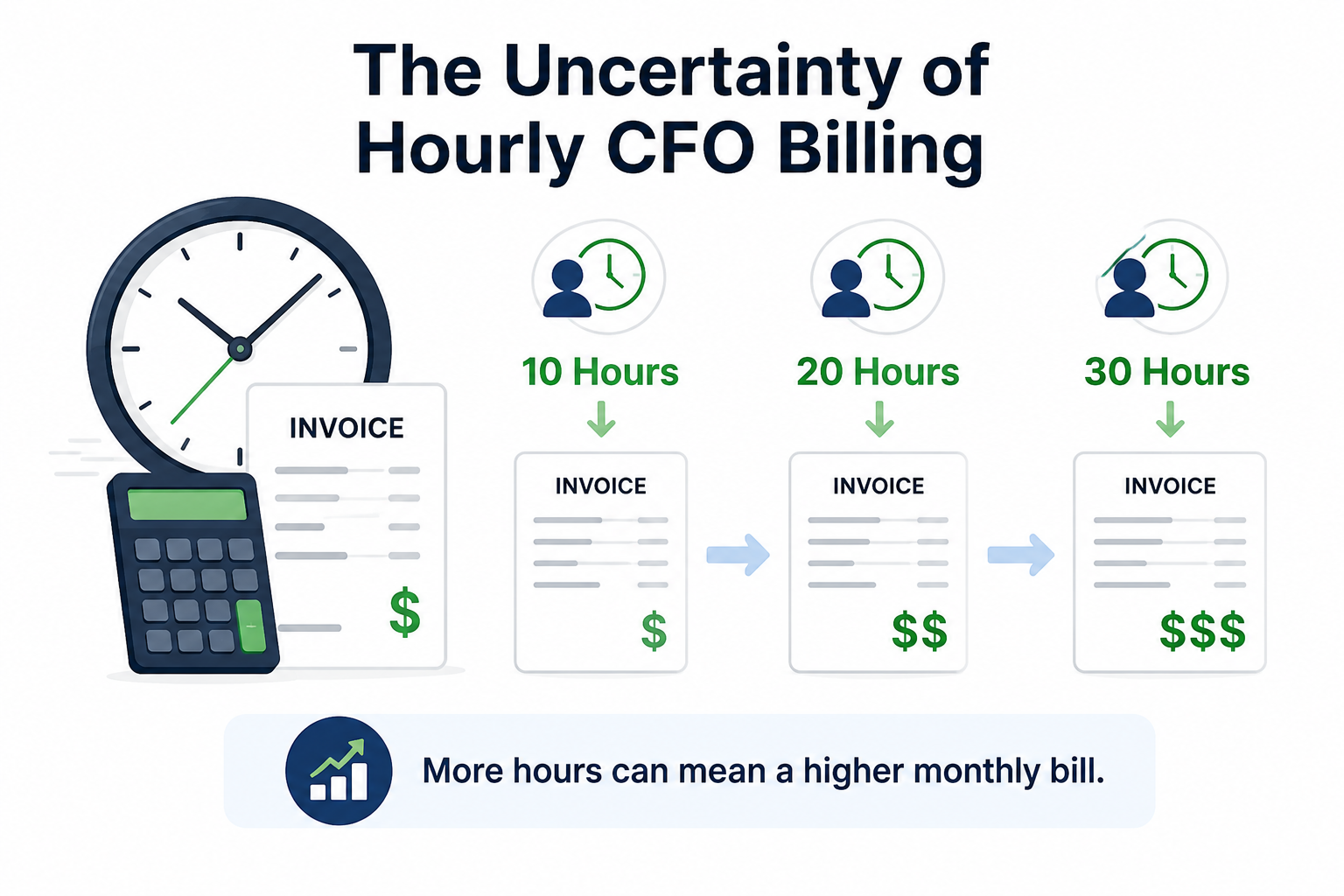
Hourly billing works against you once the relationship becomes a recurring one, because the incentive to work efficiently weakens and the total monthly cost becomes genuinely unpredictable. A month with a financing event or a complex close can run the bill far higher than a retainer would have cost for the same work.
In 30-plus years of CFO work, the pattern Stan Alhadeff sees most often with hourly arrangements is a business that starts hourly to “test things out,” keeps calling every month anyway, and ends up paying more over a year than a retainer would have cost — without ever getting the consistency a retainer relationship builds. A fractional CFO engagement is only as valuable as the discipline behind it, and hourly billing doesn’t naturally produce that discipline the way a standing monthly rhythm does.
How Business CFO for Hire prices engagements instead
We price every engagement on a monthly retainer, typically $3,000 to $10,000 a month depending on business complexity, rather than billing by the hour. That structure is covered in full — including how the range breaks down by complexity — on our fractional CFO cost guide, which is worth reading if you’re trying to budget for an ongoing relationship rather than a single project.
Every engagement starts the same way regardless of eventual scope: a free discovery call and a GAP Analysis that shows exactly what your business needs before any pricing conversation happens. Stan Alhadeff worked with one client, Amerigo Metal Recycling, through more than a decade of retainer-based engagement, and the company grew from $8 million to nearly $50 million in revenue over that relationship — the kind of sustained result an hourly arrangement rarely produces, simply because it isn’t built for the long haul.
What to ask before you agree to an hourly rate
If a fractional CFO only offers hourly billing, ask directly how many hours a typical month runs and what happens once the relationship becomes ongoing rather than project-based. A CFO worth hiring should be able to answer that plainly, and if the honest answer is “this should probably be a retainer,” a good one will tell you so.
If you’d rather skip the guesswork and get a straight answer for your specific business, book a free strategy call with Stan — it starts with the GAP Analysis, and the pricing conversation that follows is scoped to your numbers, not an hourly guess.
FAQ
What is the average hourly rate for a fractional CFO? Fractional CFO hourly rates typically run $175 to $450 an hour, depending on the CFO’s experience and specialization. Senior or highly specialized CFOs — particularly those with fundraising or M&A expertise — often charge at or above the top of that range.
Is it better to pay a fractional CFO hourly or monthly? For an ongoing relationship, a monthly retainer is usually the better structure, since it aligns incentives around solving problems efficiently rather than accumulating billable hours. Hourly billing works best for a single, bounded project rather than a recurring engagement.
What factors affect a fractional CFO’s hourly rate? A fractional CFO’s hourly rate depends mainly on experience level, area of specialization, and geography, with specialization typically mattering most. A generalist with 20 years of experience can charge similarly to a specialist with half that tenure in an in-demand area like M&A.
How many hours does a fractional CFO typically work? Hours vary by engagement, from a few hours a month for light, ongoing support to significantly more during a financing event or transaction. Most established fractional CFO relationships move to a monthly retainer once the hours become predictable and recurring.