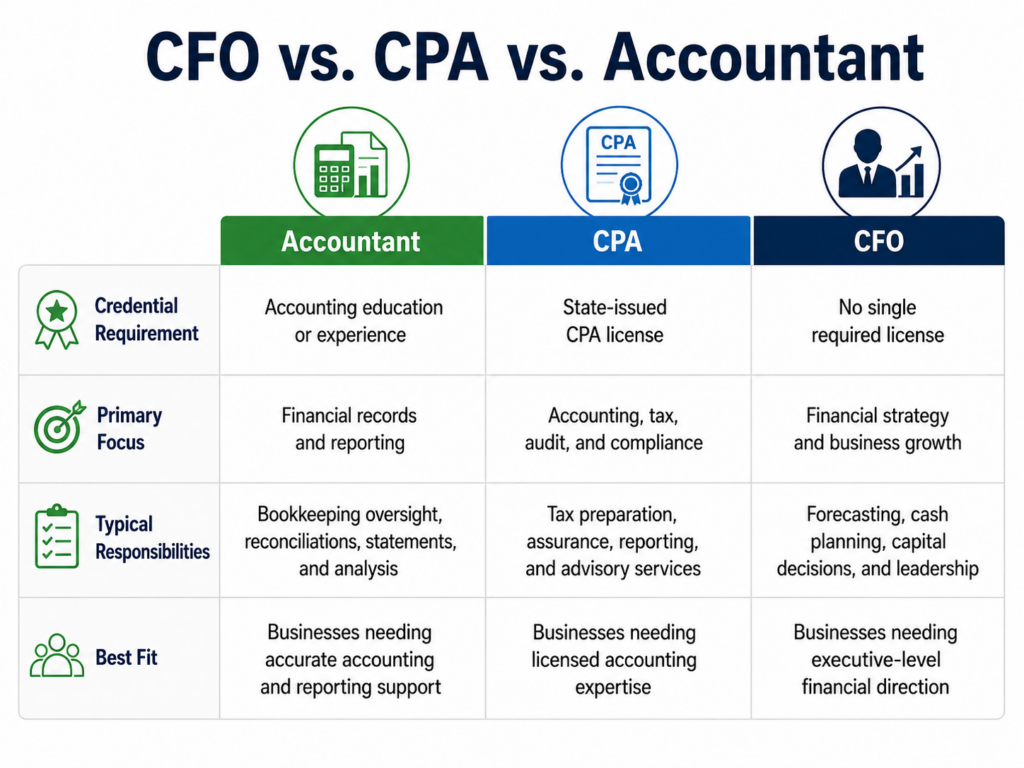
An accountant is a general job title for someone who handles financial records — no license required. A CPA is a specific, state-issued credential that requires passing a national exam and meeting education and experience requirements. A CFO is an executive role focused on financial strategy, with no license requirement of its own. All three deal with money. They’re not the same thing, and they’re not interchangeable.
That’s the part most explanations skip. Here’s what each one actually is, and which one your business needs right now.
Key takeaways
- “Accountant” is a general job title — anyone doing accounting-type work can generally use it, with no license required in most contexts.
- “CPA” is a specific, state-issued license. It requires passing the Uniform CPA Exam plus education and experience requirements that vary by state.
- “CFO” is an executive role, not a credential. No license is required, though many CFOs also hold a CPA or an MBA.
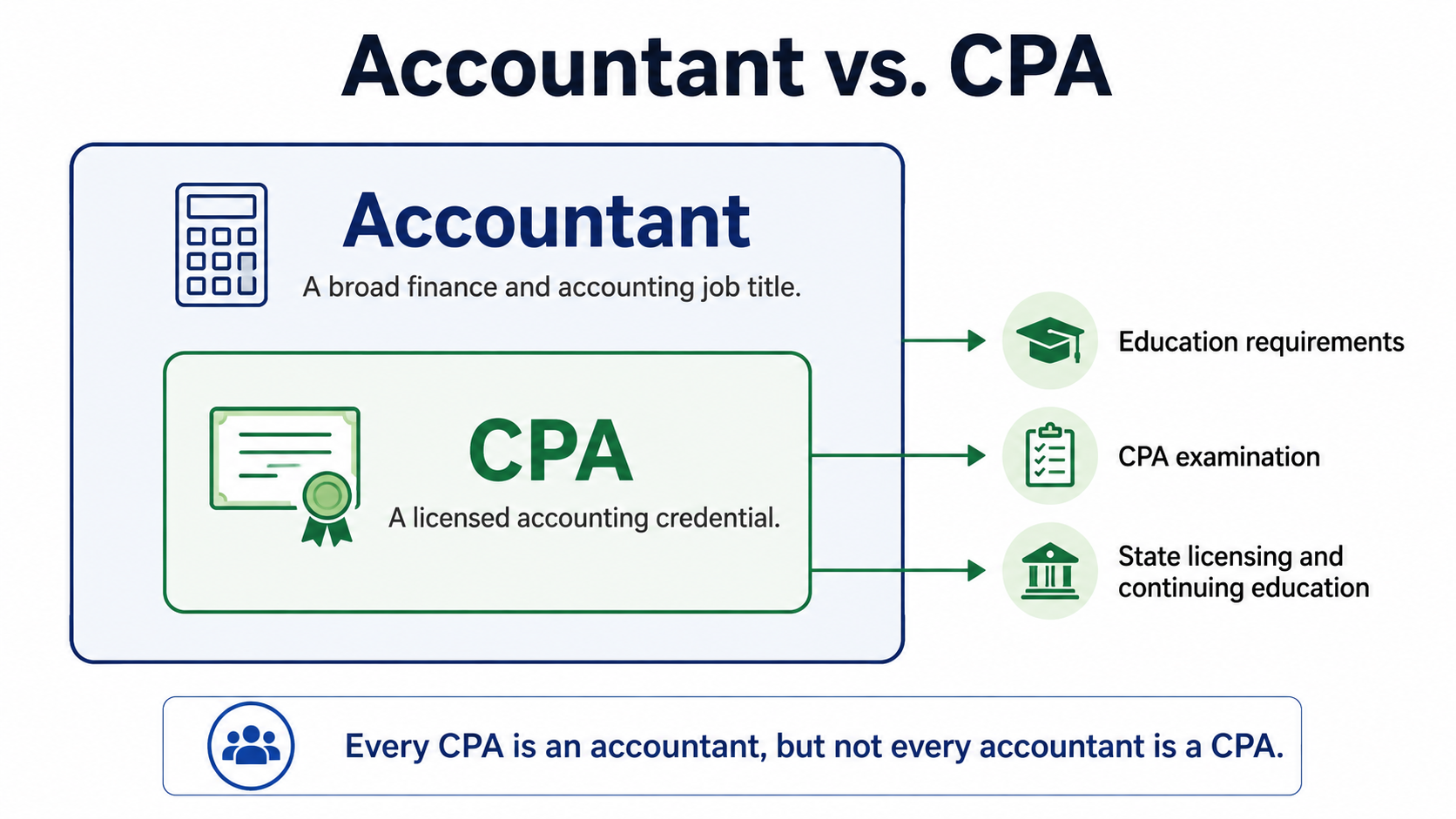
- The real confusion isn’t CFO vs. CPA — it’s that “accountant” and “CPA” get used interchangeably when they’re genuinely different things: a job title versus a license.
- Most growing businesses eventually need accounting support and CFO-level strategy together. It’s rarely a choice between one or the other.
What is an accountant?
An accountant is someone who records, organizes, and reports on a business’s financial transactions — a general job title that doesn’t require any specific license in most contexts. Someone can call themselves an accountant with a bachelor’s degree in accounting, years of hands-on experience, or sometimes neither.
That’s not a knock on accountants — plenty are highly skilled and handle real financial complexity well. It just means the title alone doesn’t tell you whether the person has been vetted to any particular standard. That’s exactly where CPA comes in.
What is a CPA?
A CPA, or Certified Public Accountant, is a specific, state-issued license that requires passing the Uniform CPA Exam and meeting education and experience requirements set by the state board of accountancy. According to the North Carolina State Board of Certified Public Accountant Examiners, CPA licensure requires satisfying what’s commonly called the “Three Es” — Education, Examination, and Experience — with the Uniform CPA Exam being the only one of the three that’s standardized nationally; education and experience requirements vary by state.
A CPA license is what allows someone to sign audited financial statements and represent a client before the IRS in certain circumstances — real, specific authority an unlicensed accountant doesn’t have. It’s a credential, not a job description, similar to how “attorney” describes a licensed status, not just anyone who reads contracts for a living.
What is a CFO?
A CFO, or Chief Financial Officer, is a senior executive responsible for a company’s financial strategy — forecasting, financing decisions, pricing, and growth planning — not a licensed credential at all. Anyone can hold the CFO title without ever taking an exam or meeting a state requirement.
Many CFOs do hold a CPA license or an MBA, often both, because deep accounting fluency helps ground the strategic work. But the title itself is about scope and responsibility within a company, not certification. A fractional CFO brings that same strategic scope to a business part-time, on a retainer, without a company needing to make a full-time executive hire to get it.
CFO vs. CPA vs. accountant: side-by-side comparison
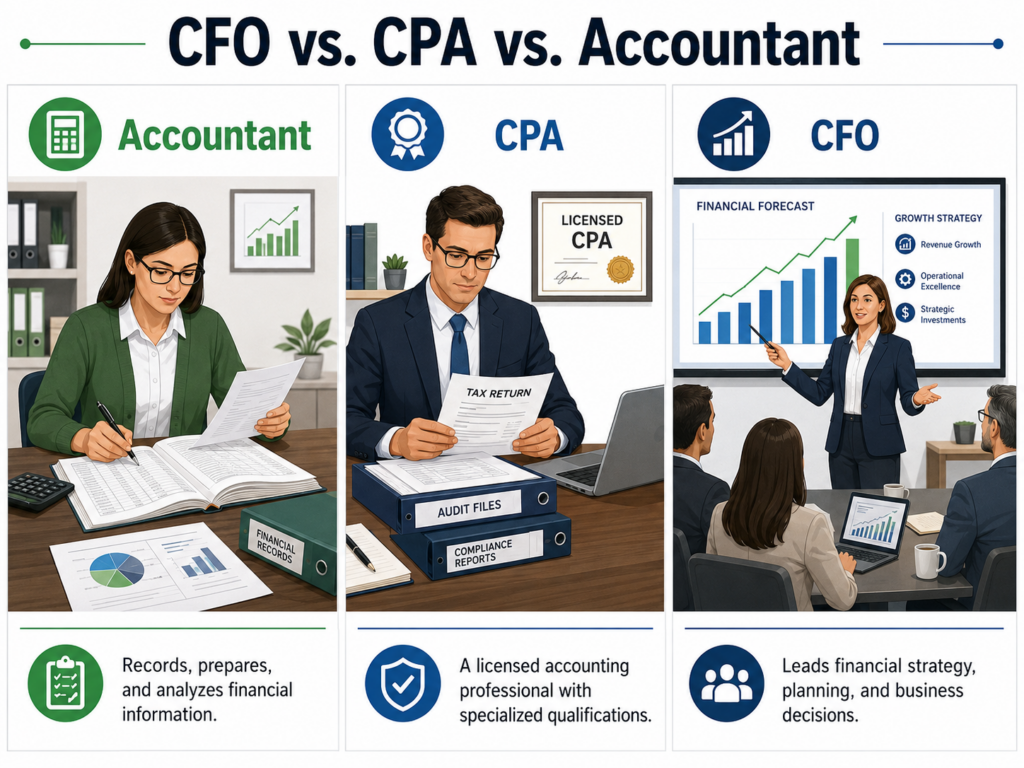
| Accountant | CPA | CFO | |
| What it is | General job title | State-issued license | Executive role |
| License required | No | Yes — Uniform CPA Exam plus state education and experience requirements | No, though many hold a CPA or MBA |
| Primary focus | Recording and organizing financial data | Tax compliance, audits, GAAP accuracy | Financial strategy, forecasting, growth decisions |
| Time orientation | Present and backward | Backward | Forward |
| Can sign audited financial statements | No | Yes | Not unless also a CPA |
| Best fit for | Day-to-day bookkeeping and reporting | Tax season, audits, regulatory compliance | Financing, pricing, and growth decisions |
The real confusion: is a CPA the same as an accountant?
No — a CPA is a licensed credential, while “accountant” is a general, unlicensed job title, and the two get treated as synonyms far more often than they should be. Someone can be a genuinely skilled, experienced accountant without ever having sat for the CPA exam, which means they haven’t been vetted to that specific standard and, in most states, can’t perform certain functions a CPA can, like signing an audited financial statement.
This distinction matters most when it’s least visible — when you’re hiring someone and assuming “accountant” and “CPA” mean the same level of verification. They don’t. If your business needs an audited financial statement for a lender or investor, or representation in a tax matter, that specifically requires a CPA, not just anyone with “accountant” in their title. Our accounting services make clear upfront what level of credential a given task actually requires, rather than assuming the label on someone’s business card settles it.
Do I need a CFO or an accountant?
You need an accountant if your question is about accuracy — are the numbers recorded correctly, is the tax return right, are the books ready for a lender. You need a CFO if your question is about strategy — should we hire, can we afford this expansion, how do we structure financing for growth. Most businesses need both, at different points and for different reasons.
A simple test: if you’re asking “is this number right,” that’s an accounting question. If you’re asking “what should we do about this number,” that’s a CFO question. Our earlier piece on CFO vs. controller: who to hire first covers the sequencing logic in more depth — the short version is that accuracy work almost always needs to come first, with strategic support layered on once the numbers underneath it can be trusted.
Can one person do all three jobs?
One person can technically wear all three hats at a very small business, but it rarely holds up well past a certain size, because accounting accuracy and strategic forecasting pull in genuinely different directions. In 30-plus years of CFO work, the pattern Stan Alhadeff sees most often is a business relying on one CPA to handle both tax compliance and strategic financial planning, which works fine until the business hits real complexity — multiple revenue streams, a financing event, a growth decision with real dollars behind it — and the CPA’s tax-focused training doesn’t extend into that strategic territory. That’s not a knock on the CPA. It’s just a different discipline, the same way a great surgeon isn’t automatically a great hospital administrator.
If you want a clear read on which of these roles your business actually needs right now, our free discovery call includes a GAP Analysis that tells you plainly, based on your actual numbers rather than a generic checklist.
Getting the label right
The confusion between accountant, CPA, and CFO isn’t really about semantics — it changes what you should expect, what you’re paying for, and what a given hire is actually qualified to do. Getting the label right up front saves a real headache later, whether that’s discovering your “accountant” can’t sign an audited statement a lender requires, or paying CFO-level rates for work that was really an accuracy problem.
If you’d like a straight answer on which of these your business needs, book a free strategy call with Stan — it starts with a look at your actual situation, not a generic definition.
FAQ
What is the difference between a CFO and an accountant? An accountant records and organizes financial data, focused on accuracy in the present and past. A CFO uses that data to guide strategy, forecasting, and growth decisions, focused on the future. One is a job title with no license required; the other is an executive role also without a license requirement, though CFOs often hold additional credentials.
What is the difference between a CPA and an accountant? A CPA is a specific, state-issued license requiring passage of the Uniform CPA Exam plus education and experience requirements. “Accountant” is a general job title that doesn’t require any license in most contexts. Someone can be an accountant without being a CPA, but every CPA has met a documented licensing standard.
Do I need a CFO or an accountant? You need an accountant if your question is about accuracy — are the numbers right, is the tax return correct. You need a CFO if your question is about strategy — should you hire, expand, or take on financing. Most growing businesses eventually need both, though rarely at the same time.
Is a CPA the same as an accountant? Not exactly. Every CPA is technically an accountant, but not every accountant is a CPA — the CPA designation requires passing a national exam and meeting state licensing requirements that an unlicensed accountant hasn’t necessarily met. The distinction matters most when a task specifically requires CPA authority, like signing an audited financial statement.
Can an accountant become a CFO? Yes, and it’s a common career path, though it requires developing a different skill set beyond accounting accuracy — forward-looking strategy, forecasting, and stakeholder communication. Many CFOs started as accountants or CPAs before moving into more strategic roles over time.

Stan Alhadeff
Founder & Fractional CFO