
A controller owns the accuracy of your financial records: the close, the reconciliations, the reports you can actually trust. A CFO uses those numbers to set strategy, pricing, financing, and growth decisions. They’re not competing roles; they’re sequential ones, and in nearly every case, the controller comes first.
That last part is where most comparisons stop short. Here’s the difference in full, and the sequencing logic most guides skip.
Key takeaways
- A controller focuses on accuracy: the books, the close, internal controls. A CFO focuses on strategy: forecasting, financing, growth decisions built on those numbers.
- If your business has neither role yet, hire a controller first. A CFO’s strategy is only as good as the numbers underneath it.
- A CFO is often a named corporate officer with real liability exposure; a controller typically isn’t, even at a senior level.
- According to the U.S. Bureau of Labor Statistics, the median annual wage for financial managers — the category that includes both CFOs and controllers — was $161,700 in May 2024, though the two roles typically sit at different points within that range.
- Most growing businesses eventually need both. The question isn’t really “which one” — it’s “which one first, and when does the second one earn its cost?”
What’s the difference between a CFO and a controller?
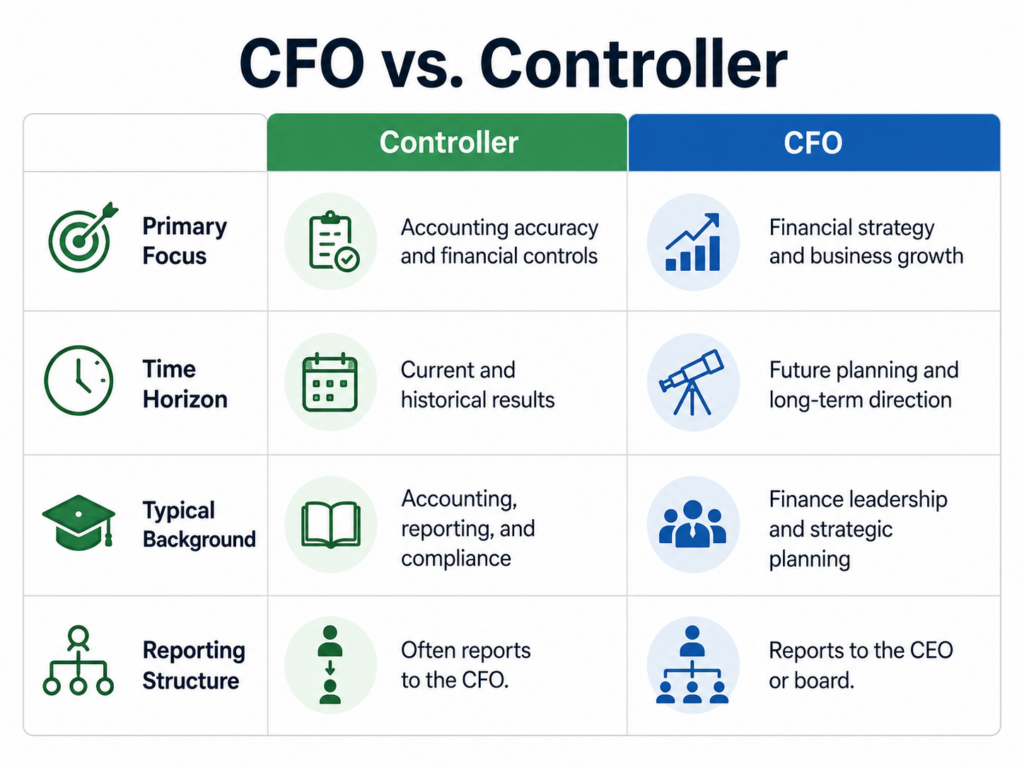
A controller is responsible for the accuracy of a company’s financial records — closing the books, maintaining internal controls, and producing statements that hold up under audit or lender review. A CFO is responsible for financial strategy — using those numbers to guide pricing, financing, and growth decisions. One looks backward and present; the other looks forward.
The distinction gets blurry at smaller companies, where one person sometimes does pieces of both jobs. It sharpens as a business grows: a controller’s expertise runs deep into GAAP, reconciliations, and compliance, while a CFO’s runs into capital structure, forecasting, and board-level communication. Different disciplines, not just different job titles.
CFO vs. controller: side-by-side comparison
| Controller | CFO | |
| Primary focus | Accuracy of financial records, monthly close, internal controls | Financial strategy, forecasting, growth decisions |
| Time orientation | Backward and present | Forward |
| Typical background | CPA, deep accounting expertise | Broader finance: capital markets, financial planning, financing strategy |
| Corporate officer status | Usually not a named corporate officer | Often a named officer with real liability exposure |
| Reports to | CFO where one exists, otherwise the owner or CEO directly | CEO and/or the board |
| Right time to engage | Once the books need dedicated, consistent ownership | Once decisions need forward strategy built on numbers you already trust |
The corporate-officer distinction is worth sitting with. A CFO can be held personally accountable if a company’s finances are misrepresented; a controller, even a very senior one, typically isn’t exposed the same way. That’s part of why the CFO seat commands a different level of compensation and scrutiny.
Who should you hire first, a CFO or a controller?
Hire a controller first in nearly every case, because a CFO’s strategic value depends entirely on numbers a controller has already made trustworthy. A brilliant forecast built on inaccurate books is just a confident guess with better formatting.
In 30-plus years of CFO work, the pattern Stan Alhadeff sees most often is an owner hiring CFO-level help before the accuracy layer is solid, usually because the CFO title sounds more impactful than “controller.” It backfires quietly: the CFO spends the first several months just getting the numbers right, work a controller should have already done, at CFO-level cost. If your reports are late, inconsistent, or something you don’t fully trust, that’s the fractional controller services gap, and it’s the one to close first regardless of how appealing the CFO conversation sounds.
There’s one exception worth naming: a business already facing an active financing event, acquisition, or exit with a tight timeline sometimes needs CFO-level strategic thinking running in parallel with controller-level cleanup, because there isn’t time to sequence it cleanly. That’s the exception, not the rule.
Can one person do both jobs?
One person can technically do both jobs at a very small company, but it rarely works well past a certain size, because the two roles pull in different directions. A controller’s instinct is caution and precision; a CFO’s instinct is forward movement and calculated risk. Asking one person to hold both mindsets at once usually means one side gets shortchanged.
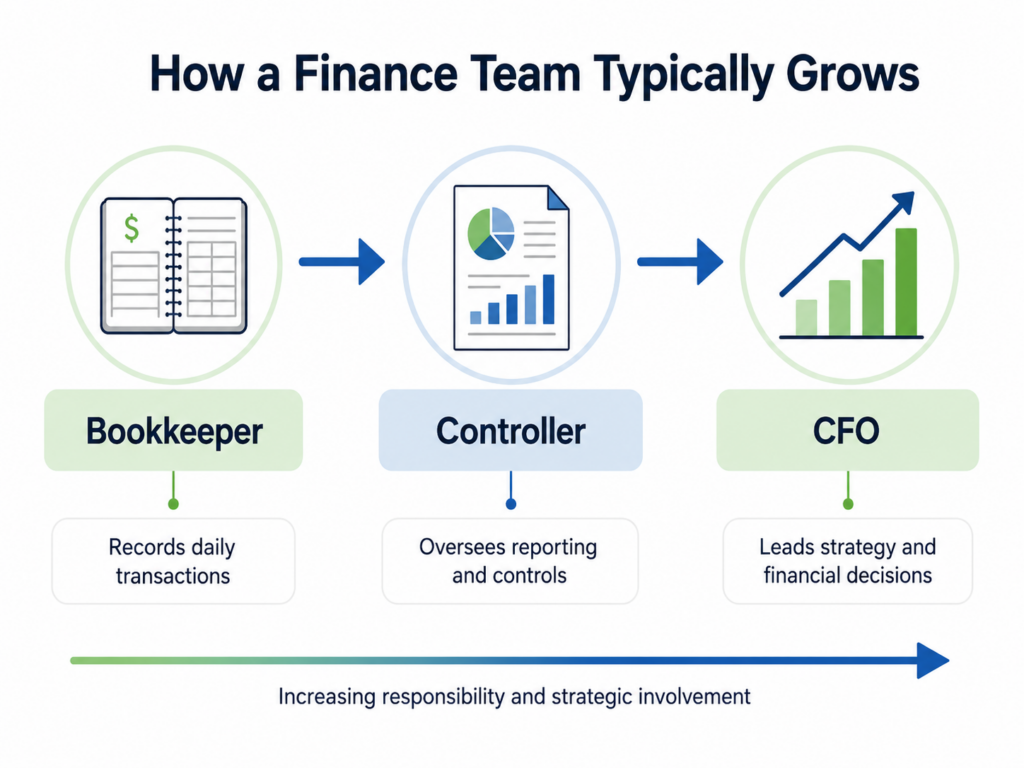
In practice, this shows up as an owner-operator or a single hire wearing both hats early on, then splitting the roles as complexity grows first by bringing in a controller to own accuracy, then adding CFO-level strategy once the business can use it.
What about a comptroller?
A comptroller is functionally similar to a controller but typically works in government or nonprofit organizations, while “controller” is the standard title in for-profit businesses. The core responsibilities — accuracy, compliance, internal controls — overlap heavily; the difference is mostly about sector and title convention rather than the substance of the work.
For a growth-stage private company, this distinction rarely matters day to day. It’s worth knowing mainly so the terms don’t get confused when researching the role.
When you need both
Most growing businesses eventually need both a controller and a CFO working together, with the controller ensuring the numbers are right and the CFO using them to drive decisions. Neither role replaces the other — a CFO without a controller is building on sand, and a controller without a CFO leaves real strategic value on the table.
Stan Alhadeff worked with one client, Amerigo Metal Recycling, through a partnership exactly like this over more than a decade, growing the company from $8 million to nearly $50 million in revenue with disciplined books underneath and strategic direction on top. According to SCORE, the SBA’s nationwide mentoring resource partner, the progression from bookkeeper to controller to CFO reflects a natural growth in financial complexity rather than a fixed timeline — which is exactly why the right sequence matters more than rushing to the bigger title. If you’re not sure which side of that line your business is on, our free discovery call includes a GAP Analysis that tells you plainly.
Getting the sequence right
The title that sounds more impressive isn’t always the one your business needs first. Getting the sequence right — controller before CFO, in almost every case — saves real money and avoids paying strategic rates for what’s actually an accuracy problem.
Book a free strategy call with Stan — it starts with the GAP Analysis, and it ends with a straight answer about which role, in which order, actually fits where your business stands today.
FAQ
What is the difference between a CFO and a controller? A controller is responsible for the accuracy of financial records, including the monthly close and internal controls. A CFO uses those numbers to guide strategy, forecasting, and growth decisions. One looks backward and present; the other looks forward.
Should I hire a CFO or a controller first? Hire a controller first in nearly every case, since a CFO’s strategic value depends on accurate numbers. An exception exists when a financing event or transaction is urgent enough that both need to happen in parallel.
Can a controller become a CFO? Yes, though the transition requires developing a different skill set — moving from accuracy-focused accounting work toward forward-looking financial strategy, forecasting, and stakeholder communication. Some controllers make this move over time; others stay specialized in the controller role by choice.
What is the difference between a controller and a comptroller? A comptroller performs largely the same function as a controller but typically works in government or nonprofit organizations, while “controller” is the standard title in for-profit businesses. The distinction is mostly about sector and title convention rather than the substance of the work.
Do small businesses need both a CFO and a controller? Not always, and rarely both at once early on. Most growing businesses start with a controller to establish accurate books, then add CFO-level strategy once the business generates enough financial complexity to use it.

Stan Alhadeff
Founder & Fractional CFO