Profit is what’s left after subtracting expenses from revenue, recorded when a sale is earned, not when cash actually changes hands. Cash flow is the real money moving in and out of your bank account, regardless of what your income statement says. A business can be genuinely profitable and still run out of cash, because these two numbers measure fundamentally different things.
That gap isn’t a rare accounting quirk. It’s one of the most common reasons growing businesses hit a real crisis while their P&L looks fine.
Key takeaways
- Profit is an accounting measure, recognized when revenue is earned under accrual accounting. Cash flow is the actual movement of money, recognized only when it lands in or leaves the bank.
- A profitable business can run out of cash when receivables grow faster than collections, when non-cash expenses like depreciation distort the P&L, or when growth itself consumes cash faster than the business earns it back.
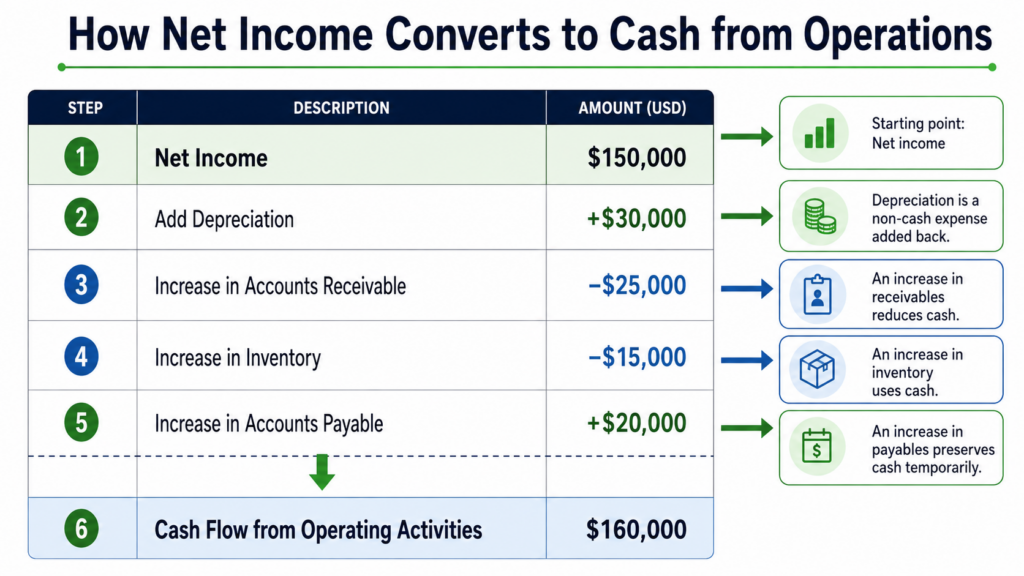
- Reconciling net income to actual cash from operations shows exactly where the gap comes from — it’s a specific, traceable set of adjustments, not a mystery.
- “Cash flow vs. profit” and “EBITDA vs. cash flow” sound similar but answer different questions — EBITDA is a specific adjusted metric used mostly in valuation and deal contexts, not the same as general profit.
- According to the Federal Reserve’s 2024 Small Business Credit Survey, 51% of small employer firms cited uneven cash flow as a financial challenge — this isn’t an edge case, it’s close to a coin flip.
What is profit?
Profit is the amount left over after subtracting a business’s expenses from its revenue, calculated under accrual accounting, which recognizes revenue when it’s earned rather than when cash is collected. A sale made today counts toward this month’s profit even if the customer doesn’t pay for 60 days.
That accrual timing is exactly why profit alone can’t tell you whether you can make payroll next week. For a deeper look at how profit is structured and read on your income statement, gross profit vs. operating profit vs. net profit and how to read a P&L cover that in full.
What is cash flow?
Cash flow is the actual money moving into and out of your business, tracked only when it’s physically received or paid, independent of when a sale was recorded on paper. A strong sales month doesn’t move your cash flow at all if the customer hasn’t paid yet.
For the full mechanics of how cash flow gets tracked and reported, how to read a cash flow statement walks through a complete worked example. The short version here: cash flow is what’s actually available to cover payroll, rent, and vendor bills, regardless of how healthy the P&L looks.
Why profit and cash flow diverge
Profit and cash flow diverge for three main reasons: receivables growing faster than collections, non-cash expenses distorting the income statement, and growth itself consuming cash before it comes back in. Any one of these can create a real gap; most growing businesses experience some combination of all three at once.
Receivables timing is the most common cause. A sale on 30- or 60-day terms shows up as profit immediately but doesn’t show up as cash for weeks or months. Non-cash expenses work in the opposite direction: depreciation reduces reported profit every month without any cash actually leaving the business that month, since the real cash outlay happened once, back when the asset was purchased. And growth consumes cash directly — hiring ahead of demand, buying inventory, and onboarding new customers all cost real money before the resulting revenue gets collected.
A worked example: reconciling profit to cash
Numbers make the mechanism concrete. Take a $4 million IT services and consulting firm with $320,000 in net income for the year.
| Line item | Amount | What it means |
| Net income | $320,000 | Healthy profit reported on the income statement |
| + Depreciation | $45,000 | Added back — a non-cash expense that reduced profit without using cash |
| − Increase in accounts receivable | ($180,000) | Customers are taking longer to pay as the business grows its client base |
| + Increase in accounts payable | $35,000 | Cash preserved by taking a bit longer to pay vendors |
| Cash from operations | $220,000 | The real cash the business actually generated |
A genuinely profitable year — $320,000 in net income — produces $220,000 in actual operating cash, a $100,000 gap driven almost entirely by growing receivables. Read only the income statement, and this business looks purely healthy. Read the reconciliation, and the real story shows up: growth is outpacing collections, and if that AR trend continues, the gap will keep widening even as reported profit stays strong.
Is this the same as EBITDA vs. cash flow?
Not quite, though the two questions are closely related and easy to conflate. “Cash flow vs. profit” compares cash flow to net income broadly — the bottom-line number on a standard income statement. “EBITDA vs. cash flow” compares cash flow to a more specific, adjusted metric — earnings before interest, taxes, depreciation, and amortization — which shows up most often in valuation, lending, and M&A conversations rather than everyday financial reporting.
If you’re evaluating your business’s day-to-day financial health, the comparison on this page is the one that matters. If you’re preparing for a sale, a valuation, or a lender conversation where EBITDA is the specific term being used, EBITDA vs. cash flow: why profitable businesses still run out of money covers that more specific comparison directly.
The warning signs your profit isn’t turning into cash
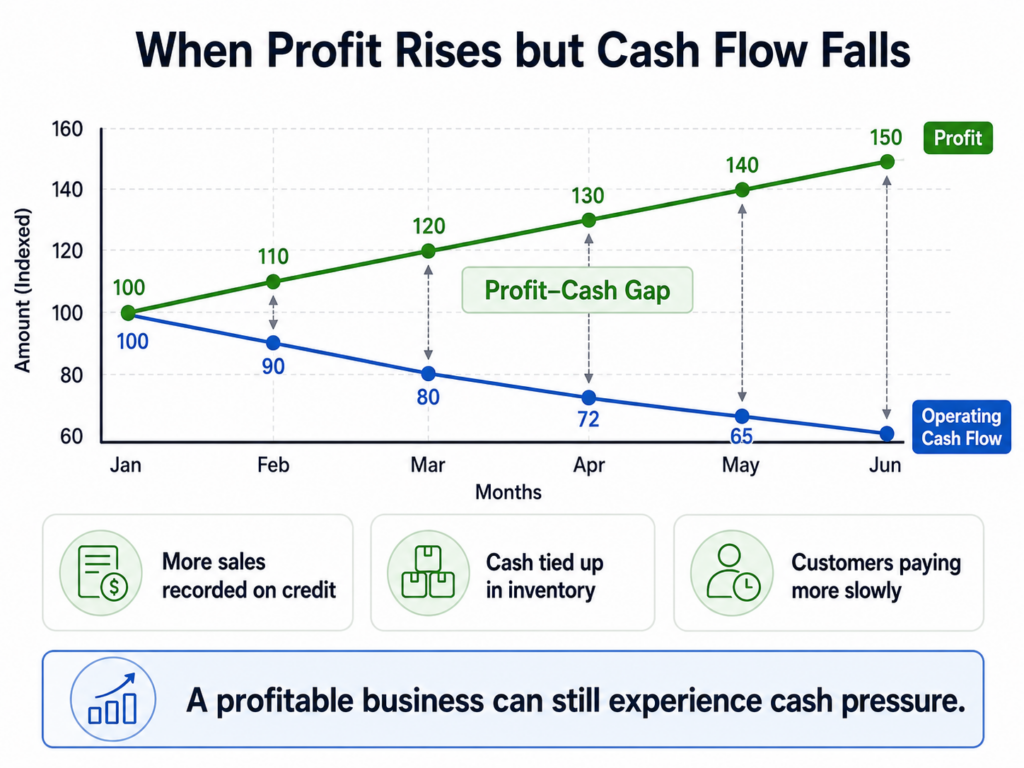
The clearest warning sign is a bank balance that isn’t growing, or is shrinking, in a period where the income statement shows solid profit — that gap should always get investigated, not shrugged off. A second sign is accounts receivable growing consistently faster than revenue, which means more of each sales dollar is sitting uncollected rather than turning into usable cash.
A third sign, and one that catches owners off guard, is relying on a rough sense of “we’re profitable, so we’re fine” instead of an actual cash flow forecast. In 30-plus years of CFO work, the pattern Stan Alhadeff sees most often is a business that discovers the profit-cash gap only when it’s already urgent — a payroll run that’s tighter than expected, a vendor payment that has to wait. The gap is almost always visible weeks in advance to anyone actually forecasting cash instead of just checking the P&L.
How to close the gap
Closing the gap starts with tightening the cash conversion cycle — collecting from customers faster, managing inventory leaner, and negotiating reasonable vendor terms — since that cycle is usually the biggest lever available. Beyond that, building a rolling cash flow forecast alongside the P&L, not instead of it, is what actually catches a widening gap before it becomes a crisis.
If you want a clear picture of where your own profit-to-cash gap stands, our free discovery call includes a GAP Analysis that walks through exactly this reconciliation for your business. Stan Alhadeff worked with one client, Amerigo Metal Recycling, through more than a decade of growth from $8 million to nearly $50 million in revenue — growth that stays fundable specifically because cash discipline kept pace with reported profit the whole way, not just for a year or two.
Reading both numbers, not just one

Profit tells you whether the business model works. Cash flow tells you whether you can survive the next 90 days. A business run on profit alone is flying with half the instruments off, and the businesses that get caught by this gap are almost never unprofitable — they’re growing, on paper doing everything right, and still running short on cash because nobody was watching the second number.
If you’d like a straight read on your own profit-to-cash gap, book a free strategy call with Stan — it starts with a real reconciliation of your numbers, not a generic explainer.
FAQ
What is the difference between cash flow and profit? Profit is an accounting measure recorded when revenue is earned, while cash flow is the actual movement of money in and out of the business, recorded only when cash changes hands. A business can show strong profit on paper while its cash flow tells a very different story.
Why can a profitable business run out of cash? A profitable business can run out of cash when receivables grow faster than collections, when non-cash expenses like depreciation distort the income statement, or when growth itself consumes cash before the resulting revenue is collected. Often it’s a combination of all three.
How do you convert net income to cash flow? Convert net income to cash flow by adding back non-cash expenses like depreciation, then subtracting increases in accounts receivable and inventory, and adding increases in accounts payable. The result is cash from operations — the real cash the business generated, distinct from reported profit.
What is the difference between cash flow vs. profit and EBITDA vs. cash flow? Cash flow vs. profit compares cash flow to net income broadly, while EBITDA vs. cash flow compares it to a more specific adjusted metric used mostly in valuation and lending contexts. The underlying timing issue is similar, but EBITDA strips out additional items like interest, taxes, and depreciation that regular net income includes.
How do you know if your cash flow problem is a profit problem? If your income statement shows a loss, that’s a profit problem — the business isn’t earning enough. If your income statement shows solid profit but your bank balance still isn’t growing, that’s a cash flow timing problem, usually tied to receivables, inventory, or growth outpacing collections.

Stan Alhadeff
Founder & Fractional CFO