A cash flow forecast is a projection of cash moving into and out of your business over a set period, typically broken into weekly or monthly buckets over a 12-month horizon. It tells you whether you’ll have enough cash on hand to cover payroll, pay vendors, and fund growth before a shortfall shows up in your bank account. Build one right, and it becomes the single most useful document in your business. Skip it, and you’re checking the balance and hoping.
Key takeaways
- A cash flow forecast tracks the timing of cash, not the timing of revenue. That distinction is why profitable companies still run out of money.
- Most SMB forecasts fail for one reason: they get built once and never touched again. A forecast only earns its keep if you check it against actuals.
- The direct method (actual cash in, actual cash out) works best for short-term, tactical forecasting. The indirect method (starting from net income) works better for longer strategic planning.
- A rolling 13-week forecast paired with a 12-month view gives you the tactical and strategic picture at the same time.
- According to the Federal Reserve’s 2024 Small Business Credit Survey, 51% of small employer firms cited uneven cash flow as a financial challenge in the prior year — this isn’t a rare problem; it’s close to a coin flip.
What is a cash flow forecast?
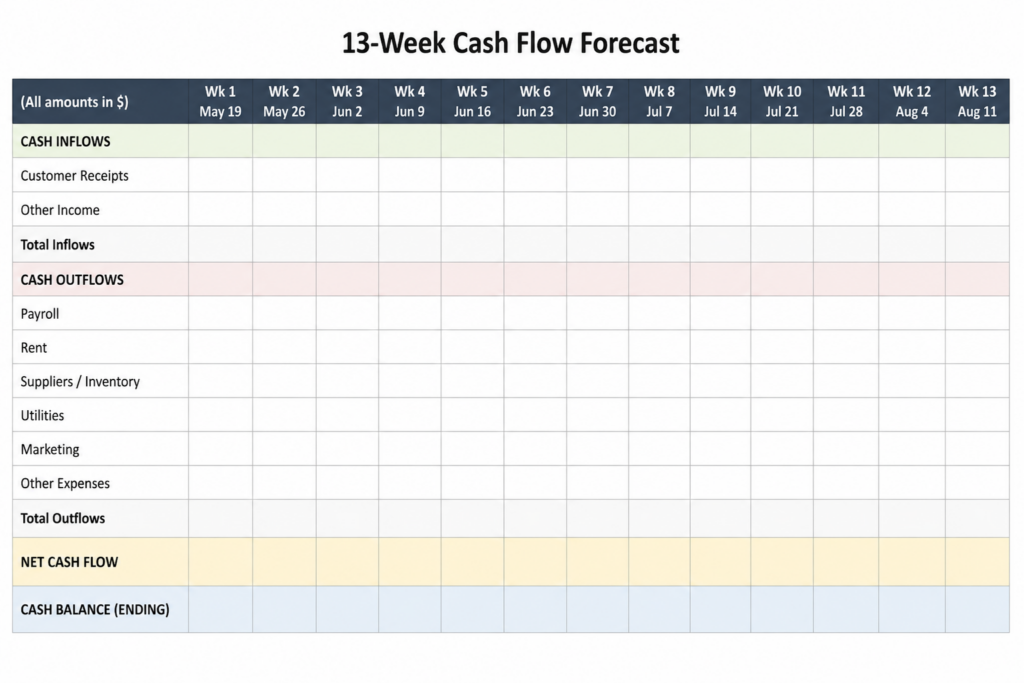
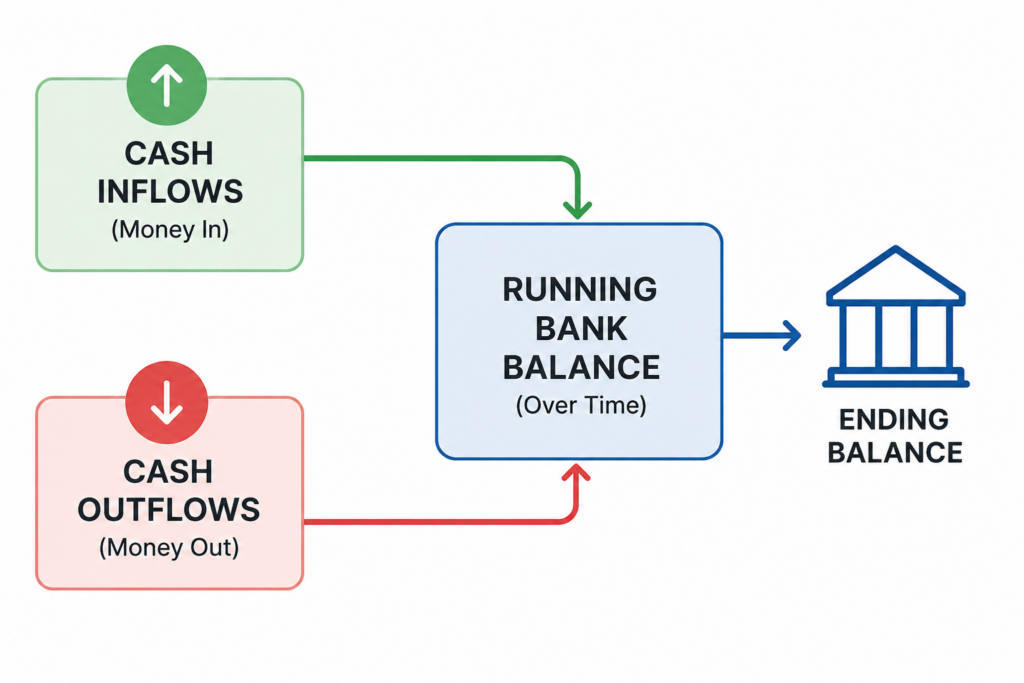
A cash flow forecast is an estimate of the cash your business expects to receive and pay out over a future period, structured to show your running bank balance at each point along the way. It’s forward-looking, built from assumptions about when customers will actually pay and when bills will actually clear, not from your income statement’s accrual entries.
That last part trips up more owners than anything else. A profit and loss statement can show a healthy month even while your bank account is bleeding out, because P&L timing follows accounting rules and cash timing follows when money physically moves. A cash flow forecast is different from a budget: a budget is a plan for how you intend to spend; a forecast predicts when money will actually land in and leave your account, regardless of what you planned. It’s also different from a cash flow statement, which looks backward at what already happened. The forecast is the only one of the three that tells you what’s coming.
Why a cash flow forecast matters more than your P&L
Here’s the plain version: a business can be profitable on paper and still miss payroll. If a customer pays on net-30 terms, January’s invoice becomes February’s cash. Meanwhile, rent, wages, and vendor bills don’t wait for your receivables to catch up. That timing gap is where growing companies get into trouble, and it’s rarely visible until it’s urgent.
According to SCORE, a resource partner of the U.S. Small Business Administration, 82% of small businesses that fail point to cash flow problems as a contributing cause. That figure gets repeated so often it’s easy to tune out, but the mechanism behind it is worth sitting with: it’s rarely a lack of sales. It’s a timing mismatch nobody caught early enough to fix.
In 30-plus years of CFO work, the pattern Stan Alhadeff sees most often is an owner who’s watching revenue climb and assuming cash is climbing with it. It isn’t, not automatically. One client, Amerigo Metal Recycling, grew from $8 million to nearly $50 million in revenue over more than a decade under Stan’s guidance — growth at that pace doesn’t survive on hope. It survives on a forecast that gets checked against actuals every week, adjusted, and trusted enough to drive real decisions: when to hire, when to draw on a credit line, when to hold off on a purchase order. Clients working this way have identified more than 20% in cost savings within the first year of a real forecasting discipline, and in at least one case, an accurate, well-documented forecast helped secure $1.5 million in alternative funding that a lender wouldn’t have extended without the numbers to back it up.
Direct vs. indirect cash flow forecasting: which method should you use?
The direct method builds your forecast from actual expected cash receipts and payments — money in from customers, money out for payroll and vendors. The indirect method starts with net income from your P&L and adjusts for non-cash items like depreciation and changes in receivables and payables. Most growing businesses need both, at different time horizons.
| Direct method | Indirect method | |
| Starting point | Actual cash receipts and payments | Net income, adjusted for non-cash items |
| Best for | Short-term, weekly, or 13-week forecasts | Longer-range 12-month+ strategic planning |
| Data needed | Bank transactions, AR/AP aging, payroll calendar | Income statement, balance sheet, depreciation schedule |
| Strength | High precision on near-term cash position | Ties naturally to your existing financial statements |
| Weakness | Labor-intensive to maintain weekly | Less precise on exact week-to-week timing |
If you only build one forecast, build the direct-method version. It’s the one that actually catches a cash gap before it hits.
How to create a cash flow forecast in 7 steps
Step 1: Choose your forecast period and cadence
Pick a 13-week rolling forecast for tactical decisions, a 12-month forecast for strategic ones, or both. A 13-week forecast, updated weekly, is the standard tool CFOs reach for when cash is tight, or growth is fast — it’s granular enough to catch a gap 30 to 60 days out, which is usually enough runway to fix it. A 12-month forecast, updated monthly, is what a bank or investor will want to see. Most growing companies need both running side by side.
Step 2: Set your starting cash position
Pull your actual bank balance today, across every operating account, not a projected or expected number. This is your opening balance for period one, and every subsequent number in the forecast builds off of it. If you’re combining multiple accounts, add them together and treat the sum as your true starting liquidity.
Step 3: Project cash inflows by when they’ll actually arrive
List every expected source of cash — customer payments, contract renewals, loan proceeds, asset sales — and place each one in the week or month you actually expect the money to clear, not the week you invoice it. If your customers typically pay in 30 days, a sale made in March becomes April’s cash. This single adjustment is what separates a forecast from a wish list.
Step 4: Project cash outflows, separated by fixed and variable
Fixed costs — rent, base payroll, loan payments, insurance — happen whether or not you make a sale, so they’re the easiest to forecast accurately. Variable costs — materials, commissions, seasonal labor — move with revenue and need to be tied to your sales assumptions, not guessed independently. Don’t forget the irregular ones: annual insurance renewals, quarterly tax payments, equipment purchases. These are the line items that blow up an otherwise solid forecast because they only show up once or twice a year and are easy to forget until the bill lands.
Step 5: Calculate net cash flow and your running balance
For each period, subtract total outflows from total inflows to get net cash flow, then add that to your opening balance to get your closing balance — which becomes next period’s opening balance. This running total is the entire point of the exercise. A single negative month isn’t necessarily a crisis; a string of them, or one deep enough to go negative, is your early warning.
Step 6: Stress-test with a best-case and worst-case scenario
Build a conservative version where a major customer pays late or a big order slips, and an optimistic version where a new contract closes early. This isn’t busywork. It shows you how much room you actually have and where the real pressure points sit, so a surprise doesn’t become a scramble.
Step 7: Track actuals and update the forecast on a rolling basis
Every week (for the 13-week model) or every month (for the 12-month model), replace your projections with what actually happened, then extend the forecast forward to keep the same window. A forecast built in January and never touched again is fiction by March. This step is the one owners skip most often, and it’s the one that makes everything else worth doing.
A worked example: a $6M HVAC company’s three-month cash flow forecast
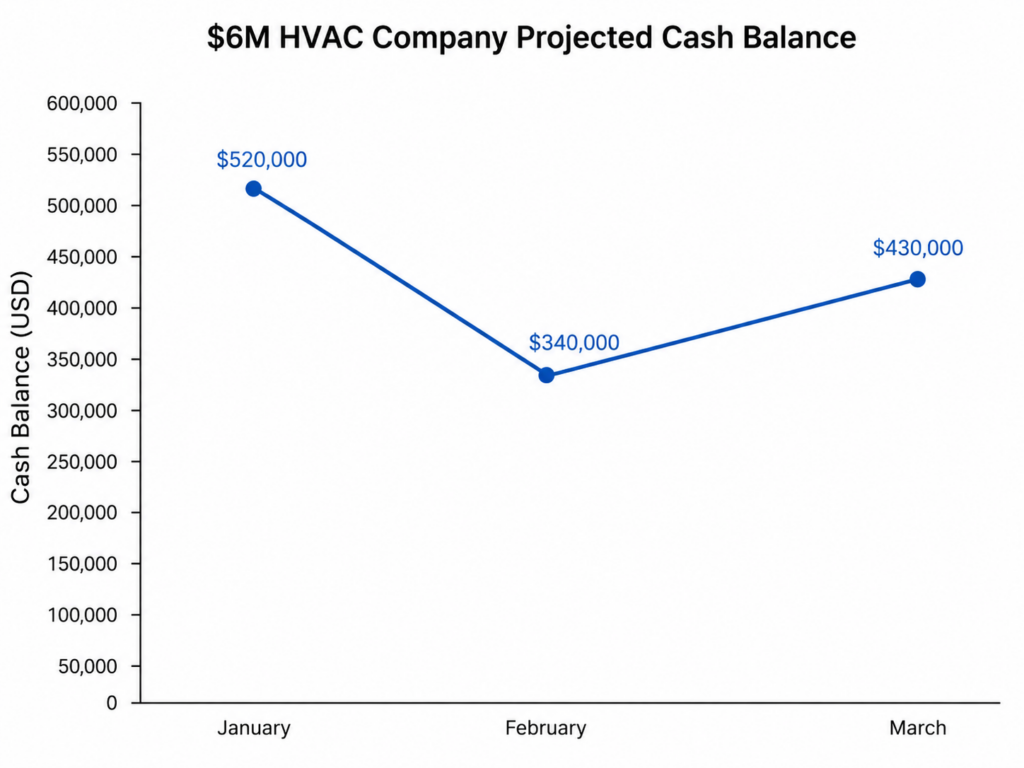
Numbers make this real. Take a $6 million HVAC company carrying $85,000 in cash going into the new year. Winter is its slow season for installations, but payroll, rent, and an annual insurance renewal don’t slow down with it.
| January | February | March | |
| Opening balance | $85,000 | $85,000 | $20,000 |
| Cash inflows (customer payments + service contracts) | $435,000 | $310,000 | $460,000 |
| Cash outflows (payroll, materials, rent, loan payment, insurance, vendors) | $435,000 | $425,000 | $410,000 |
| Net cash flow | $0 | -$115,000 | $50,000 |
| Line of credit draw | — | $50,000 | — |
| Closing balance | $85,000 | $20,000 | $70,000 |
Without the forecast, February looks fine right up until it isn’t: a $115,000 net cash outflow against an $85,000 opening balance puts the account $30,000 in the red the week the annual insurance premium and a soft collections month collide. Because the forecast surfaced that gap 60 days out, the owner arranged a $50,000 draw on an existing line of credit ahead of time, at a rate they’d already negotiated, instead of scrambling for emergency financing at whatever terms a lender would offer under pressure. That’s the entire value of forecasting in one table: the problem gets solved on the owner’s schedule, not the bank’s.
If you want a second set of eyes on your own numbers before you take them to a lender or investor, our free discovery call includes a GAP Analysis that shows exactly where the forecast needs work, with no obligation attached.
The cash flow forecasting mistakes that sink growing businesses
Most forecasts fail for a small number of repeatable reasons.
- Recording revenue when it’s invoiced, not when it’s collected. On net-30 or net-60 terms, this makes the forecast look healthier than reality and hides the exact gap it exists to catch.
- Building it once and never updating it. A forecast that isn’t checked against actuals every week or month stops being a forecast and becomes a guess with a spreadsheet attached.
- Forgetting the irregular expenses. Annual insurance, quarterly estimated taxes, equipment repairs, and one-off capital purchases don’t show up every month, so they’re the line items owners consistently leave out.
- Being optimistic on collection timing. If a customer has paid late twice, assume they’ll do it again. Conservative estimates protect you; optimistic ones just delay the surprise.
When a spreadsheet is still fine, and when it isn’t
A simple monthly spreadsheet is genuinely enough for a lot of businesses: single-location, predictable receivables, one owner who checks the numbers weekly and has the time to keep it current. If that’s you, don’t overbuild this. A clean direct-method template, maintained honestly, will serve you well.
It stops being enough once the business gets complicated in ways a spreadsheet can’t easily absorb: multiple entities or locations, a fundraise or bank financing in progress, seasonal swings large enough to threaten payroll, or an owner who simply doesn’t have four hours a month to keep the model honest. At that point, the forecast usually needs someone who owns it daily. A fractional controller keeps the books and the forecast tied together in real time, while a fractional CFO uses that forecast to drive the bigger calls — when to hire, when to finance, when to hold. Retainers for fractional CFO work typically run $3,000 to $10,000 a month industry-wide, against a fully burdened full-time CFO salary of $300,000 to $450,000 a year — a gap wide enough that most growth-stage companies never need to make that hire directly.
How often should you update your cash flow forecast?
Update a 13-week forecast weekly and a 12-month forecast monthly, replacing projections with actual results each time and extending the window forward to maintain the same length. Businesses with tight cash or fast growth should lean toward weekly review regardless of which model they’re running. A forecast that isn’t updated against reality within 30 days of being built has already stopped being useful.
Beyond the routine cadence, rebuild the underlying assumptions any time something structural changes: a new major customer, a new location, a pricing change, or a shift in payment terms with a key vendor or client. Small, regular updates keep the numbers honest. A full rebuild keeps the model relevant.
Turning the forecast into a habit, not a project
A cash flow forecast only pays off if it becomes something you actually look at, not a document that gets built in January and reopened at tax time. Put a recurring 20 minutes on the calendar each week to check actuals against the model, and treat a widening gap between the two as the signal it is. That habit, more than any spreadsheet formula, is what separates businesses that see a cash crunch coming from those that get caught by surprise.
For more on building the financial infrastructure for a growing company, our Knowledge Center has additional guides on the reporting and planning tools that pair with forecasting. And if you’d rather have a CFO build and run this with you than build it alone, book a free strategy call with Stan — it starts with a straight look at where your numbers stand today.
FAQ
What is a cash flow forecast? A cash flow forecast is a projection of the cash your business expects to receive and pay out over a future period, showing your running bank balance along the way. It’s built from when money actually moves, not from accounting entries, which is why it can flag a shortfall your P&L won’t show.
How do you create a cash flow forecast? You create a cash flow forecast by setting your current cash balance, projecting inflows and outflows by the date they’ll actually clear, calculating net cash flow for each period, and updating it against actuals on a regular schedule. The seven-step process above walks through each part in detail.
What’s the difference between a cash flow forecast and a cash flow statement? A cash flow forecast looks forward and predicts your future cash position; a cash flow statement looks backward and reports what already happened. Both matter, but only the forecast tells you what’s coming before it arrives.
What’s the difference between a cash flow forecast and a budget? A budget is a plan for how you intend to spend money; a cash flow forecast predicts when money will actually land in and leave your bank account, regardless of what was planned. A business can be on budget and still run short on cash if collections slow down.
What’s the difference between direct and indirect cash flow forecasting? The direct method forecasts actual expected cash receipts and payments, while the indirect method starts from net income and adjusts for non-cash items. The direct method suits short-term, weekly forecasts; the indirect method suits longer 12-month strategic planning.
What is a 13-week cash flow forecast? A 13-week cash flow forecast is a rolling, weekly-updated projection covering roughly one financial quarter, used to catch a cash gap 30 to 60 days before it happens. It’s the standard tool CFOs use when cash is tight or growth is outpacing collections.
How far ahead should a cash flow forecast go? Most growing businesses run a 12-month forecast for strategic planning and a rolling 13-week forecast for tactical, week-to-week decisions. Which one you lean on more depends on how predictable your cash position already is.

Founder & Fractional CFO
Business CFO for Hire
Author of Run the Business, Don’t Become It