The cash conversion cycle (CCC) measures how many days it takes your business to turn cash spent on inventory into cash collected from customers. The formula is CCC = DIO + DSO − DPO, where DIO is days inventory outstanding, DSO is days sales outstanding, and DPO is days payable outstanding. A shorter cycle means less of your cash is tied up along the way.
Most guides to this metric stop at the formula and a generic example. This one covers that, plus what it actually takes to shorten your own number without breaking something else in the process.
Key takeaways
- Cash conversion cycle = Days Inventory Outstanding + Days Sales Outstanding − Days Payable Outstanding, measured in days.
- A lower CCC means less cash tied up in the gap between paying suppliers and collecting from customers. A negative CCC means customers effectively fund your inventory before you have to pay for it.
- The “good” number is industry-specific; a construction or manufacturing business will structurally run a longer cycle than a software or professional services business, and comparing across industries isn’t useful.
- The three levers that shorten CCC faster collections, leaner inventory, longer payment terms — each carry a real trade-off if pushed too hard.
- In 30-plus years of CFO work, the pattern Stan Alhadeff sees most often is an owner chasing the number itself instead of the actual cash it frees up, and damaging a good supplier relationship in the process.
What is the cash conversion cycle?
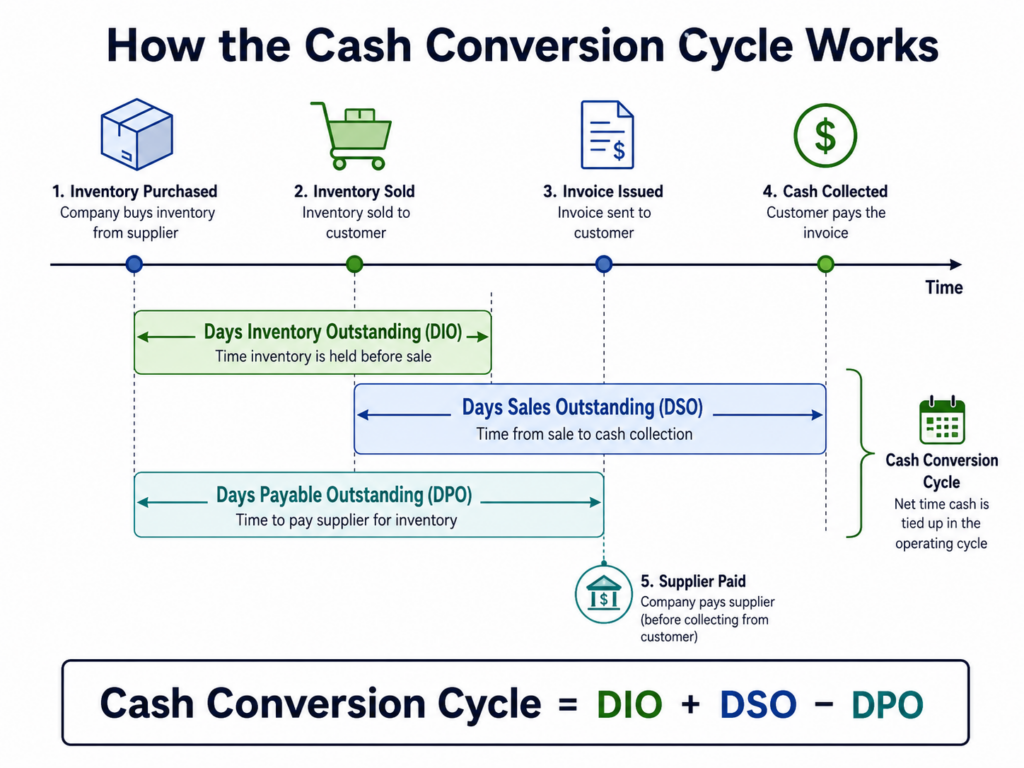
The cash conversion cycle is the number of days between when your business pays cash for inventory and when it collects cash from selling that inventory to a customer. It’s a single number that captures how efficiently your working capital moves, combining three separate timing gaps into one metric.
A shorter cycle means your cash comes back faster, which means less of it sits tied up in inventory and unpaid invoices at any given moment. That freed-up cash is real; it can fund growth, reduce how much you need to borrow, or simply give the business more breathing room.
Cash conversion cycle formula
The cash conversion cycle formula is CCC = DIO + DSO − DPO. Each of the three components measures a different timing gap, and calculating CCC means calculating all three first.
Days Inventory Outstanding (DIO) measures how long inventory sits before it sells: DIO = (Average Inventory ÷ Cost of Goods Sold) × 365. Days Sales Outstanding (DSO) measures how long it takes to collect cash after a sale: DSO = (Average Accounts Receivable ÷ Revenue) × 365. Days Payable Outstanding (DPO) measures how long your business takes to pay its own suppliers: DPO = (Average Accounts Payable ÷ Cost of Goods Sold) × 365. Add DIO and DSO, subtract DPO, and the result is your cash conversion cycle in days.
A worked example
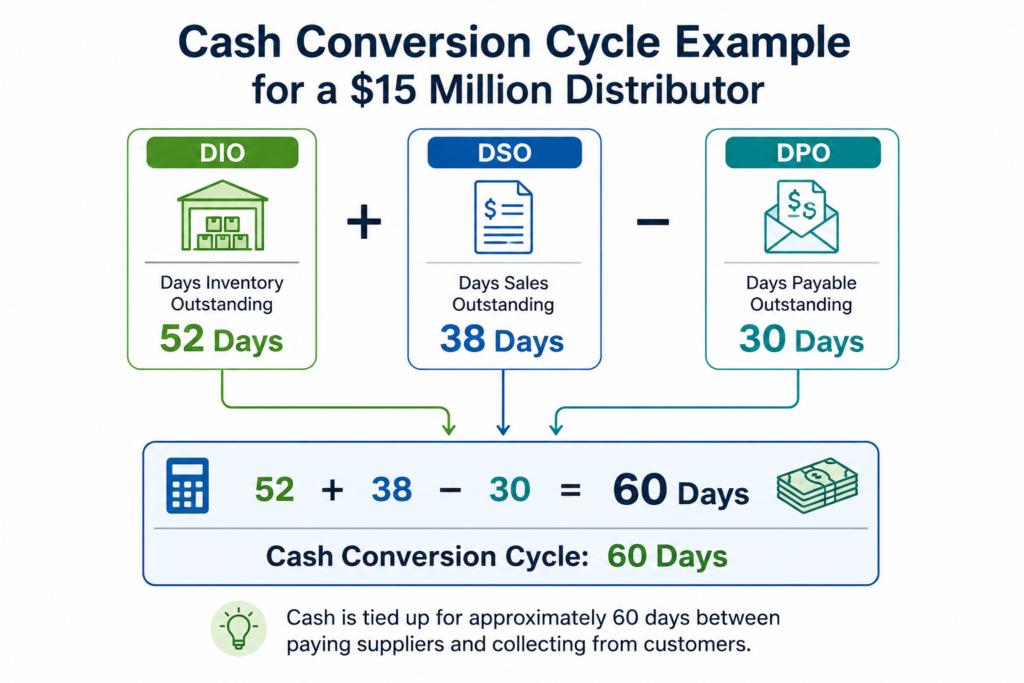
Take a $15 million industrial parts distributor with $10.5 million in cost of goods sold, $1.85 million in average accounts receivable, $2.1 million in average inventory, and $950,000 in average accounts payable.
DSO = ($1,850,000 ÷ $15,000,000) × 365 = 45 days DIO = ($2,100,000 ÷ $10,500,000) × 365 = 73 days DPO = ($950,000 ÷ $10,500,000) × 365 = 33 days
CCC = 45 + 73 − 33 = 85 days
That means roughly 85 days pass, on average, between the cash going out for inventory and the cash coming back in from a sale. For a $15 million business, that gap represents real, meaningful money sitting outside the bank account at any given time — money that either came from the business’s own cash reserves or from borrowing to cover it.
Cash conversion cycle benchmarks by industry
There’s no universal “good” cash conversion cycle — the right benchmark depends entirely on the industry, because businesses with heavy inventory naturally run longer cycles than businesses without it. Using working-capital data from NYU Stern’s Damodaran dataset (January 2026), here’s how several industries compare, converted to an approximate day count using each balance-sheet item as a share of sales:
| Industry | Approx. CCC (days) | What drives it |
| Construction supplies | ~87 | Meaningful inventory investment, moderate collection periods |
| Machinery/equipment manufacturing | ~94 | Long inventory cycles from production lead times |
| Distribution/wholesale | ~69 | Inventory-heavy, partially offset by supplier terms |
| IT/computer services | ~44 | Light inventory, offset somewhat by slower collections |
| Professional / business services | ~48 | No inventory, but collections still take real time |
| Software (SaaS) | ~33 | Minimal inventory, the shortest cycle of the group |
| Trucking/transportation | ~29 | No inventory to speak of, fast-turning receivables |
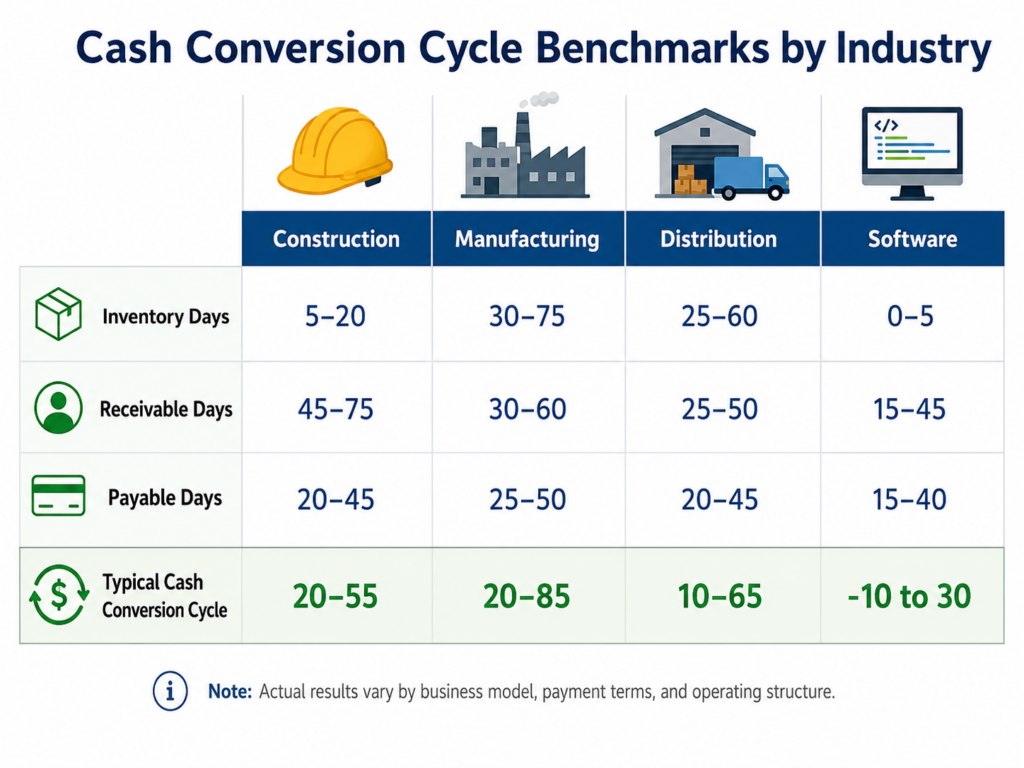
Figures are directional approximations based on sector-level public-company data (Damodaran, NYU Stern, January 2026), using sales-based ratios as a proxy where COGS-based figures weren’t available in the published dataset. Private company benchmarks can differ; use these to understand relative industry patterns, not as a precise target.
The pattern is clear even before you get to exact numbers: businesses carrying real inventory — construction, manufacturing, distribution — structurally run longer cycles than service-based or software businesses, and that’s normal, not a red flag on its own.
What a good — or bad — cash conversion cycle actually means
A good cash conversion cycle is one that’s improving over time and sits in line with or better than your specific industry, not an arbitrary number pulled from a different sector. Comparing a distribution company’s 69-day cycle to a SaaS company’s 33-day cycle tells you nothing useful; comparing this year’s cycle to last year’s, in the same business, tells you a great deal.
A negative CCC where DPO exceeds DIO plus DSO means customers are effectively funding your inventory before you have to pay your own suppliers. It’s rare outside of a few business models (some large retailers manage it), and it’s not something most growth-stage businesses should chase as a goal in itself. What matters more is the trend: a cycle getting shorter, quarter over quarter, means cash is freeing up. One getting longer, even if the absolute number still looks fine against industry peers, deserves a closer look before it becomes a real cash flow problem the same kind of gap a cash flow forecast is built to catch early.
How to shorten your cash conversion cycle
Shortening your CCC means working one or more of the three levers: collect from customers faster, hold less inventory, or pay suppliers on a longer schedule. Each lever has real, practical tactics behind it, and the strongest results usually come from working more than one at a time.
To shorten DSO, invoice immediately rather than batching, tighten payment terms, and follow up on overdue accounts before they become a pattern rather than after. To shorten DIO, forecast demand more accurately so cash isn’t tied up in stock nobody’s buying yet, and clear out slow-moving inventory rather than letting it quietly accumulate. To lengthen DPO, negotiate longer payment terms with key vendors but do the math on any early-payment discount first, since a 2%-net-10 discount is often worth more than the extra float from waiting the full 30 days.
When a shorter CCC isn’t actually the goal
A shorter cash conversion cycle isn’t automatically better if getting there damages something else that matters more. Squeezing DPO past what a vendor relationship can comfortably absorb risks losing priority treatment, favorable pricing, or the relationship itself, right when you need it most. Cutting DIO too aggressively risks stockouts that cost far more in lost sales and frustrated customers than the working capital saved.
In 30-plus years of CFO work, the pattern Stan Alhadeff sees most often is an owner fixated on the CCC number itself rather than the actual cash it frees up, stretching a good supplier relationship past the point where it’s still a good relationship, to shave a few days off a metric nobody outside the finance function is even looking at. The goal isn’t the shortest possible number. It’s freeing up real cash without breaking the operational relationships the business depends on. If you want a second set of eyes on where your own working capital is actually tied up, our free discovery call includes a GAP Analysis that shows you plainly.
Turning the number into cash
The cash conversion cycle is only useful once it changes a real decision: whether to tighten collections, whether to carry less inventory, whether a vendor conversation about terms is overdue. Stan Alhadeff worked with one client, Amerigo Metal Recycling, through more than a decade of exactly this kind of working-capital discipline while the company grew from $8 million to nearly $50 million in revenue growth that stays funded partly because cash doesn’t sit trapped longer than it needs to.
If you’d like a straight read on where your own cycle stands and what it would actually take to shorten it, book a free strategy call with Stan. It starts with the GAP Analysis, and it ends with real numbers, not a generic benchmark.
FAQ
What is the cash conversion cycle? The cash conversion cycle measures the number of days between when a business pays cash for inventory and when it collects cash from selling that inventory. A shorter cycle means less cash is tied up along the way.
What is the formula for cash conversion cycle? The cash conversion cycle formula is CCC = DIO + DSO − DPO, where DIO is days inventory outstanding, DSO is days sales outstanding, and DPO is days payable outstanding. Each component is calculated separately before combining them into the final figure.
What is a good cash conversion cycle? A good cash conversion cycle depends entirely on the industry; inventory-heavy businesses like construction or manufacturing naturally run longer cycles than service or software businesses. The most useful benchmark is your own trend over time, not a number from a different industry.
How do you shorten a cash conversion cycle? Shortening a cash conversion cycle means working one or more of three levers: collecting from customers faster, holding less inventory, or negotiating longer payment terms with suppliers. Each lever carries a real trade-off if pushed too aggressively.
What does a negative cash conversion cycle mean? A negative cash conversion cycle means a business pays its suppliers after it has already collected cash from customers, effectively letting customers fund the inventory. It’s uncommon outside a handful of business models and isn’t a realistic goal for most growth-stage businesses.

Stan Alhadeff
Founder & Fractional CFO