A 13-week cash flow forecast is a short-term liquidity model that projects your actual cash receipts and payments week by week, over a rolling 13-week window — roughly one fiscal quarter. It uses the direct method, tracking real cash movement rather than the accrual-based revenue and expenses on your income statement, which makes it the clearest early-warning system most businesses have for a coming cash shortfall.
Below is the full breakdown — what it is, why 13 weeks specifically, and a free downloadable template already built with the same worked example used in this guide.
Key takeaways
- A 13-week cash flow forecast projects actual weekly cash receipts and payments over a rolling quarter, using the direct method rather than accrual accounting.
- The 13-week window balances two things: weekly buckets are granular enough to catch a payroll-week crunch, and 13 weeks is long enough to plan around a debt paydown, a vendor renegotiation, or a financing conversation.
- The model has three core sections: cash inflows, cash outflows, and the resulting net cash flow that rolls into each week’s ending balance.
- Weeks 1–4 should be genuinely precise. Weeks 9–13 will be rougher, and that’s normal — the far weeks exist to catch a shortfall early, not to predict it exactly.
- In 30-plus years of CFO work, the pattern Stan Alhadeff sees most often is a business that builds the model, updates it faithfully, and still gets surprised — because nobody had a plan for what to actually do the moment it flagged a problem.
What is a 13-week cash flow forecast?
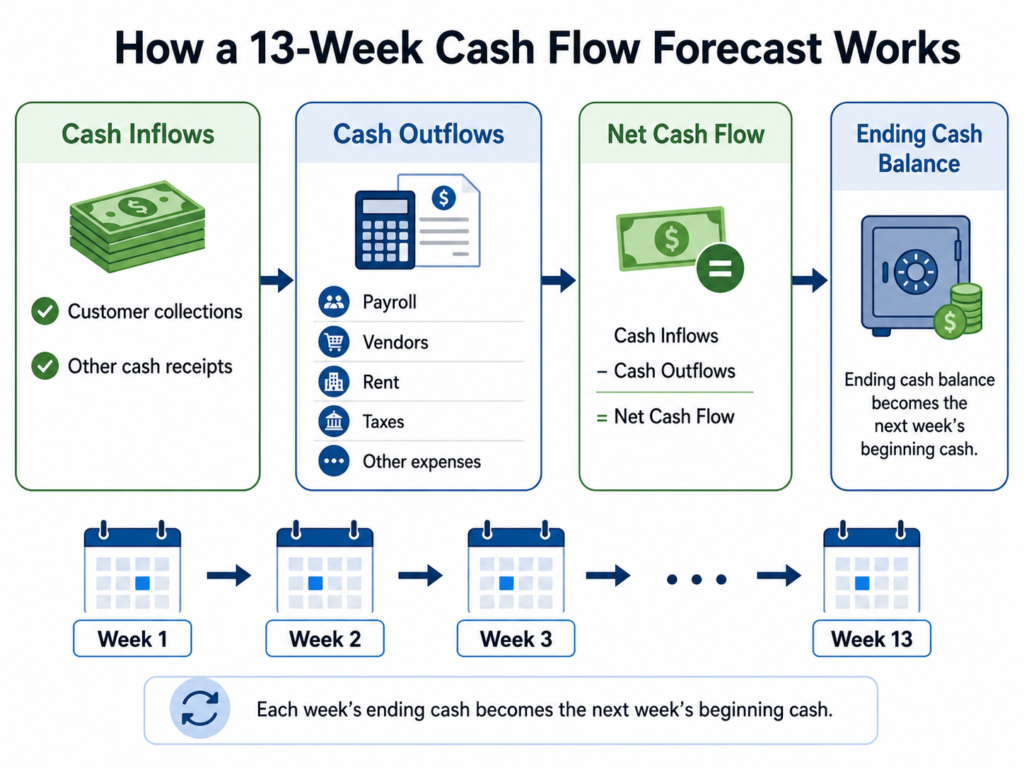
A 13-week cash flow forecast is a rolling model that projects a business’s actual cash inflows and outflows week by week over the next quarter, built on the direct method — real cash receipts and disbursements, not the revenue and expense figures on an income statement. It’s “rolling” because a new week gets added as each week passes, so the forecast always looks 13 weeks ahead rather than counting down to a fixed end date.
That distinction from a budget matters. A budget is a plan built once and measured against for a year. A 13-week cash flow forecast is a living tool, rebuilt weekly against real numbers, designed to answer one specific question: given what’s actually in the bank and what’s actually coming in and going out, will there be enough cash to operate for the next quarter?
Why 13 weeks specifically?
Thirteen weeks is the standard window because it balances granularity against planning horizon — weekly buckets are detailed enough to catch a tight payroll week, and a full quarter is long enough to actually plan around what the model shows you. A shorter window catches problems too late to act on them; a longer one loses the weekly precision that makes the tool useful in the first place.
A quarter also happens to match how most financing conversations actually work. A debt paydown, a vendor term renegotiation, or a bank line-of-credit conversation all need real lead time — 13 weeks gives you enough runway to see a shortfall coming and actually do something about it, rather than discovering it the week it happens.
The three sections of a 13-week cash flow model
Every 13-week model breaks into three sections: cash inflows, cash outflows, and the net cash flow that determines how each week’s ending balance carries into the next. Each section answers a different piece of the same question.
Cash inflows capture what’s actually landing in the bank — customer collections and any other cash deposits, tracked by the week they’re expected, not the week the sale was recorded. Cash outflows capture every real cash payment — payroll, vendor payments, rent, debt service, taxes, and anything else leaving the account. Net cash flow is simply inflows minus outflows for that week, and it rolls forward: this week’s ending balance becomes next week’s beginning balance, which is what makes the whole model a genuine rolling forecast instead of 13 disconnected snapshots.
A worked example: reading the model
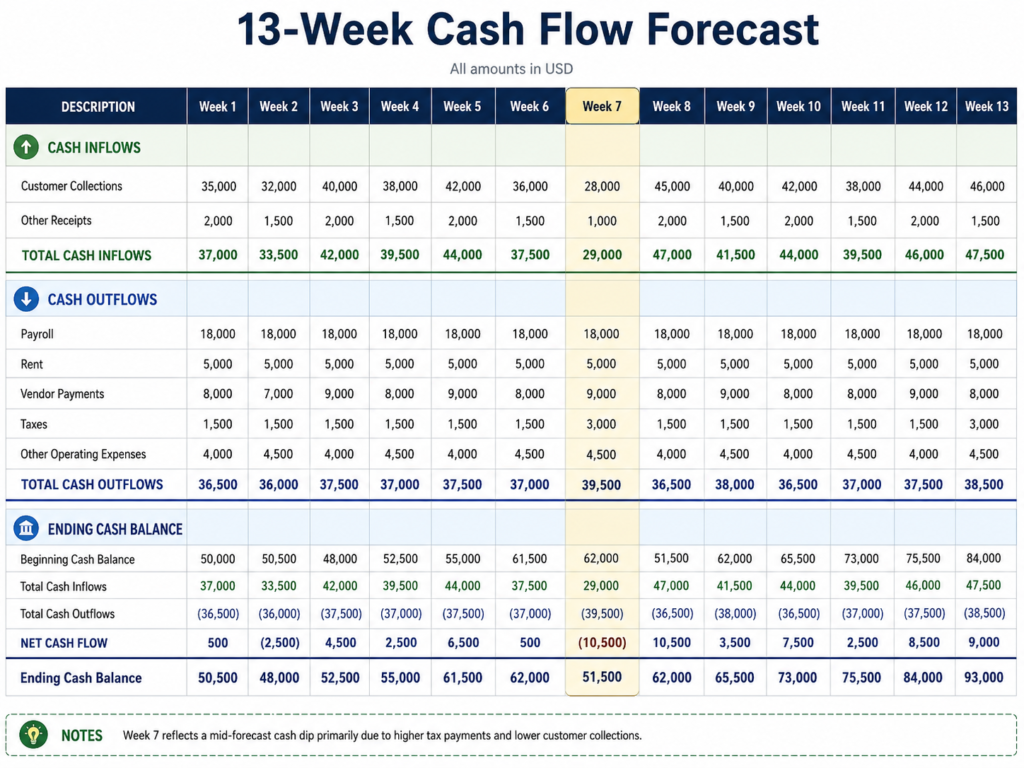
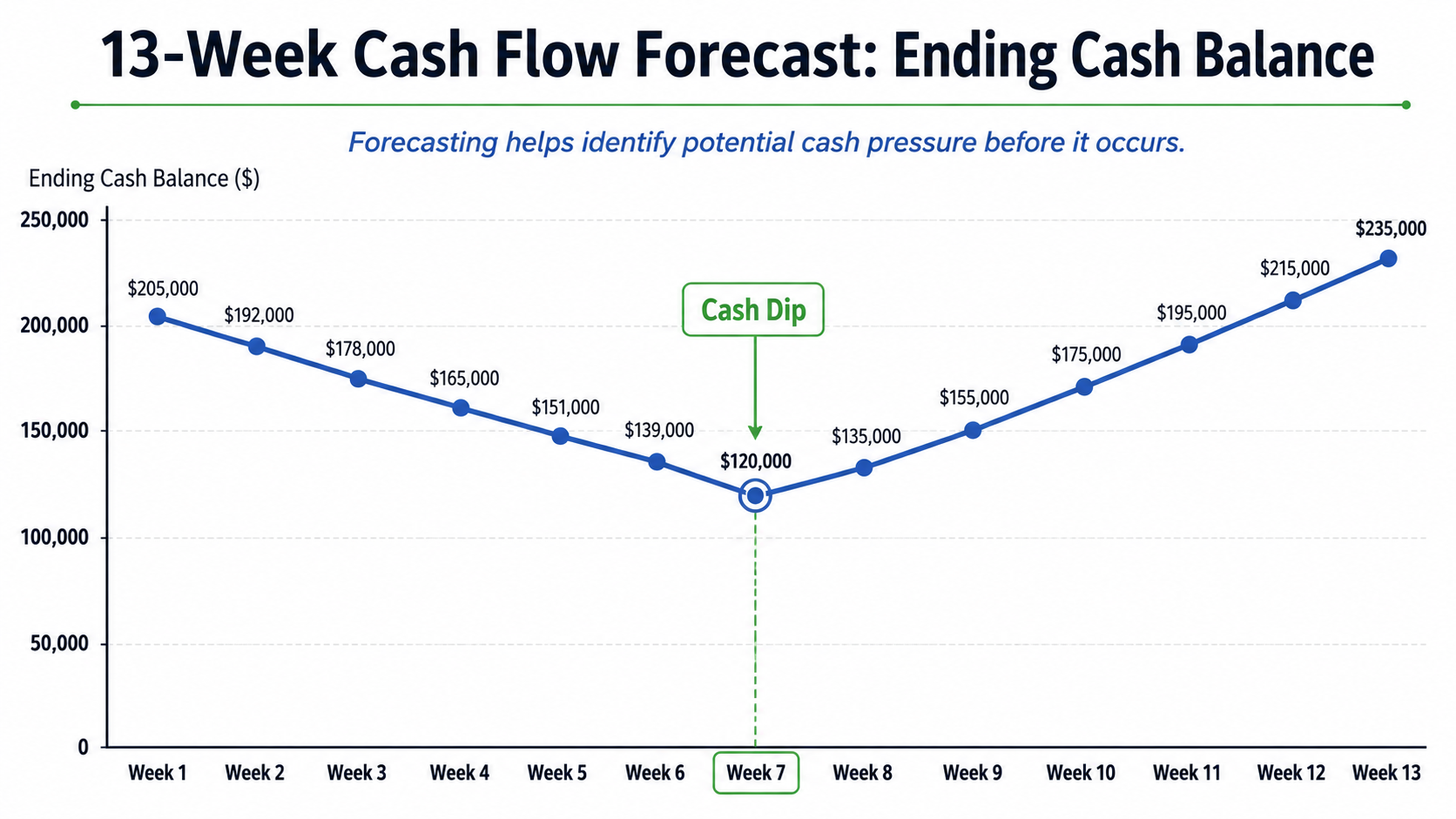
The downloadable template includes a full worked example so you can see the mechanics before you touch your own numbers. Take a business starting Week 1 with a $180,000 cash balance, generating roughly $190,000–$220,000 a week in collections against payroll, vendor payments, rent, and debt service.
For twelve of the thirteen weeks, the business runs solidly cash-positive, building its balance steadily. Then Week 7 shows a real dip: a large, one-time equipment purchase pushes that week’s outflows well past its inflows, pulling the ending balance down by roughly $119,000 in a single week before the business recovers the following week. Read only the total quarter and you’d miss that entirely. Read the model week by week, and Week 7 is visible three, four, even six weeks in advance — plenty of time to time the purchase differently, arrange short-term financing, or simply confirm the dip is affordable before it happens rather than after.
How to build your own — download the template
Download the free 13-week cash flow forecast template to start with the same structure used in the example above — direct method, rolling weekly, with a variance-tracking section built in. The template comes pre-filled with example numbers so you can see exactly how the formulas connect before you replace them with your own.
Start with your actual current cash balance for Week 1, then fill in your best estimate of weekly collections and payments across all three sections. Update it every week without exception — a 13-week model that’s three weeks stale has already missed the window to act on whatever it would have shown you. If getting your own books clean enough to forecast confidently is the real gap, that’s exactly what accounting services exist to fix first.
What to do when the model flags a problem
The model’s entire value shows up the moment it flags a genuine shortfall a week where the ending balance drops uncomfortably low or goes negative and what you do next matters more than the forecast itself. The most common responses: accelerate collections on a specific large invoice, delay a discretionary vendor payment by a week or two, draw on a line of credit before the gap actually hits, or hold off on a planned hire until the timing clears.
In 30-plus years of CFO work, the pattern Stan Alhadeff sees most often is a business that builds this exact model, updates it faithfully every week, and still gets surprised — not because the forecast was wrong, but because nobody had a plan for what to actually do once it flagged something. The forecast is diagnostic. The response is where the real value gets captured. If you want a second set of eyes on your own 13-week model and what it’s actually telling you, our free discovery call includes a GAP Analysis that walks through exactly that.
How this differs from your annual budget
A 13-week cash flow forecast and an annual budget serve different purposes and work well together rather than replacing each other. The budget sets the year’s strategic direction, while the 13-week model gives you near-term operational visibility into whether you’ll actually have the cash to execute it. A budget can look perfectly healthy on paper, while a specific quarter’s timing creates a real cash crunch the budget alone would never surface.
Stan Alhadeff worked with one client, Amerigo Metal Recycling, through more than a decade of growth from $8 million to nearly $50 million in revenue, and a rolling cash forecast like this one was part of what kept that growth funded through real timing gaps along the way — not because the annual numbers were ever in doubt, but because the week-to-week reality sometimes told a different story than the yearly plan.
Building the habit, not just the spreadsheet
A 13-week cash flow forecast is only as useful as the discipline behind updating it. The template does the mechanical work. The habit — checking it every week, actually acting on what it shows — is what turns it from a spreadsheet into a genuine early-warning system.
If you’d like help building this out for your specific business, or want a straight read on what your own cash position is actually telling you, book a free strategy call with Stan — it starts with your real numbers, not a generic template.
FAQ
What is a 13-week cash flow forecast? A 13-week cash flow forecast is a rolling model that projects a business’s actual cash inflows and outflows week by week over the next quarter, using the direct method rather than accrual-based accounting. It’s rebuilt weekly, always looking 13 weeks ahead.
Why is it 13 weeks specifically? Thirteen weeks balances granularity against planning horizon — weekly buckets are detailed enough to catch a tight payroll week, and a full quarter gives enough lead time to plan around a debt paydown, a vendor renegotiation, or a financing conversation.
How accurate should a 13-week cash flow forecast be? Weeks 1 through 4 should be genuinely precise, since near-term receipts and payments are usually well known. Weeks 9 through 13 will naturally be rougher — the goal there is to catch a potential shortfall early, not to predict the exact number.
How often should you update a 13-week cash flow model? Update it every week without exception, adding a new week 13 as the oldest week rolls off. A forecast that’s several weeks stale has already missed the window to act on whatever it would have shown.
What’s the difference between a 13-week cash flow forecast and a budget? A budget sets annual strategic direction and is measured over a full year. A 13-week cash flow forecast gives near-term operational visibility into whether you’ll actually have the cash to execute that budget, and the two work together rather than replacing each other.

Stan Alhadeff
Founder & Fractional CFO