Days Sales Outstanding measures how many days of credit sales are tied up in accounts receivable. The basic DSO formula is average accounts receivable divided by net credit sales, multiplied by the number of days in the period.
Knowing the formula isn’t enough.
If your DSO rises from 35 days to 50 days, the real question isn’t whether 50 looks bad on a dashboard. It’s how much additional cash those 15 days pulled out of your bank account, which customers caused the change, and what you’re going to do about it.
That’s where DSO becomes useful.
Key takeaways
- DSO = Average Accounts Receivable ÷ Net Credit Sales × Days in Period.
- Rising DSO means more sales are sitting in receivables instead of cash, assuming sales mix and timing haven’t materially changed.
- One additional DSO day represents approximately one day’s credit sales tied up in A/R.
- The right DSO target depends more on your payment terms, industry, customer mix, and historical performance than on a generic benchmark.
- Cutting DSO should improve cash conversion without giving away margin or damaging good customer relationships.
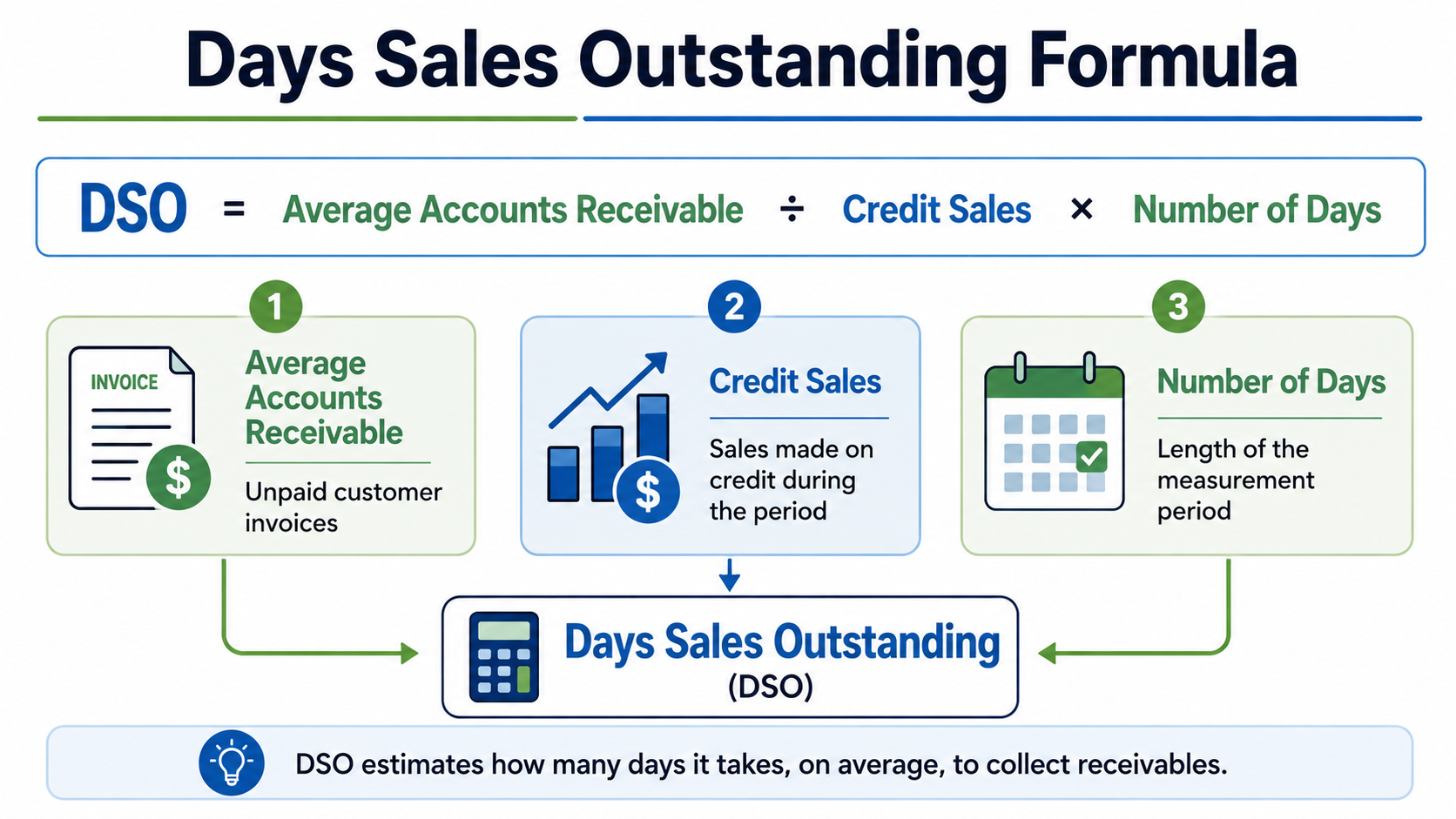
What is Days Sales Outstanding?
Days Sales Outstanding, or DSO, is a working-capital metric that estimates how many days of credit sales are currently represented by accounts receivable. It helps management judge how efficiently invoiced sales are turning into cash and whether collection performance is improving or deteriorating over time.
You’ll also hear DSO described as the average number of days a company takes to collect payment.
That’s useful shorthand, but there’s an important nuance.
The standard formula doesn’t examine every invoice and calculate the exact time between each invoice date and payment date. Instead, it relates your receivable balance to your average daily credit sales.
Think of it this way.
A DSO of 42 means your accounts receivable balance is roughly equal to 42 days of credit sales at the sales pace used in the calculation.
The Association for Financial Professionals also identifies DSO as one component of the cash conversion cycle, alongside inventory and payables.
For a CEO, the usefulness is straightforward.
A/R is revenue you’ve earned but can’t spend yet.
Payroll doesn’t accept receivables. Neither does your landlord, insurance company, lender or key supplier.
What is the DSO formula?
The standard DSO formula divides accounts receivable by credit sales and multiplies the result by the number of days in the measurement period. For better period matching, many finance teams use average accounts receivable rather than a single ending balance and net credit sales rather than total sales whenever the data is available.
DSO = (Average Accounts Receivable ÷ Net Credit Sales) × Number of Days
Average accounts receivable can be calculated as:
Average A/R = (Beginning A/R + Ending A/R) ÷ 2
For an annual calculation:
DSO = (Average A/R ÷ Annual Net Credit Sales) × 365
For a 90-day quarter:
DSO = (Average A/R ÷ Quarterly Net Credit Sales) × 90
The numerator and denominator need to describe the same period.
That’s where sloppy DSO calculations go wrong.
Which sales number should you use?
Use net credit sales when you can.
DSO is supposed to measure receivables created by credit sales.
If your company generates $10 million of sales but $4 million is paid immediately by card or cash, putting the entire $10 million in the denominator can artificially reduce DSO because those cash sales never created receivables.
Investopedia specifically notes that DSO calculations should focus on credit sales rather than cash sales.
Some accounting systems don’t make net credit sales easy to isolate.
If essentially all of your sales are invoiced on credit, total net revenue may be a reasonable practical proxy. Just use the same methodology every period so the trend remains comparable.
Consistency matters more than pretending the underlying data is more precise than it is.
Should you use ending or average accounts receivable?
Average A/R is usually better when you’re comparing a balance-sheet amount with sales earned throughout a period.
Suppose your receivables were $800,000 on January 1 and $1.2 million on December 31.
Using only the $1.2 million year-end balance ignores everything that happened between those dates.
A simple average gives:
($800,000 + $1,200,000) ÷ 2 = $1,000,000 average A/R
For a stable business, that may be sufficient.
For a seasonal or rapidly growing business, even beginning- and ending-average balances can distort what happened during the year. Monthly average balances or a more detailed receivables analysis may give management a cleaner picture.
Don’t let convenience outrank accuracy when a major cash decision depends on the metric.
How do you calculate Days Sales Outstanding?
To calculate Days Sales Outstanding, choose a measurement period, determine average accounts receivable, determine net credit sales for the same period, divide A/R by credit sales, and multiply by the number of days. The resulting number expresses the receivable balance in equivalent days of credit sales.
Worked DSO example
Assume a B2B company has:
| Item | Amount |
| Beginning accounts receivable | $850,000 |
| Ending accounts receivable | $950,000 |
| Quarterly net credit sales | $2,700,000 |
| Days in quarter | 90 |
First calculate average accounts receivable:
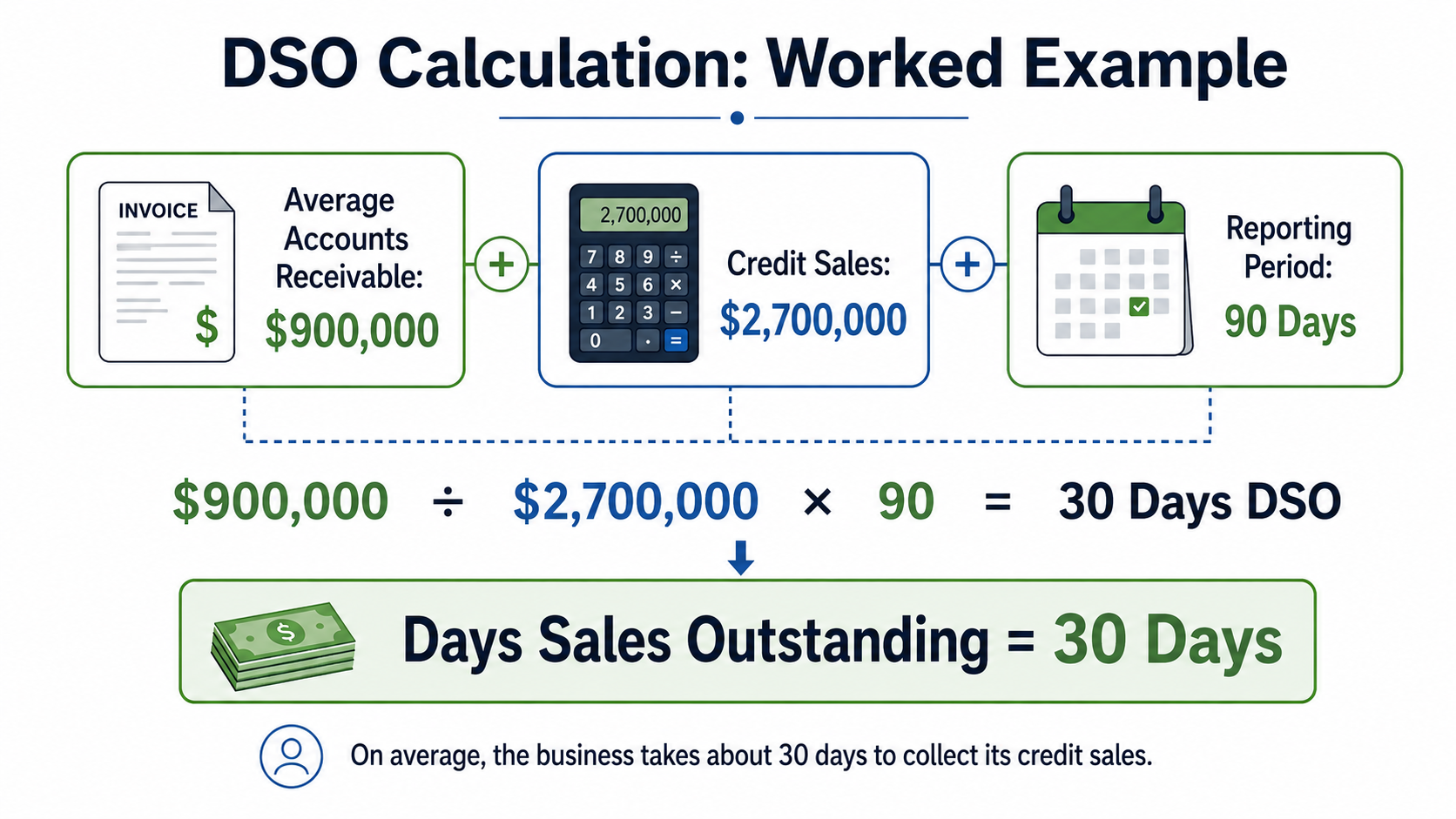
($850,000 + $950,000) ÷ 2 = $900,000
Then calculate DSO:
($900,000 ÷ $2,700,000) × 90 = 30 days
The company’s DSO is 30 days.
That sounds good if customers are on Net 30 terms.
But don’t declare victory yet.
Open the aging report.
If half of your customers pay in 15 days while three major accounts sit at 70 days, the 30-day portfolio average can hide a concentrated collection problem.
A KPI tells you where to look. It rarely tells you the whole story.
How much cash is tied up in each DSO day?
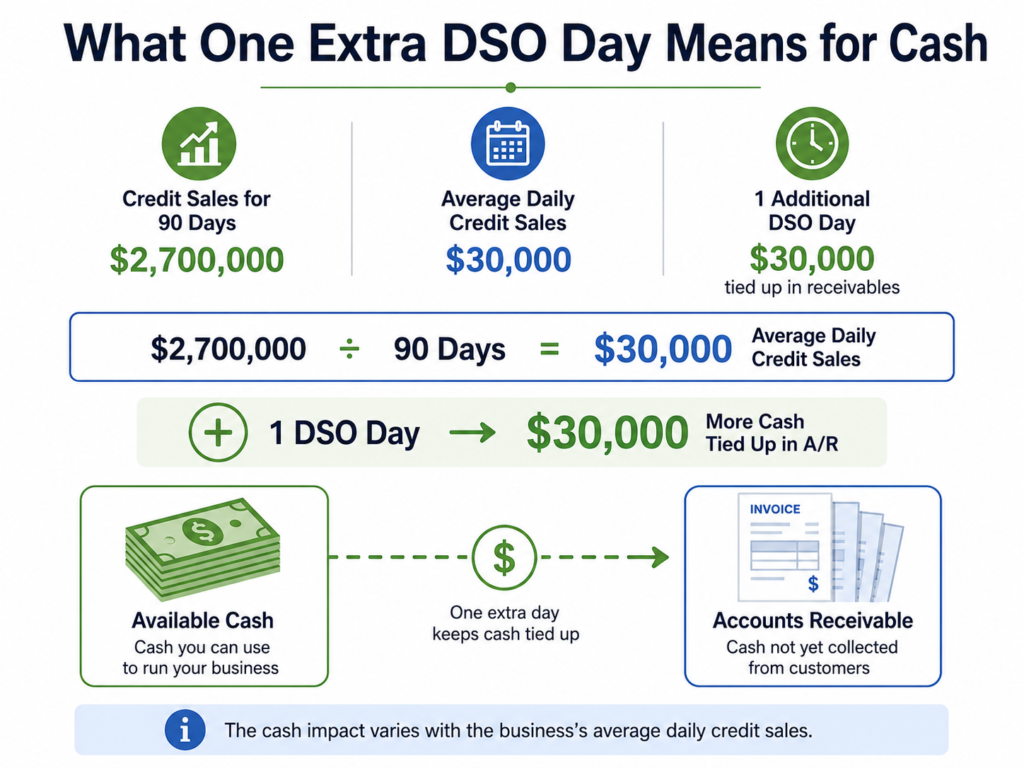
This is the calculation I want owners to pay more attention to:
Average daily credit sales = Annual credit sales ÷ 365
Then:
Approximate cash tied up by excess DSO = Average daily credit sales × Excess DSO days
Take a company with $12 million in annual credit sales.
Average daily credit sales are approximately:
$12,000,000 ÷ 365 = $32,877 per day
Assume DSO is 52 days and management believes 42 days is realistic based on contractual terms and customer behavior.
The ten-day difference represents approximately:
10 × $32,877 = $328,770
Roughly $329,000 is tied up in that ten-day difference, assuming sales remain stable.
That’s why DSO is more than a finance-department ratio.
Every unnecessary DSO day represents approximately one additional day of credit sales sitting outside your bank account.
Dropping the metric by ten days doesn’t create $329,000 of profit. It can, however, convert roughly that amount of receivables into cash sooner.
Very different thing.
What is a good Days Sales Outstanding?
A good Days Sales Outstanding figure makes sense for your contractual payment terms, industry, customer mix, and historical collection pattern. Lower is generally better, but there is no universal DSO target that every business should pursue, and an arbitrary benchmark can lead management toward the wrong decisions.
You’ll see generic rules online.
For example, Investopedia cites fewer than 45 days as a general rule of thumb while also stressing that DSO varies by industry and should be evaluated over time.
I wouldn’t run your company around a generic 45-day number.
Start with your own terms.
If nearly every customer is Net 30 and your DSO is 58 days, you’ve got a gap worth explaining.
If large customers contractually receive Net 60 and reliably pay on day 55, a 55-day DSO doesn’t automatically mean your collections team is failing.
Next, compare the trend.
A move from 34 to 37 days may not sound serious. On $20 million of annual credit sales, those three days represent roughly $164,000 of additional sales sitting in A/R.
That’s a management conversation.
Finally, look underneath the average.
A stable DSO can conceal a deteriorating aging profile if new sales growth is masking older unpaid balances.
The number is the starting point.
What causes DSO to increase?
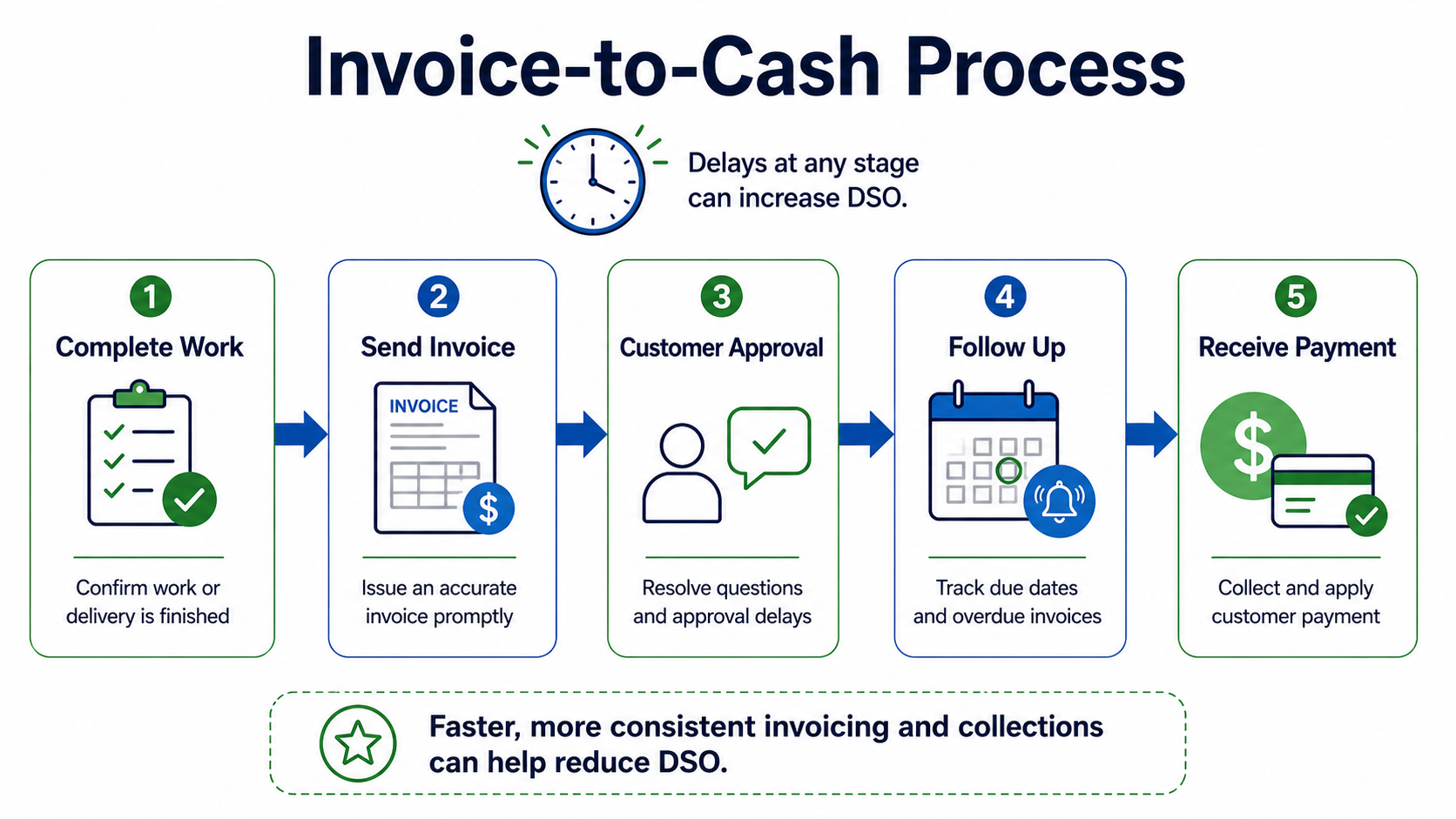
DSO usually rises because invoices go out late, payment terms become longer, customers pay beyond agreed terms, billing errors create disputes, credit standards loosen, or collection follow-up breaks down. Sales mix and rapid changes in revenue can also move the formula even when customer payment behavior has not materially changed.
From the CFO seat, I would separate the causes into two groups.
The first is commercial.
Sales may be approving Net 60 terms to win deals while management’s cash forecast still assumes customers pay in 30 days. A few major accounts can materially change the company’s collection profile.
The second is process failure.
A project finishes Friday, but nobody issues the invoice until the following Thursday. The invoice gets rejected because a purchase-order number is missing. It sits in someone’s inbox for four more days. Then accounting restarts the process.
The customer hasn’t paid late yet.
Your company gave away nearly two weeks before the customer’s payment clock even started.
In 30+ years of CFO work, this is one pattern Stan Alhadeff has seen repeatedly: a cash problem that looks financial often begins as an operating-process problem.
That distinction matters because you don’t fix bad billing with a better dashboard.
How does DSO affect cash flow and the cash conversion cycle?
DSO affects cash flow because a higher receivable balance leaves more earned revenue waiting outside the company’s bank account. It also forms part of the cash conversion cycle, which measures how long operating cash remains committed to inventory and receivables before being recovered from customers after considering supplier-payment timing.
The simplified cash conversion cycle formula is:
CCC = DIO + DSO − DPO
Where:
- DIO = Days Inventory Outstanding
- DSO = Days Sales Outstanding
- DPO = Days Payable Outstanding
That relationship is widely used in working-capital analysis.
If DSO falls by ten days and everything else stays equal, the cash conversion cycle also falls by ten days.
For a service business with little or no inventory, receivables can be one of the largest working-capital levers available.
This is also why profitable growth can make cash tighter.
Imagine sales rise 30%, but DSO climbs at the same time.
You haven’t just funded more work. You’re waiting longer to collect on a larger revenue base.
Growth consumed cash before it produced cash.
That is the kind of issue fractional CFO services should identify before management tries to solve the shortfall with another loan.
How to reduce DSO: 9 practical ways
The most reliable way to reduce DSO is to tighten the entire invoice-to-cash process rather than relying on aggressive collections after invoices are already overdue. Faster invoicing, clean billing, clear terms, credit controls, disciplined follow-up, and rapid dispute resolution usually improve cash conversion more sustainably than simply pressuring customers to pay faster.
1. Send invoices immediately
Don’t give customers free days before their payment terms even begin.
If work is billable on completion Friday, sending the invoice the following Wednesday has already added five days to your potential collection cycle.
Set clear billing triggers.
For recurring services, automate recurring invoices where appropriate.
For project businesses, connect billing milestones to operational completion instead of relying on someone to remember at month-end.
For companies with messy invoicing workflows, back-office support can matter as much as the collection script because invoice speed begins with the process behind the books.
2. Make invoices difficult to reject
A fast invoice that’s wrong isn’t fast.
Missing purchase orders, incorrect legal entities, wrong billing contacts, unsupported expenses, and mismatched contract terms all give customers legitimate reasons to kick invoices back.
The fix is boring.
That’s good.
Build a pre-send checklist for high-value invoices. Confirm the bill-to entity, PO number, pricing, tax treatment, supporting documentation and the customer’s accounts-payable contact.
AFP recommends accurate automated invoicing and clear invoice information as core DSO-reduction practices.
3. Agree on payment terms before the sale
Payment terms are part of pricing.
Treat them that way.
A customer asking for Net 60 instead of Net 30 is asking you to finance another 30 days of the relationship.
Sometimes that makes sense.
Maybe it’s a strategic account with strong margins and low credit risk.
But the decision belongs in the commercial discussion before the contract is signed, not on an invoice after the work is finished.
Sales shouldn’t be able to give away working capital without anyone pricing the cash consequence.
4. Tighten customer credit controls
Revenue isn’t automatically good revenue.
If a customer repeatedly stretches terms, requires constant collection work, and creates a meaningful bad-debt risk, the headline sale can be much less attractive than it looked in the pipeline.
Credit policies don’t have to become bureaucratic.
Start with exposure.
Set sensible limits based on customer size, payment history, and the amount your company could afford to have outstanding if something goes wrong.
For higher-risk or new customers, consider deposits, milestone billing, or partial prepayment where the commercial relationship supports it.
The goal isn’t to reject good business.
It’s to stop financing bad business accidentally.
5. Manage A/R by aging bucket and owner
One total accounts receivable number is almost useless operationally.
Break it down.
Current. 1–30 days overdue. 31–60. 61–90. Over 90.
Then assign an owner.
If $400,000 is sitting more than 60 days overdue, somebody should know which invoices make up that balance, who is responsible for each customer relationship, what has already been done, and what happens next.
A finance team shouldn’t spend Monday morning discovering the same overdue invoice it discussed last Monday.
A clean aging schedule is also one of the places where strong accounting support becomes essential. Strategy built on unreliable receivable records isn’t strategy.
It’s guesswork.
6. Build a consistent reminder and escalation process
Don’t begin collecting on day 45 for a Net 30 invoice.
Good collections start before an account becomes seriously overdue.
A simple cadence might include confirming invoice receipt, sending a reminder shortly before the due date, following up immediately after the date passes, and escalating based on age, dollar amount, and customer importance.
The exact cadence depends on your business.
Consistency is the point.
AFP recommends standardized reminders, late-payment alerts and collection processes rather than ad hoc follow-up.
Automation can handle routine reminders.
People should handle exceptions.
7. Resolve invoice disputes quickly
An invoice marked “disputed” can become a comfortable place for cash to disappear.
Don’t accept that label without an owner and a next action.
What is disputed?
Who needs to approve the correction?
Does operations owe documentation?
Does sales need to confirm scope?
Can the undisputed portion be collected now?
AFP specifically identifies unresolved customer disputes as a cause of delayed payment and recommends a standardized process for resolving them.
A DSO project that lives only in accounting will eventually stall.
Sales, operations and customer service often control pieces of the collection timeline.
8. Remove payment friction
Make it easy for a willing customer to pay.
If the only option requires a paper check routed through three desks, you introduced delay that has nothing to do with customer credit quality.
Offer appropriate electronic payment methods.
Make bank instructions easy to verify.
Use payment links or portals where they make sense.
Keep payment details consistent and secure.
For recurring relationships, automatic payment arrangements may work when the customer and contract support them.
Every handoff between “approved for payment” and “cash received” is another place to lose days.
9. Change the economics for chronic late payers
Some customers aren’t going to become faster because you send prettier reminders.
Change the deal.
You may need shorter terms, deposits, progress billing, tighter credit limits or different pricing for customers who consistently require more working capital.
Early-payment discounts can work too, but don’t hand them out automatically.
A 2% discount to collect 20 days sooner isn’t free cash.
It’s margin.
Run the math.
If that customer is already highly profitable and the released cash solves a real working-capital constraint, the trade may be sensible. If margins are already thin, paying customers to meet terms can solve one financial problem by creating another.
This is where the CFO earns the seat.
Reducing DSO is not the goal. Improving cash economics is the goal.
If DSO keeps climbing and you’re not sure which part of the process is responsible, Business CFO for Hire begins engagements with a free discovery and GAP Analysis. A free CFO strategy call can help determine whether the bottleneck is billing, collections, reporting, working capital or a larger cash-flow issue. Business CFO for Hire’s supplied client information confirms that this GAP Analysis is the starting point for engagements.
Does a lower DSO always mean a healthier business?
No. A lower DSO is generally favorable, but forcing the number down can hurt a business if management tightens credit enough to lose profitable customers, gives away too much margin through early-payment discounts, or reacts to a temporary formula distortion caused by seasonality or changing sales volume. Context still matters.
Take a customer producing $1.5 million of annual revenue at an attractive margin.
The customer pays reliably in 47 days under contractual Net 45 terms.
You could demand Net 30 to improve DSO.
You might also lose the account.
That’s not good cash management.
A sudden fall in DSO can be misleading too.
If sales decline sharply while customers pay older invoices, the receivable balance may fall and DSO can temporarily look better even though the business itself weakened.
Investopedia flags sales-volume changes, industry differences, and the proportion of credit sales as limitations that can affect DSO interpretation.
Seasonal businesses need even more care.
If December produces twice the normal monthly sales volume, a period-end DSO calculation can move because of sales timing rather than a meaningful change in collection behavior.
When the simple formula stops explaining what you’re seeing, go deeper.
Look at aging, customer-level DSO, overdue balances, disputed invoices, and actual payment behavior.
Turn Days Sales Outstanding into a cash-management KPI
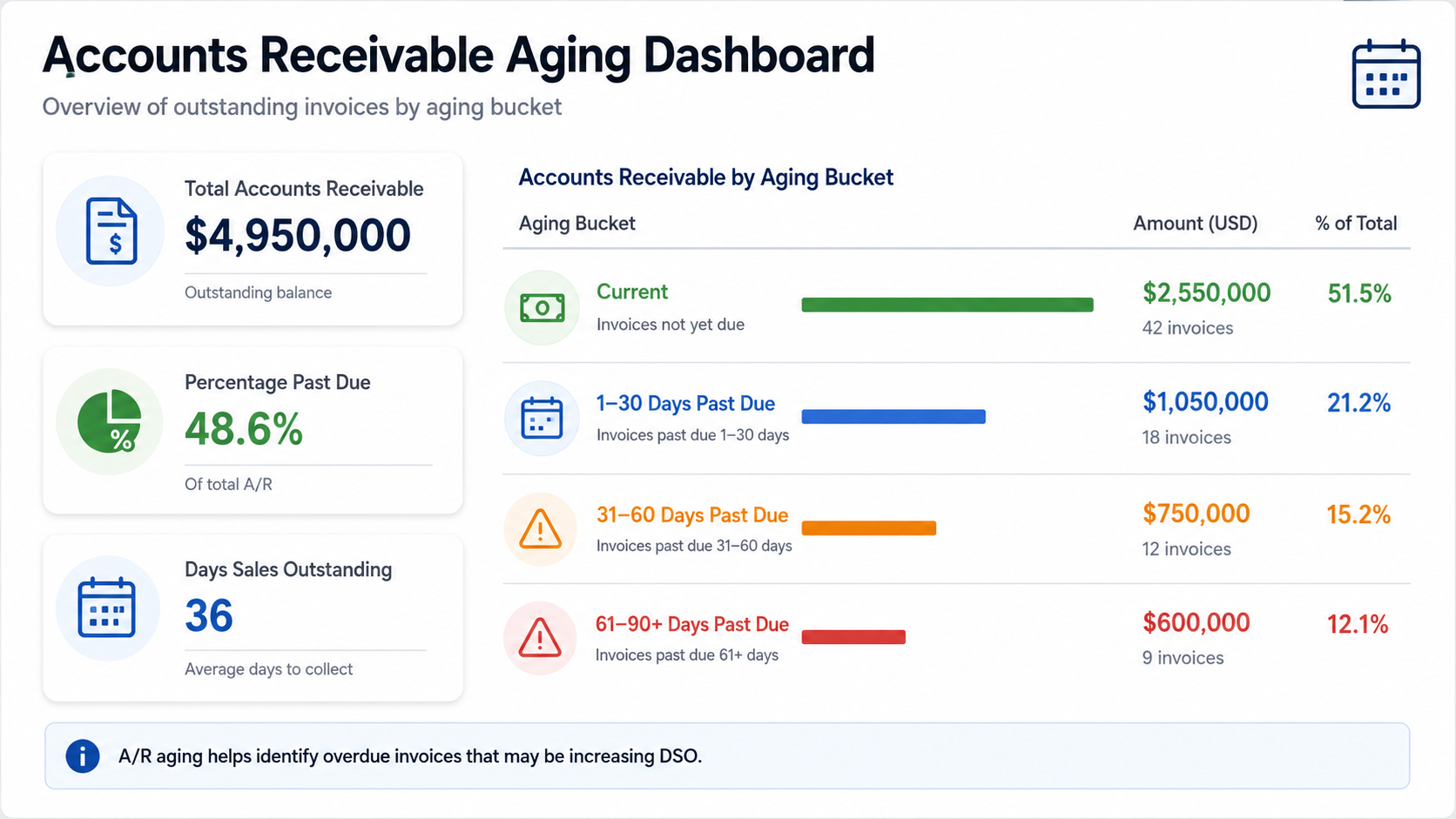
The Days Sales Outstanding formula belongs on a finance dashboard, but the meeting shouldn’t end after someone reports that DSO is 43 days.
Ask five questions.
What changed?
How many dollars does the change represent?
Which customers drove it?
Is the cause contractual, operational or credit-related?
What specifically will happen before the next reporting period?
Suppose annual credit sales are $15 million.
One DSO day represents roughly:
$15,000,000 ÷ 365 = $41,096
Let DSO slip five days and roughly $205,000 more in sales is sitting in receivables, assuming sales remain stable.
Now the KPI has someone’s attention.
That’s the difference between bookkeeping and financial leadership.
Bookkeeping tells you what A/R is.
A CFO helps determine why it’s there, how much cash the delay is costing the business and which action improves the economics without creating a larger problem somewhere else.
Business CFO for Hire works with growth-stage businesses between $1 million and $50 million in revenue, and Stan Alhadeff brings 30+ years of financial leadership experience to that work. Those are the businesses where a few extra collection days can turn from a minor accounting metric into a serious funding requirement.
You can find more practical finance resources in the Business CFO for Hire Knowledge Center and examples of client engagements in the firm’s case studies.
If sales are strong but too much cash keeps sitting in receivables, book a free CFO strategy call. The next step isn’t chasing an arbitrary DSO target. It’s finding the specific collection days your business can recover profitably.
FAQ
What does Days Sales Outstanding mean?
Days Sales Outstanding measures how many days of credit sales are represented by a company’s outstanding accounts receivable. Management uses DSO to monitor how efficiently invoiced revenue converts into cash. A rising trend can signal slower collections, longer payment terms, billing problems or changes in the company’s sales mix.
How do you calculate DSO?
Calculate DSO by dividing average accounts receivable by net credit sales and multiplying the result by the number of days in the measurement period. For an annual calculation, multiply by 365. Using average A/R and credit sales from the same period usually provides a more consistent comparison than mixing an ending balance with unrelated sales data.
What is a good DSO?
A good DSO depends on your contractual payment terms, industry, customer mix, and historical collection performance. A company offering Net 30 terms generally has more reason to investigate a 55-day DSO than a company whose major customers legitimately receive Net 60 terms. Trends against your own target are usually more useful than a universal benchmark.
Is a higher or lower DSO better?
A lower DSO is generally better because it means less sales revenue remains tied up in accounts receivable. However, management should not reduce DSO at any cost. Excessively strict credit terms or expensive early-payment discounts can improve the metric while hurting revenue, margin or valuable customer relationships.
What causes Days Sales Outstanding to increase?
DSO can increase because invoices are sent late, payment terms grow longer, customers pay late, invoice errors create disputes or collection follow-up becomes inconsistent. Changes in sales volume and seasonality can also affect the calculation. A rising DSO should therefore trigger analysis of both customer behavior and the company’s invoice-to-cash process.
How can a company reduce DSO?
A company can reduce DSO by invoicing faster, eliminating billing errors, setting clear payment terms, applying appropriate credit controls and following a consistent collection process. Rapid dispute resolution, easier payment methods and tighter management of chronic late payers can shorten collection time further without relying solely on aggressive collection calls.
How does DSO affect cash flow?
Higher DSO generally leaves more money tied up in accounts receivable instead of available cash. If a business generates $12 million of annual credit sales, each DSO day represents roughly $32,877 of sales at the average daily run rate. Reducing unnecessary collection days can therefore release meaningful working capital without requiring additional revenue.
What is the difference between DSO and accounts receivable turnover?
DSO expresses receivable collection efficiency in days, while accounts receivable turnover expresses it as the number of times receivables turn over during a period. Both evaluate similar underlying activity from different perspectives. DSO is often easier for operating teams to use because it can be compared directly with customer payment terms.