Hiring a fractional CFO means defining the actual gap in your business first, then vetting candidates against a specific set of questions covering experience, capacity, working style, and judgment — not just a resume review. Get the process right, and you end up with a genuine strategic partner. Rush it, and you end up paying CFO rates for something less.
Here’s the full process, plus 15 questions organized so you can actually compare candidates side by side instead of just collecting answers.
Key takeaways
- Before you interview anyone, get clear on whether your gap is accuracy (a controller-level problem) or strategy (a CFO-level problem) — hiring the wrong level of role is a common, expensive mistake.
- Fifteen questions, grouped into four categories — experience and fit, capacity and structure, the work itself, and judgment and honesty — cover what most competitor checklists miss.
- A candidate who markets themselves as “industry agnostic” isn’t automatically a red flag, but it’s not the selling point some providers treat it as either.
- How someone bills — hourly versus retainer — tells you almost as much about the engagement as anything they say in the interview.
- A fractional CFO worth hiring will tell you plainly if you don’t need one yet. That’s one of the more useful things you can learn from a single conversation.
The fractional CFO hiring process, step by step
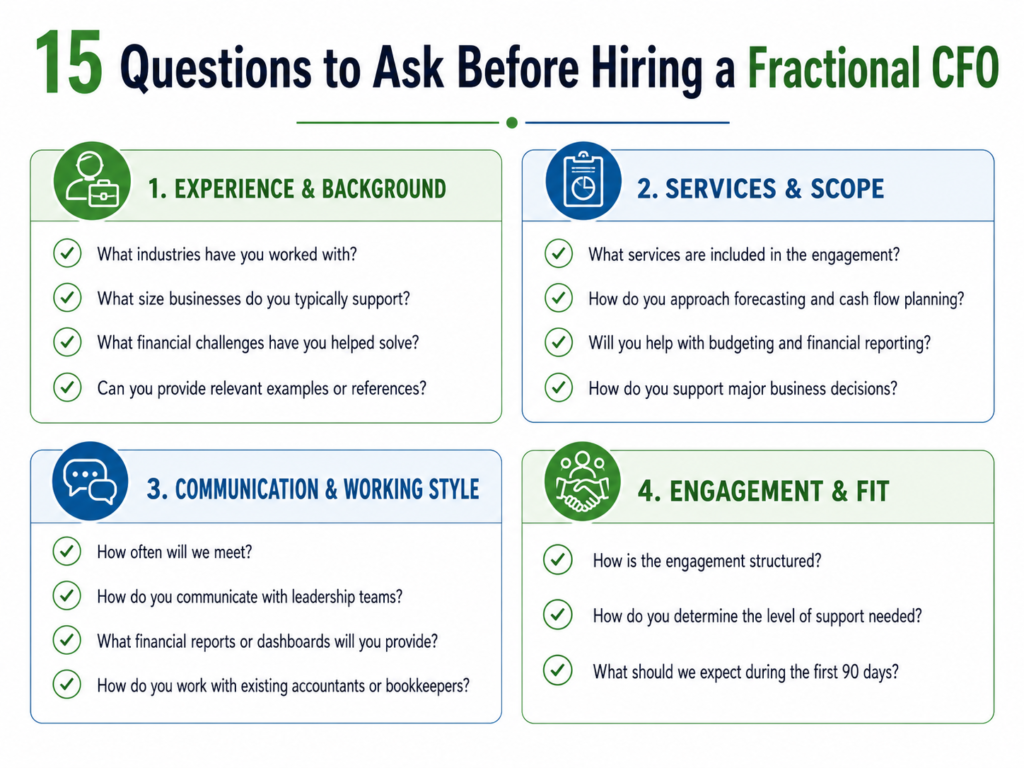
Hiring a fractional CFO well means working through five steps in order: define the actual gap, build a shortlist, run a real discovery conversation, ask a consistent set of questions across every candidate, and check at least one reference directly before signing anything.
Start by getting honest about what’s actually missing. If your books close late or you don’t trust your own reports, that’s usually a controller-level accuracy problem, not a strategy problem — and no amount of CFO-level forecasting fixes numbers that were wrong to begin with. Once you’re confident the gap is strategic, build a shortlist of two or three candidates or firms, and treat the first call as a real conversation, not a pitch you sit through. Ask the same fifteen questions below of every candidate, in the same order, so the answers are genuinely comparable. Then check at least one reference yourself, directly — not a testimonial handed to you, an actual phone call.
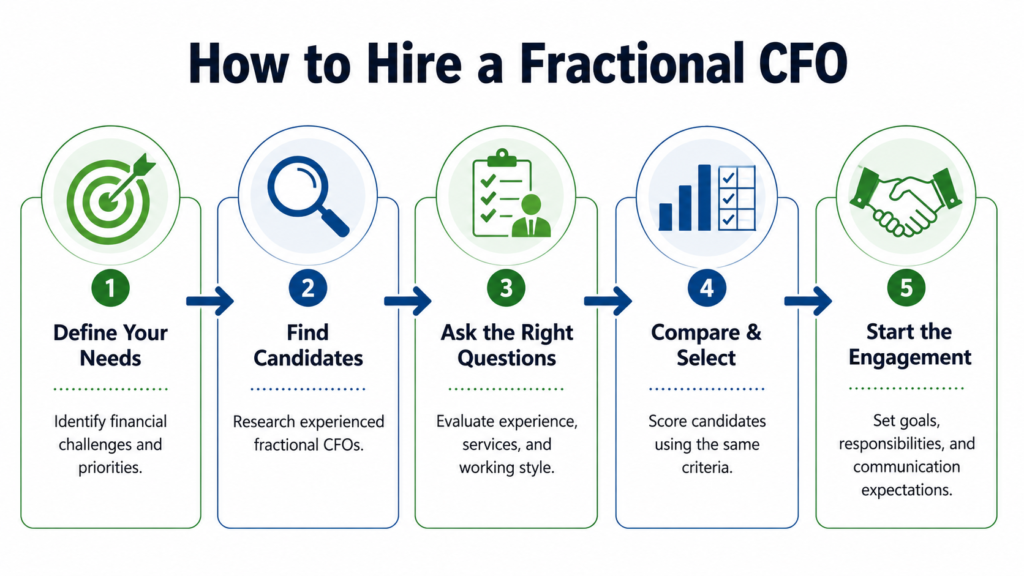
15 questions to ask before you hire a fractional CFO
Experience and fit
- Have you ever worked as a full-time CFO, not just fractional? Fractional work is its own discipline, but a candidate who’s never carried full CFO-level responsibility anywhere is missing a real reference point for judgment calls.
- What industries have you worked in, and what’s your direct experience with businesses like mine? A generalist background isn’t disqualifying, but real pattern recognition — knowing how a construction company’s WIP report behaves differently than a SaaS company’s ARR — comes from having actually done the work in that kind of business before.
- Walk me through a specific problem you solved for a client around my size and complexity. Vague answers here are the clearest early signal of thin experience. Ask for the actual numbers involved, not just the story.
Capacity and structure
- How many other clients do you currently work with, and what does real availability look like when something urgent comes up? There’s no universal right answer, but there is a wrong one: hesitation or vagueness about whether they’d genuinely have capacity during a crunch.
- Is this your primary focus, or work alongside something else? A candidate doing fractional CFO work as a side project alongside a full-time job is a different commitment level than someone who’s built their practice around it.
- What does a typical month look like in this engagement — a set cadence, or purely reactive support? You want a clear answer here, not “it depends on what comes up.” Structure is what separates a real engagement from occasional advice.
- Do you bill hourly or on a retainer, and why? This one matters more than it sounds. Hourly billing in an ongoing relationship creates a subtle incentive to let tasks take as long as they take. For a genuine fractional CFO cost comparison, a defined monthly retainer is almost always the more aligned structure.
The work itself
- How do you approach cash flow forecasting, and how often does it get updated? Listen for specifics: a rolling model, a defined update cadence, real inputs — not a general description of “keeping an eye on cash.”
- What KPIs would you actually track for a business like mine? A strong candidate names specific metrics relevant to your business within the conversation itself, not a generic list they’d give anyone.
- What accounting software do you work in, and can you integrate with what we already use? A practical, low-drama question, but a candidate who can’t answer it clearly is signaling a rougher on boarding than you want.
- Do you have direct experience with financing, fundraising, or a sale process? If you’re heading toward a bank conversation, an equity raise, or an eventual exit, this experience matters more than general strategic advice.
Judgment and honesty
- What’s a mistake you’ve seen a business like mine make, and how would you catch it earlier? This tests pattern recognition directly — a candidate with real field experience will have a specific, concrete answer ready.
- Where do you not have deep expertise, and who would you bring in to cover that gap? Nobody is great at everything. A candidate who claims otherwise is telling you something important about their self-awareness, not their skill.
- How do you handle a disagreement with leadership about direction? You’re not looking for someone who always agrees. You’re looking for someone who can disagree constructively and still move the relationship forward.
- What would make you tell me I don’t need a fractional CFO yet? This is the question most candidates aren’t prepared for, and the answer tells you more about their honesty than almost anything else on this list.
Red flags to watch for
The clearest red flag is vagueness where specificity should be easy — a candidate who can’t name a real KPI, a real client outcome, or a real cash flow methodology without generalities is showing you exactly what the engagement will feel like. A second is reluctance to provide a reference, or references that turn out to be difficult to actually reach.
A third, more subtle one: some providers market themselves as “industry agnostic,” treating it as a selling point. In 30-plus years of CFO work, the pattern Stan Alhadeff sees most often runs the other way — real value comes from pattern recognition specific to how a business actually makes and loses money, and that’s genuinely different for a construction company managing retainage and WIP schedules than it is for a SaaS company tracking MRR and churn. Being willing to work across industries is fine. Treating total industry-agnosticism as a strength is usually a sign the depth isn’t there yet.
What a strong answer actually sounds like
A weak answer to the cash flow forecasting question sounds like “I stay on top of cash flow closely and update projections regularly.” A strong answer sounds like “I build a 13-week rolling cash flow model, update it every Friday against actuals, and flag any variance over 10% the same week it shows up — for a $6M business, that’s usually the difference between catching a gap 60 days out and discovering it in the bank account.”
That’s the pattern worth listening for across all fifteen questions: names, numbers, and specifics instead of general reassurance. If a candidate can’t get specific about their own process, they’re unlikely to get specific about yours.
Making the hire with confidence
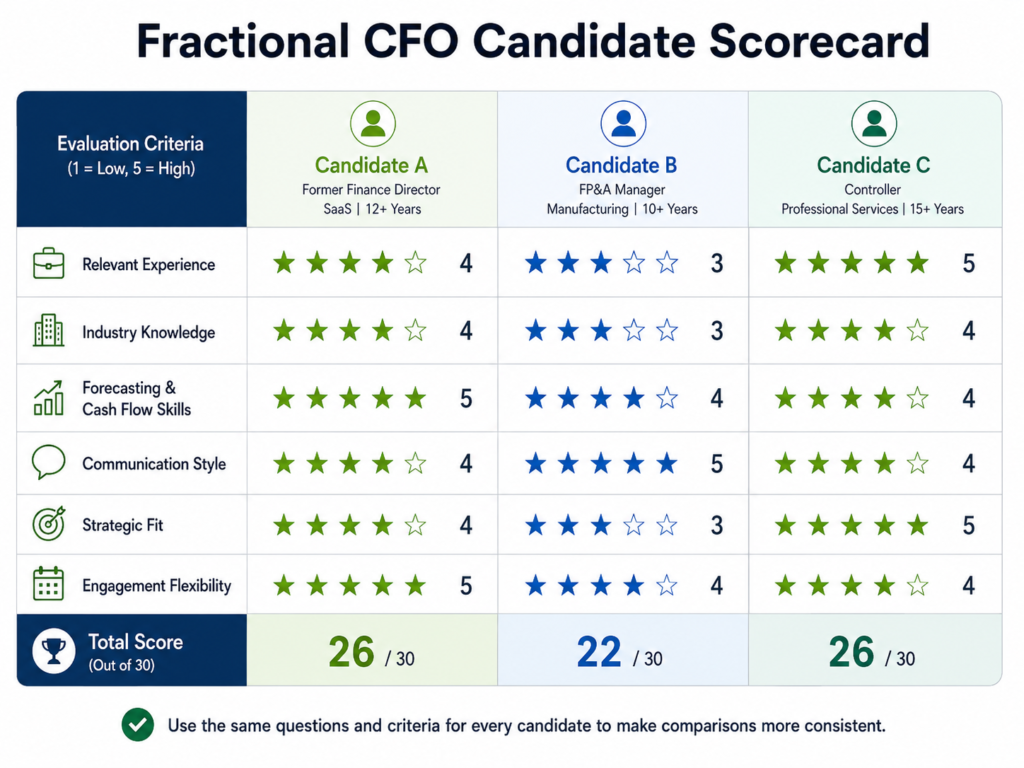
The fifteen questions above aren’t a script to read verbatim — they’re a framework to keep every conversation honest and comparable. Run the same list past every candidate, take real notes, and trust the pattern that emerges more than any single impressive-sounding answer.
Stan Alhadeff has been on the other side of this exact conversation for over 30 years, including more than a decade with one client, Amerigo Metal Recycling, grown from $8 million to nearly $50 million in revenue. If you’d like to put these questions to a real conversation, book a free strategy call with Stan — it starts with a GAP Analysis, not a sales pitch, so you’ll get a straight answer either way.
FAQ
How do you hire a fractional CFO? Hiring a fractional CFO means defining the actual gap in your business first, building a shortlist of candidates, running a real discovery conversation, asking a consistent set of questions across every candidate, and checking at least one reference directly before signing anything.
What questions should I ask a fractional CFO before hiring? Ask about their direct full-time and industry experience, their current client capacity, how they structure and bill engagements, their approach to cash flow forecasting and KPIs, and their honesty about where their own expertise ends. Fifteen specific questions across these categories are covered in detail above.
What are red flags when hiring a fractional CFO? Vague answers where specificity should be easy, reluctance to provide reachable references, and hourly billing with no defined scope for an ongoing relationship are the clearest warning signs. A candidate marketing themselves as fitting every industry equally well is also worth a closer look.
How much does a fractional CFO cost? Most fractional CFO retainers run $3,000 to $10,000 a month, compared with $300,000 to $450,000 a year fully burdened for a full-time CFO. The exact cost depends on your business’s complexity and how much involvement the engagement actually requires.
Should a fractional CFO bill hourly or on retainer? A monthly retainer is generally the better structure for an ongoing relationship, since it aligns incentives around solving problems efficiently rather than accumulating billable hours. Hourly billing fits a single, bounded project better than an ongoing strategic partnership.

Stan Alhadeff
Founder & Fractional CFO