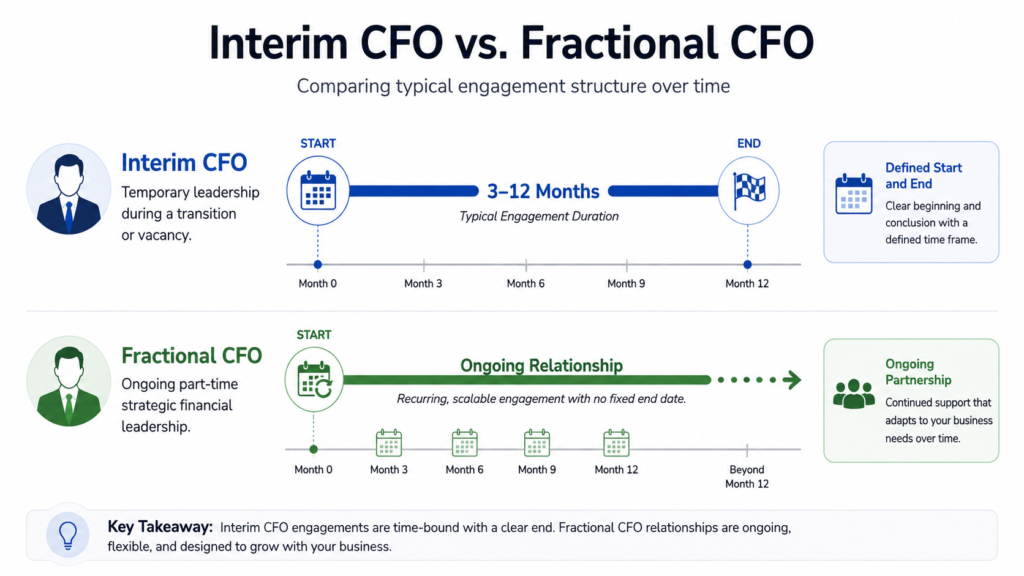
An interim CFO is a full-time (or near full-time) executive brought in temporarily, usually for three to twelve months, to cover a specific leadership gap — a sudden departure, an acquisition, a restructuring. A fractional CFO is a part-time executive on an ongoing retainer, typically working with a business indefinitely rather than toward a fixed end date. Both bring senior-level financial leadership. The difference is commitment level and purpose, and getting that choice wrong costs more than it should.
Key takeaways
- An interim CFO works full-time or near full-time, typically for three to twelve months, filling a specific leadership gap until a permanent solution is in place.
- A fractional CFO works part-time on an ongoing retainer, usually $3,000 to $10,000 a month, without a fixed end date.
- Interim CFOs are usually the right call for a sudden departure at a company complex enough to need daily executive coverage. Fractional CFOs fit ongoing strategic needs that don’t require a full-time seat.
- According to Business Talent Group’s 2025 High-End Independent Talent Report, requests for interim CFOs account for half of all interim finance leadership requests — the single largest share of any finance role, reflecting how often companies reach for full-time interim coverage the moment a CFO seat opens.
- Not every CFO departure actually requires a full-time interim replacement. For many growth-stage businesses, a fractional CFO can cover the same gap at a fraction of the cost and commitment.
What is an interim CFO?
An interim CFO is a senior finance executive brought in on a full-time or near full-time basis, temporarily, to fill a specific leadership gap — most often a sudden CFO departure, an acquisition, a restructuring, or a financial crisis. The engagement typically runs three to twelve months, ending once a permanent CFO is hired or the transition period is over.
Because the role is full-time, an interim CFO functions much like a temporary employee: embedded in daily operations, running board meetings, managing the finance team, and carrying the full weight of the seat until someone permanent takes over. The cost usually tracks close to full-time CFO compensation, sometimes at a premium given the need for immediate availability.
What is a fractional CFO?
A fractional CFO is a senior finance executive who works with a business part-time, on an ongoing retainer, without a fixed end date — typically $3,000 to $10,000 a month, compared with $300,000 to $450,000 a year fully burdened for a full-time hire. Where an interim CFO fills a temporary full-time seat, a fractional CFO provides scaled, ongoing strategic leadership indefinitely.
Fractional CFOs often work with more than one client at a time, since the engagement is scoped to a set number of hours or days rather than a full workweek. That’s the structural difference that matters most: an interim CFO is temporary and full-time; a fractional CFO is ongoing and part-time.
Interim CFO vs. fractional CFO: side-by-side comparison
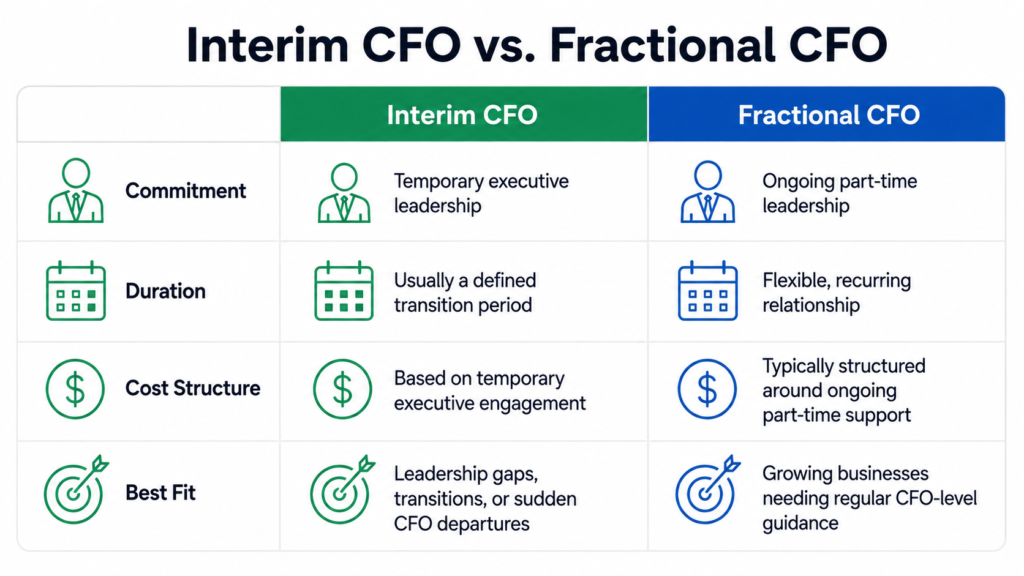
| Interim CFO | Fractional CFO | |
| Commitment | Full-time or near full-time | Part-time, scaled to need |
| Duration | Temporary, typically 3–12 months | Ongoing, no fixed end date |
| Typical trigger | Sudden departure, M&A, restructuring, crisis | Steady growth, strategic gap, no full-time need yet |
| Cost | Often near full-time CFO compensation | $3,000–$10,000/month |
| Client relationship | Usually one client at a time | Often multiple clients simultaneously |
| Best fit | A leadership gap that genuinely requires daily, full-time coverage | Ongoing strategic support without full-time complexity |
When you actually need an interim CFO
You need an interim CFO when the gap is genuinely full-time — a departure at a company complex enough that daily executive presence matters, an active M&A process requiring constant attention, or a crisis that needs someone embedded in operations every day until it’s stabilized. The common thread across real interim situations is that the workload doesn’t tolerate part-time coverage, even temporarily.
According to Business Talent Group’s 2025 High-End Independent Talent Report, requests for interim CFOs make up half of all interim finance leadership requests — more than any other finance role, and a signal of just how often companies default to full-time interim coverage the moment a CFO seat opens. That default isn’t wrong for every business. It’s just not automatically right for every business either.
When a fractional CFO can cover the same gap
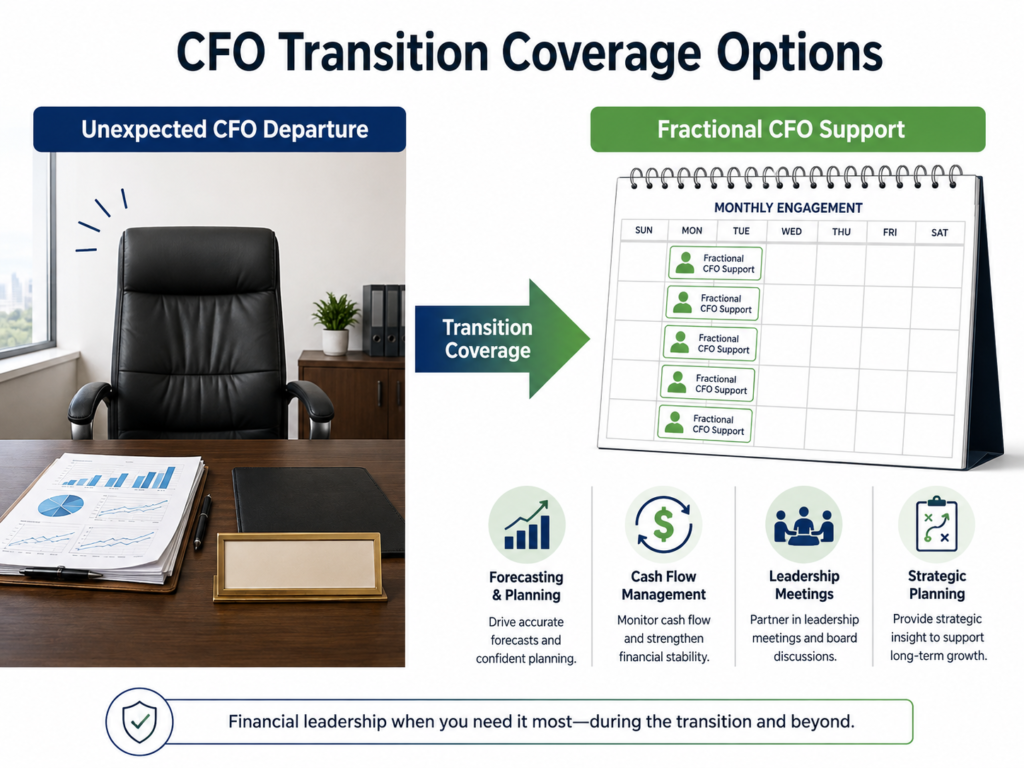
A fractional CFO can often cover a CFO departure without full-time interim coverage when the actual workload doesn’t fill forty hours a week, even during the transition — which describes a real share of businesses in the $1M to $50M range. A fractional engagement front-loaded with more hours in the first 60 to 90 days can step in quickly, stabilize lender and investor relationships, keep the monthly close moving, and close the gap without the cost or commitment of a formal interim placement.
In 30-plus years of CFO work, the pattern Stan Alhadeff sees most often is a board or ownership group reaching for “interim CFO” the instant a CFO leaves, assuming full-time coverage is the only way to keep things stable — when for a lot of businesses at this revenue range, that instinct is sized for a bigger, more complex organization than the one actually in the room. The honest question worth asking first: does this gap genuinely require someone in the seat forty hours a week, or does it require someone who can move fast and cover what actually needs covering? If you’re not sure which situation you’re in, our free discovery call includes a GAP Analysis that gives you a straight answer.
Can a fractional CFO become an interim CFO, or vice versa?
Yes — the line between the two roles is more about structure than substance, and a fractional CFO can shift into heavier, near-full-time involvement during an acute transition without technically changing titles. The reverse is less common: an interim CFO’s engagement is generally scoped around a temporary full-time commitment from the outset, making a permanent shift to a lighter, ongoing fractional arrangement a bigger structural change than simply scaling hours up or down.
This flexibility is one of the practical advantages of the fractional model for a growth-stage business: the same relationship can flex from a lighter monthly cadence to intensive, near-daily involvement during a real transition, then scale back down once things stabilize, without the overhead of ending one engagement and starting another. [Note: the strategist’s brief calls for an interlink to an existing “interim CFO” post here — URL pending confirmation per the flag at the top of this deliverable.]
Getting the coverage right, not just the title
The real cost of getting this choice wrong isn’t the title on the engagement; it’s paying for full-time commitment in a situation that doesn’t actually need it, or under-resourcing a gap that genuinely required daily attention. Sizing the coverage to the actual workload, not the instinct to over-correct after a departure, is what keeps the decision from being more expensive than it needed to be.
If you’re facing a CFO transition and want a straight read on what your business actually needs, book a free strategy call with Stan. It starts with a look at your real situation, not a default assumption.
FAQ
What is an interim CFO? An interim CFO is a senior finance executive brought in full-time or near full-time, temporarily, to fill a specific leadership gap such as a sudden departure, an acquisition, or a restructuring. The engagement typically lasts three to twelve months until a permanent solution is in place.
What is the difference between an interim CFO and a fractional CFO? An interim CFO works full-time on a temporary basis, usually three to twelve months, while a fractional CFO works part-time on an ongoing retainer with no fixed end date. The core difference is commitment level and duration, not the caliber of financial leadership provided.
How long does an interim CFO typically stay? Interim CFO engagements typically last three to twelve months, ending once a permanent CFO is hired or the transition that triggered the need is resolved. Some engagements convert into permanent hires if the fit works well.
Can a fractional CFO cover a CFO departure? Yes, in many cases. If the actual workload doesn’t require a full forty-hour week even during the transition, a fractional CFO can step in quickly, stabilize key relationships, and cover the gap without the cost of a full-time interim placement.
Which is more expensive, interim or fractional CFO? Interim CFOs generally cost more, since the engagement tracks close to full-time CFO compensation, sometimes at a premium for immediate availability. Fractional CFOs typically run $3,000 to $10,000 a month, since the engagement is scaled to a defined scope rather than a full-time seat.

Stan Alhadeff
Founder & Fractional CFO