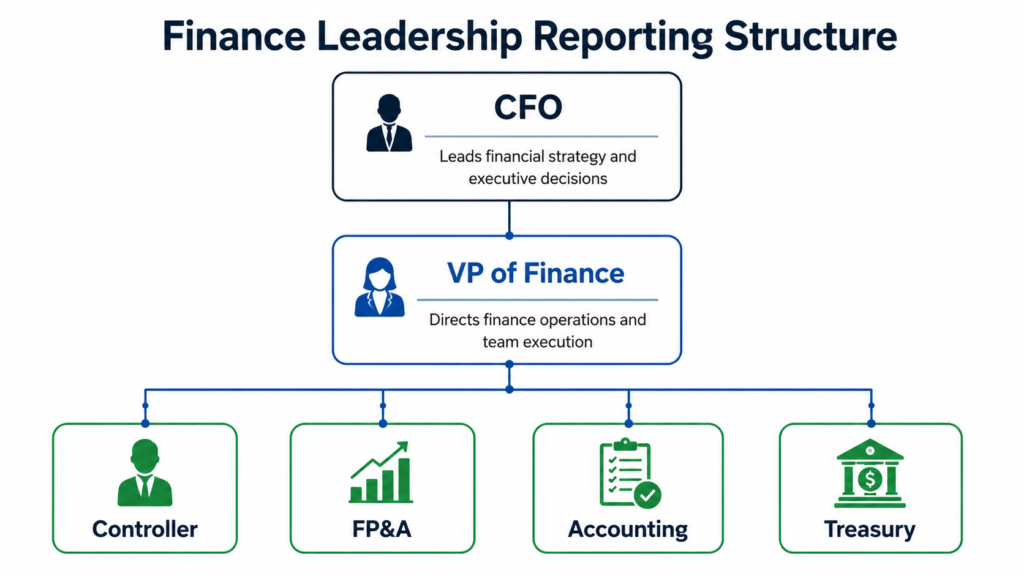
A VP of Finance runs the finance function day-to-day — budgeting, forecasting, managing the accounting team, keeping the numbers accurate and on schedule. A CFO sits at the executive level, setting financial strategy, managing lender and investor relationships, and answering for the company’s financial direction in the boardroom. Where both roles exist in the same company, the VP of Finance typically reports to the CFO.
That’s the clean version. The messier truth is that these titles get used inconsistently across companies, and most of the salary data comparing them online doesn’t hold up to scrutiny — more on that below.
Key takeaways
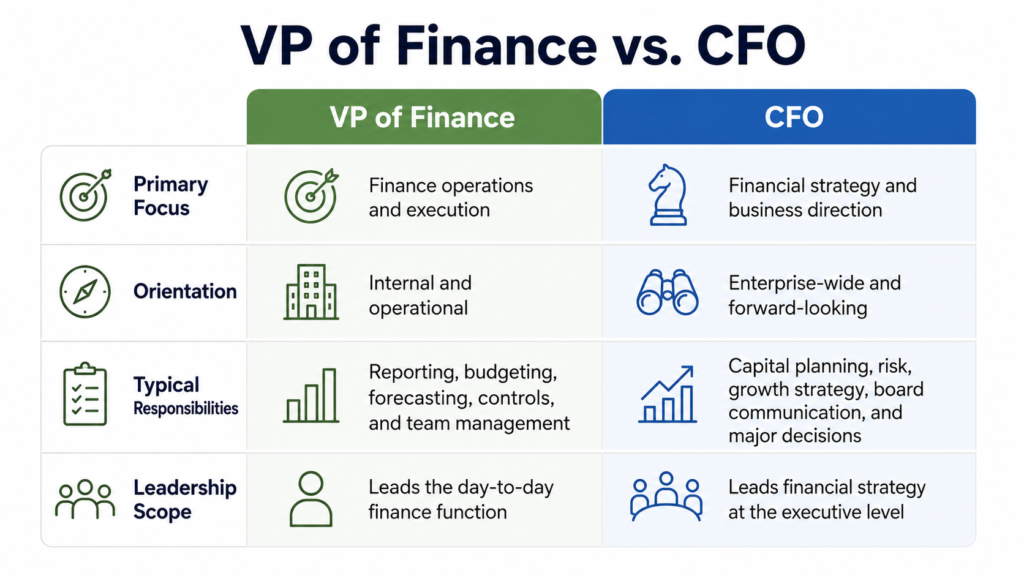
- A VP of Finance is execution-focused: running the finance function, managing the team, keeping the numbers accurate. A CFO is strategy-focused: capital structure, financing, board and investor relationships.
- Where both roles exist, the VP of Finance typically reports to the CFO.
- “Finance director” and “head of finance” are largely the same role as VP of Finance under a different regional or company naming convention, not a distinct fourth title.
- Salary data comparing these two titles online is genuinely unreliable — sources contradict each other, and in at least one case, a single publisher contradicts itself across two different articles.
- For most $1M–$50M businesses, the real question isn’t which full-time title to hire — it’s whether a fractional CFO can deliver the strategic layer without either full-time salary.
What does a VP of Finance do?
A VP of Finance manages a company’s finance function day-to-day — budgeting, forecasting, overseeing the accounting and finance team, and making sure the numbers are accurate and delivered on schedule. The role is execution-focused: turning financial strategy into operational reality.
Typical responsibilities include managing the monthly close process, running the budgeting cycle, overseeing financial reporting, and supervising the accounting staff underneath the role. A VP of Finance is deeply involved in the internal mechanics of the finance function, less often the person representing the company externally to lenders or investors.
What does a CFO do?
A CFO sets a company’s financial strategy — capital structure, financing decisions, pricing, and growth planning — and represents the company’s financial position to the board, lenders, and investors. The role is outward-facing and strategic, sitting at the executive level alongside the CEO and COO.
A fractional CFO delivers that same strategic scope to a growing business part-time, on a retainer, without the company needing to make a full-time executive hire to get it. That distinction — strategic scope delivered on a scaled basis — is often more relevant to a $1M–$50M business than the VP-of-Finance-vs-CFO title question itself.
VP of Finance vs. CFO: side-by-side comparison
| VP of Finance | CFO | |
| Primary focus | Execution: running the finance function day-to-day | Strategy: capital structure, financing, growth planning |
| Orientation | Internal | External (board, lenders, investors) and internal |
| Typical responsibilities | Budgeting, forecasting, close management, team oversight | Financial strategy, capital raising, board reporting, M&A |
| Reports to | CFO, where one exists | CEO and/or the board |
| Best fit | Companies needing operational finance discipline | Companies needing strategic financial leadership |
Does a VP of Finance report to the CFO?
Yes, in companies large enough to have both roles, the VP of Finance typically reports to the CFO, with the VP running the internal finance function while the CFO handles strategy and external relationships. That reporting line reflects the difference in scope between the two roles more than a difference in seniority alone.
Not every company has both. Smaller and mid-sized businesses often have one or the other, not both, and the title in use sometimes says more about company convention than about the actual scope of the job. [LINK: this is the natural spot for the “who reports to the CFO” post referenced in the brief — URL needs confirmation before this goes live]
What about finance director or head of finance?
Finance director and head of finance are largely the same role as VP of Finance, described under a different regional or company-specific naming convention rather than representing a genuinely distinct fourth title. “Finance director” shows up more often in UK and European company structures; “VP of Finance” is more common in US-based companies, particularly in tech and venture-backed businesses.
The underlying scope — internal, execution-focused, running the finance function day to day — stays consistent across all three labels. If you’re evaluating a candidate or a service provider, focus on what the role actually covers rather than which of these three titles happens to be on the business card.
VP of Finance vs. CFO salary: what the data actually shows
Search for “VP of Finance vs. CFO salary” and the numbers you’ll find don’t agree with each other — in at least one case, they don’t even agree with themselves. One frequently-cited source claims VP of Finance pay exceeds CFO pay on average. A separate site published two different articles citing CFO salaries nearly $300,000 apart from each other. None of it traces back to a named, verifiable methodology.
That’s not a rounding error you can average your way past. It’s a signal the underlying data isn’t rigorous enough to build a hiring decision on. What is verifiable: according to the U.S. Bureau of Labor Statistics, the median annual wage for financial managers — the broad occupational category that includes both CFOs and VPs of finance — was $161,700 in May 2024. The Bureau doesn’t break that figure out by “CFO” versus “VP of Finance” specifically, because in practice, the titles aren’t standardized enough for even the government’s own occupational classification to draw a clean line between them. If federal labor statistics can’t cleanly separate the two, a blog citing a precise number for one versus the other is working from something less rigorous than official data, not more.

Which one does your business actually need?
For a $1M–$50M business hiring its first senior finance leader, the VP-of-Finance-vs-CFO question is usually the wrong question to start with. The right one is: does this role need to sit across from a board, negotiate with lenders, and drive capital strategy, or does it need to run the finance function well day to day, with someone else providing the strategic layer above it?
In 30-plus years of CFO work, the pattern Stan Alhadeff sees most often is a growing business defaulting to a VP-of-Finance-level hire because it’s the more affordable full-time option, then discovering a year later that nobody in the building can actually answer a lender’s strategic question with confidence. Most businesses at this stage don’t need to choose between two full-time executive salaries. A fractional CFO delivers the strategic layer — the part a VP of Finance role typically doesn’t cover — on a retainer instead of a six-figure full-time commitment. If you’re not sure which layer your business is actually missing, our free discovery call includes a GAP Analysis that tells you plainly.
Getting the scope right, not just the title
Whether you call the role VP of Finance, finance director, head of finance, or CFO, the title matters less than the actual scope: is this person running the finance function, or setting the strategy on top of it? Most growing businesses eventually need both functions covered — they just don’t need both as separate full-time executive hires from day one.
If you’d like a straight read on what your business actually needs right now, book a free strategy call with Stan — it starts with a look at your real numbers, not a title on an org chart.
FAQ
What is the difference between a VP of Finance and a CFO? A VP of Finance runs the finance function day-to-day — budgeting, forecasting, team management — while a CFO sets financial strategy and represents the company to the board, lenders, and investors. One is execution-focused and internal; the other is strategic and largely external.
Does a VP of Finance report to the CFO? Yes, in companies that have both roles, the VP of Finance typically reports to the CFO. Not every company has both — many smaller and mid-sized businesses have one role or the other, not both.
Is a finance director the same as a VP of Finance? Largely, yes. “Finance director” and “VP of Finance” describe the same execution-focused, internal finance role under different regional or company-specific naming conventions, rather than representing genuinely distinct positions.
How much does a VP of Finance make compared to a CFO? Reliable, verifiable data comparing the two specifically is hard to find — competitor sources online contradict each other significantly. The U.S. Bureau of Labor Statistics reports a median annual wage of $161,700 for financial managers broadly, a category that includes both titles without separating them.
Does my business need a VP of Finance or a CFO? Most growth-stage businesses don’t need to choose between two full-time executive hires. The real question is whether you need someone running the finance function day to day, strategic financial leadership, or both — and a fractional CFO can often deliver the strategic layer without a full-time salary commitment.

Stan Alhadeff
Founder & Fractional CFO