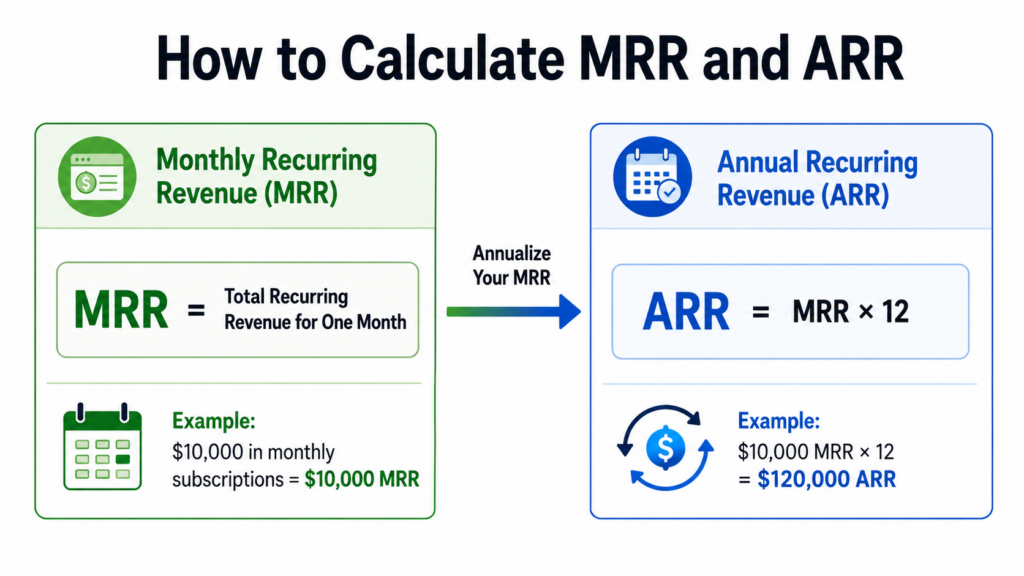
MRR (Monthly Recurring Revenue) measures the predictable subscription revenue your business collects each month. ARR (Annual Recurring Revenue) measures that same predictable revenue normalized to a 12-month period. Same underlying revenue, different time horizon — and the difference in how each gets calculated matters more than most guides to this topic let on.
Key takeaways
- MRR = the recurring subscription revenue collected in a given month, excluding one-time fees. ARR = that recurring revenue normalized to an annual basis.
- The basic shortcut, ARR = MRR × 12, only works cleanly when your customer base and contract terms stay constant — which is rarely true in practice.
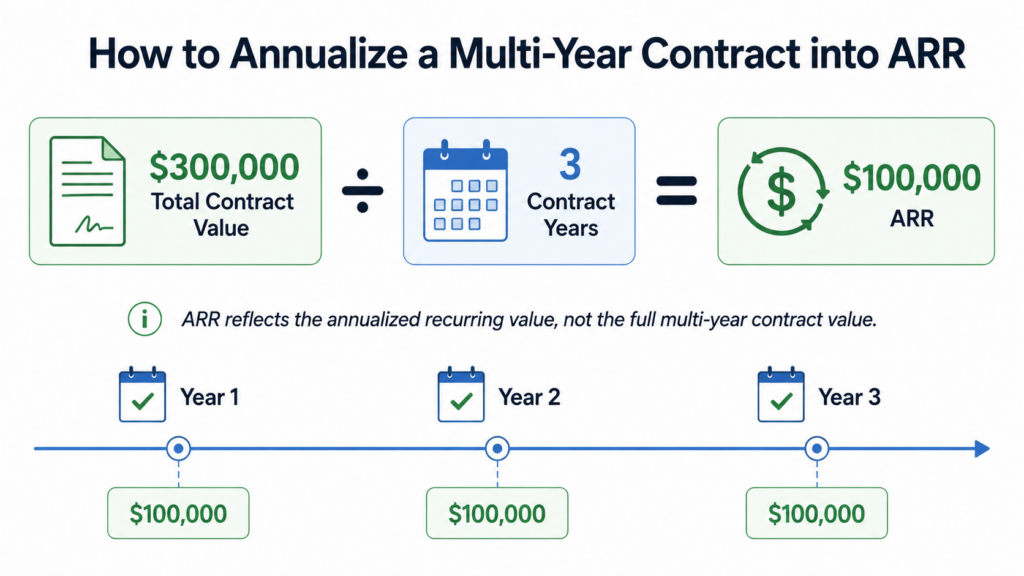
- Multi-year contracts need to be divided by their term length before counting toward ARR. A three-year, $300,000 contract is $100,000 in ARR, not $300,000.
- Track MRR if your business runs on monthly contracts or you’re early-stage; track ARR if you run on annual contracts or you’re reporting to investors or lenders.
- A sloppily calculated ARR number isn’t just a communication problem — it’s a real risk the moment a lender’s or acquirer’s diligence team rebuilds the number from your actual contracts.
What is MRR (Monthly Recurring Revenue)?
MRR is the total predictable subscription revenue a business collects in a given month, excluding one-time fees, setup charges, or other non-recurring income.
MRR = Sum of all active subscription revenue collected in the month
A simpler version for businesses with consistent per-customer pricing: MRR = Number of active subscribers × Average Revenue Per User (ARPU). If you have 200 customers paying an average of $150 a month, your MRR is $30,000. MRR moves in real time with new customers, upgrades, downgrades, and churn, which makes it the metric to watch for short-term momentum.
What is ARR (Annual Recurring Revenue)?
ARR is the total predictable subscription revenue a business expects to generate over a 12-month period, normalized from monthly, quarterly, or multi-year contracts to a consistent annual basis.
ARR (basic) = MRR × 12
ARR (comprehensive) = Sum of annualized contract values, where annual contracts count directly, monthly contracts are multiplied by 12, and multi-year contracts are divided by their term length — plus expansion revenue, minus contraction and churned revenue
The basic formula is a fast approximation. The comprehensive formula is the one that actually holds up when your contract mix isn’t uniform, which is most real businesses.
ARR vs. MRR: side-by-side comparison
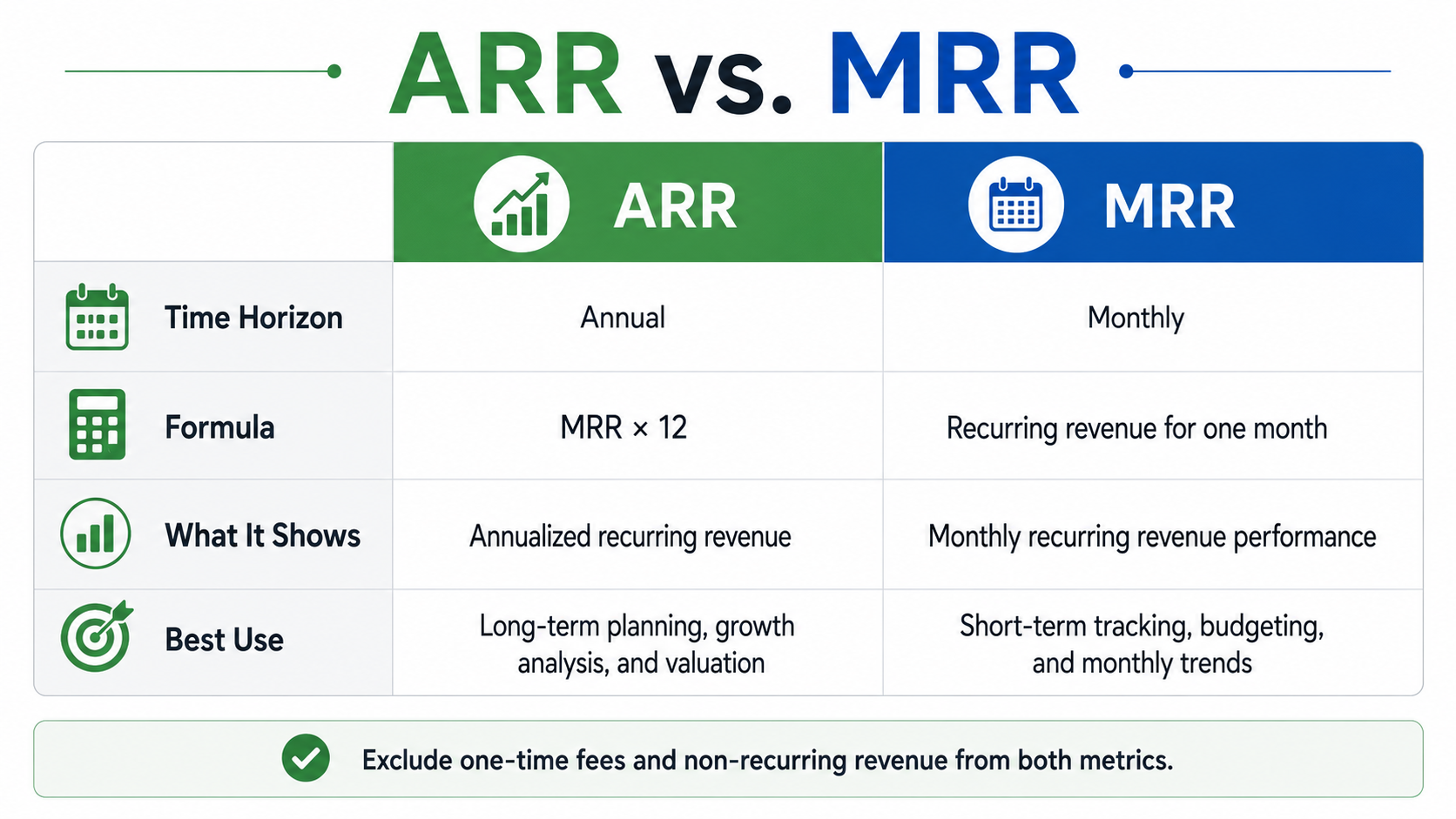
| MRR | ARR | |
| Time horizon | One month | Twelve months |
| Basic formula | Sum of active monthly subscription revenue | MRR × 12 |
| Best for | Tracking short-term momentum, churn, and expansion in real time | Annual planning, investor and lender reporting, long-term view |
| Most common at | Early-stage companies, monthly-contract businesses | B2B companies with annual contracts, later-stage reporting |
| Sensitivity | Reacts immediately to any change in the customer base | Smoother, normalized view — less noisy month to month |
Why “ARR = MRR × 12” isn’t always right
The basic formula only produces an accurate number when your customer base and contract terms are stable and uniform, which is the exception, not the rule, for most growing subscription businesses. The moment you have multi-year contracts, mixed monthly and annual terms, or meaningful churn and expansion in a given month, a straight MRR × 12 calculation drifts from reality.
Here’s the mistake that shows up most often: a company signs a three-year contract worth $300,000 total and records the full $300,000 as that year’s ARR. The correct figure is $300,000 divided by three years — $100,000 in ARR from that contract, with the remaining two years’ worth counted in the following periods. Get this wrong across a handful of large multi-year deals, and a company’s reported ARR can run meaningfully ahead of what the underlying contracts actually support.
Which one should you track?
Track MRR if your business runs primarily on monthly contracts or you’re early-stage and need to see momentum change in near real time. Track ARR if your business runs on annual or multi-year contracts, or you’re reporting to investors, lenders, or a board that wants the longer-term view.
Most growth-stage B2B SaaS companies end up tracking both — MRR for the operational, month-to-month pulse of the business, and ARR for the strategic conversations with anyone evaluating the company from outside. The two aren’t competing metrics; they’re the same underlying revenue viewed at two different resolutions.
The mistake that shows up in diligence
A sloppily calculated ARR number is a real financial risk, not just a communication problem, because it eventually gets tested by someone with no incentive to accept it at face value. A board deck rarely gets audited. A term sheet, a bank underwriting file, or an acquisition’s quality-of-earnings review absolutely does.
In 30-plus years of CFO work, the pattern Stan Alhadeff sees most often is a company that’s been reporting ARR using the generous shortcut — full multi-year contract values counted upfront, one-time fees quietly folded in, churn not properly netted out — right up until a lender or acquirer’s finance team rebuilds the number from the actual contracts and gets something meaningfully lower. That gap doesn’t just cost a few points on a valuation multiple. It costs trust in every other number in the data room, because once one figure is caught being wrong, a diligence team stops taking anything at face value. If you’re heading into a business valuation or a financing conversation, this is exactly the kind of gap worth finding before someone else does.
How to keep your ARR and MRR numbers trustworthy
Keep your numbers trustworthy by defining the calculation methodology once, in writing, and applying it consistently across every dashboard, board update, and financing conversation — not recalculating it slightly differently depending on the audience. Annualize multi-year contracts by dividing by their term length, exclude one-time fees consistently, and net out churn and contraction every period rather than only when the number looks good without it.
For SaaS-specific fractional CFO work, this kind of methodology discipline is one of the most common gaps we find during an initial GAP Analysis — not because the underlying business is unhealthy, but because the reported numbers were never built to survive a real diligence process. If you want a straight read on whether your own ARR and MRR would hold up, our free discovery call includes a GAP Analysis that checks exactly that.
Getting the number right before someone else checks it
ARR and MRR are simple concepts with a real risk of getting quietly wrong at the edges — multi-year contracts, mixed terms, inconsistent treatment of churn. The formulas aren’t complicated. The discipline to apply them the same way every time is what actually separates a trustworthy number from one that falls apart under real scrutiny.
If you’d like a second set of eyes on how your own ARR and MRR are calculated before you take them into a raise, a bank conversation, or a sale, book a free strategy call with Stan — it starts with a straight look at the actual math, not a generic checklist.
FAQ
What is ARR? ARR, or Annual Recurring Revenue, is the total predictable subscription revenue a business expects to generate over a 12-month period, normalized from monthly, quarterly, or multi-year contracts to a consistent annual basis. It’s the standard long-term revenue metric for subscription businesses.
What is MRR? MRR, or Monthly Recurring Revenue, is the total predictable subscription revenue a business collects in a given month, excluding one-time fees or non-recurring charges. It’s the metric most often used to track short-term momentum and churn in near real time.
How do you calculate ARR? The basic formula is ARR = MRR × 12, which works when your customer base and contract terms are stable. The more accurate formula sums annualized contract values directly — annual contracts as-is, monthly contracts multiplied by 12, multi-year contracts divided by their term length — plus expansion, minus churn and contraction.
How do you calculate MRR? MRR is the sum of all active subscription revenue collected in a given month, excluding one-time fees. A simplified version multiplies the number of active subscribers by the average revenue per user (ARPU).
Is ARR just MRR times 12? Only as a rough approximation. The MRR times 12 shortcut breaks down once a business has multi-year contracts, mixed monthly and annual terms, or meaningful churn and expansion in a given period, since it assumes a static customer base that rarely exists in practice.
Which should a SaaS company track, ARR or MRR? Companies with mostly monthly contracts or early-stage businesses typically lean on MRR for real-time momentum, while companies with annual contracts or those reporting to investors and lenders lean on ARR. Most growth-stage SaaS companies track both, since they answer different questions.

Stan Alhadeff
Founder & Fractional CFO