
Bookkeeping is the process of recording your business’s financial transactions accurately and consistently. Accounting is what happens next: interpreting those records to produce financial statements, guide tax strategy, and inform real decisions. Bookkeeping answers “what happened.” Accounting answers “what does it mean, and what should we do about it?”
Most businesses need both, but not necessarily from the same person, and not necessarily forever in the same form.
Key takeaways
- Bookkeeping records financial transactions; accounting interprets those records to produce statements, guide tax decisions, and support strategy.
- Bookkeepers typically need no formal license, while accountants generally hold a bachelor’s degree, often with a CPA for more advanced work.
- According to the U.S. Bureau of Labor Statistics, employment of bookkeeping, accounting, and auditing clerks is projected to decline 6% from 2024 to 2034 due to automation, while employment of accountants and auditors is projected to grow 5% over the same period.
- Neither role is “better”; they’re sequential, not competing. Bookkeeping is the foundation accounting depends on.
- Bookkeeping and accounting are the first two rungs of a longer ladder. Most growing businesses eventually need a controller and, later, CFO-level strategy too.
What is bookkeeping?
Bookkeeping is the day-to-day process of recording a business’s financial transactions sales, purchases, payments, and receipts accurately and consistently in a ledger or accounting software. It’s administrative and transactional by nature: the job is to capture what happened, correctly and on time, not to interpret what it means.
Typical bookkeeping tasks include data entry, invoicing, categorizing expenses, reconciling bank accounts, and basic payroll processing. Most bookkeepers work in tools like QuickBooks or Xero, and the role generally doesn’t require a specific license or degree — accuracy, consistency, and attention to detail matter more than formal credentials.
What is accounting?
Accounting takes the transactions a bookkeeper records and interprets them, preparing financial statements, ensuring compliance with GAAP, filing taxes, and analyzing the numbers to support real decisions. Where bookkeeping is about recording, accounting is about understanding.
Accountants typically hold a bachelor’s degree, and many pursue a CPA license for more advanced work like audits, complex tax strategy, or public company reporting. The role carries more judgment and more responsibility: an accountant is expected to catch something that doesn’t look right, explain why a number moved, and advise on what to do next work a bookkeeper isn’t generally expected to do.
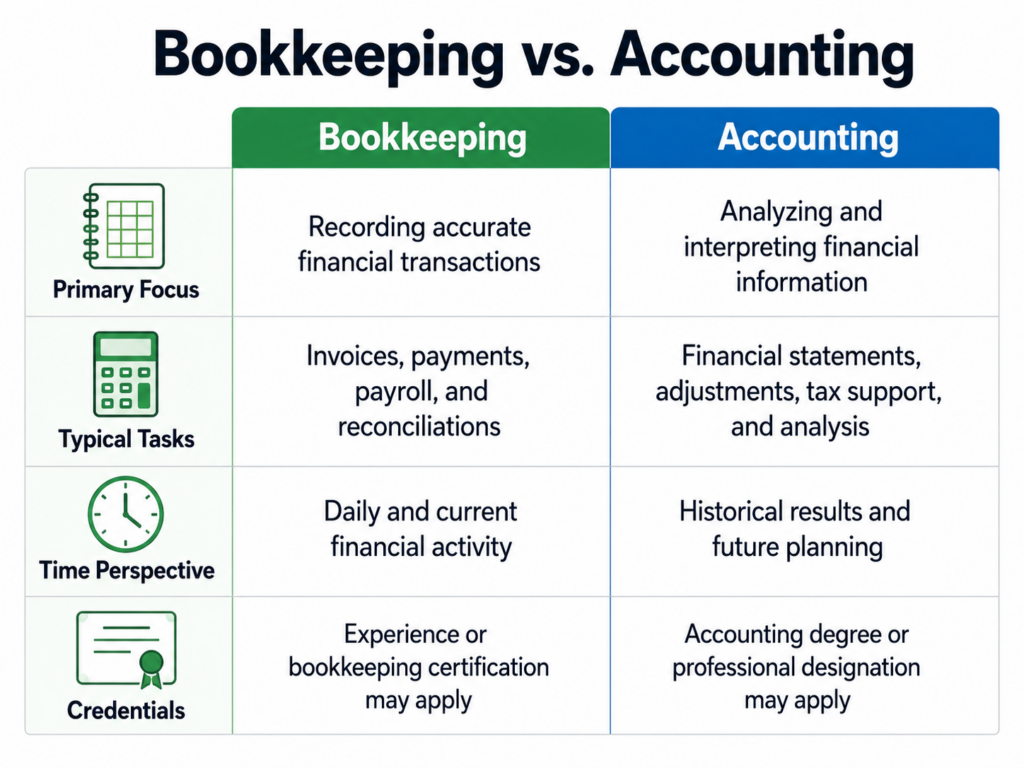
Bookkeeping vs. accounting: side-by-side comparison
| Bookkeeping | Accounting | |
| Focus | Recording transactions accurately | Interpreting and analyzing financial data |
| Time orientation | Present — what happened | Broader — trends, compliance, planning |
| Typical tasks | Data entry, invoicing, reconciliations, basic payroll | Financial statements, tax filing, financial analysis, audits |
| Typical credentials | No license required; certificate or associate degree common | Bachelor’s degree; CPA common for advanced roles |
| Decision-making role | None — organizes data for others to use | Advises on taxes, budgeting, and financial strategy |
| Feeds into | The accounting process | Controller and CFO-level strategy |
Where bookkeeping ends, and accounting begins
Bookkeeping ends and accounting begins the moment the work shifts from recording a transaction to deciding what that transaction means for the business. A bookkeeper categorizing an expense correctly is bookkeeping; an accountant explaining why margins dropped two points this quarter, and what to do about it, is accounting.
In practice, the line blurs at smaller businesses, where one person, sometimes the owner, does pieces of both. That works until the business outgrows it. A bookkeeper spending hours trying to interpret trends they weren’t trained to analyze is a poor use of time on both ends; an accountant spending their week on data entry is an expensive way to get basic transactions recorded.
Do you need a bookkeeper, an accountant, or both?
Every business with any revenue needs bookkeeping — clean, accurate records are the non-negotiable foundation everything else depends on. Most businesses need accounting as soon as tax complexity, compliance requirements, or the sheer volume of decisions being made outgrow what raw transaction records alone can support.
A simple test: if your question is “did we record this correctly,” that’s bookkeeping. If your question is “what does this mean, and what should we do,” that’s accounting. Two or more unanswered questions in the second category, regularly, is a clear signal you need real accounting support, not just more bookkeeping hours. Our accounting services cover exactly this layer: the point where clean records turn into statements and decisions you can actually act on.
Why the value keeps shifting toward accounting
The market itself is telling this story clearly. According to the U.S. Bureau of Labor Statistics, employment of bookkeeping, accounting, and auditing clerks is projected to decline 6% from 2024 to 2034, driven largely by software automating much of the transactional work these roles used to require. Over the same period, the Bureau projects employment of accountants and auditors to grow 5% — faster than the average for all occupations.
That contrast isn’t a coincidence. Software has gotten genuinely good at the mechanical part of bookkeeping — categorizing transactions, reconciling accounts, flagging obvious errors. What software still can’t do is exercise judgment: catch a trend before it becomes a problem, explain why a number moved in a way that changes a decision, or advise on tax strategy that fits a specific business. That judgment is exactly what accounting adds on top of bookkeeping, and it’s exactly the work that’s becoming more valuable, not less, as the transactional layer gets automated out from under it.
The full finance ladder: bookkeeping is just the first rung
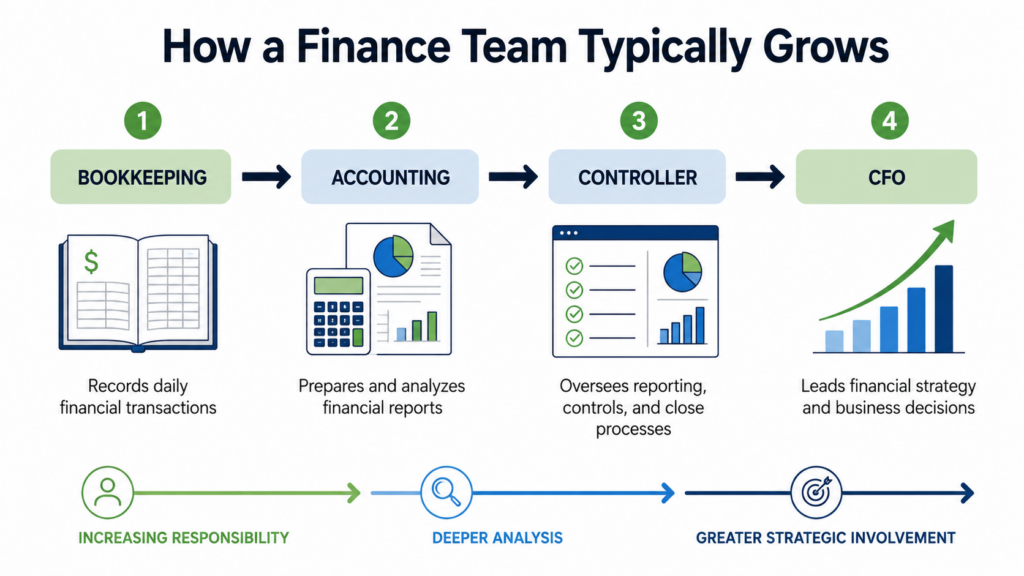
Bookkeeping and accounting are the first two steps in a longer progression, not the whole story — most growing businesses eventually add a controller to own accuracy at scale, and later a CFO to turn the numbers into strategy. Each rung builds on the one below it, which is why skipping a step rarely works out.
In 30-plus years of CFO work, the pattern Stan Alhadeff sees most often is an owner trying to solve a controller-level or CFO-level problem with more bookkeeping hours, because that’s the layer they already understand. It doesn’t work — a bookkeeper can’t fix a close that’s structurally too slow, and an accountant filing taxes correctly isn’t the same as someone forecasting cash 13 weeks out. If you want the fuller picture of what comes next, what a financial controller actually does and CFO vs. controller: who to hire first cover the next two rungs in detail. If you’re not sure which rung your business is actually standing on right now, our free discovery call includes a GAP Analysis that tells you plainly.
Getting the foundation right
Clean bookkeeping and solid accounting aren’t the finish line — they’re the foundation everything above them depends on, including controller-level accuracy and CFO-level strategy. Skip or underbuild either one, and every decision built on top of it inherits the same weakness.
If you’d like a straight read on where your own finance function stands, book a free strategy call with Stan — it starts with the GAP Analysis, and it tells you plainly whether the gap is bookkeeping, accounting, or something further up the ladder.
FAQ
What is the difference between bookkeeping and accounting? Bookkeeping is the process of recording financial transactions accurately; accounting interprets those records to produce financial statements, guide tax strategy, and inform decisions. Bookkeeping answers what happened; accounting answers what it means.
Do I need a bookkeeper or an accountant? Every business needs bookkeeping for accurate records, and most need accounting once tax complexity or decision-making needs outgrow raw transaction data alone. If your unanswered questions are about what the numbers mean rather than whether they’re recorded correctly, that’s a sign you need accounting.
Can a bookkeeper do the work of an accountant? A bookkeeper can handle some overlapping tasks, but interpreting financial data, preparing formal statements, and advising on tax strategy generally requires an accountant’s training and credentials. Asking a bookkeeper to do accounting-level analysis is a common way growing businesses end up with unreliable financial guidance.
What comes after bookkeeping and accounting as a business grows? As a business grows, the next steps are typically a controller, who ensures accuracy and ownership of the close at scale, and later a CFO, who uses the numbers to drive strategy and major decisions. Each role builds on the one before it.
How much does bookkeeping cost compared to accounting? Bookkeeping generally costs less than accounting because it requires less specialized training and carries less decision-making responsibility. Exact pricing varies by transaction volume and complexity, which is why costs are typically scoped to the specific business rather than quoted as a flat rate.

Stan Alhadeff
Founder & Fractional CFO