A fractional CFO works part-time on a retainer, typically $3,000 to $10,000 a month, while a full-time CFO is a salaried executive employee costing $300,000 to $450,000 a year fully burdened. The skill set is identical — the difference is commitment level, and the right choice depends on whether your business generates enough CFO-level work to fill a full-time seat.
For most businesses between $1 million and $50 million in revenue, that threshold hasn’t been crossed yet. Here’s how to know for sure.
Key takeaways
- A fractional CFO and a full-time CFO do the same job — forecasting, financing, strategy — at different commitment levels and price points.
- Fractional retainers run $3,000–$10,000/month; full-time compensation runs $300,000–$450,000/year fully burdened.
- The decision usually isn’t permanent. Most businesses start fractional and transition to full-time once the workload — not just the revenue — justifies it.
- Sometimes the honest answer is neither yet. If your books aren’t accurate, that’s a controller-level gap, and neither type of CFO fixes it.
- According to the U.S. Bureau of Labor Statistics, the median annual wage for financial managers — the category that includes CFOs — was $161,700 in May 2024, before the benefits and bonus that typically push a full-time hire well past that figure.
What’s the difference between a fractional CFO and a full-time CFO?

A fractional CFO delivers the same strategic work as a full-time CFO — cash flow forecasting, financing strategy, pricing, board and investor communication — but on a part-time, scaled retainer instead of a full-time salary. The work is identical in kind; what changes is how much of it, and how consistently.
A full-time CFO is embedded in the business daily, building institutional knowledge that comes from being inside every meeting and every decision as it happens. A fractional CFO brings the same caliber of expertise, refined across multiple client engagements, but shows up on a schedule scoped to what the business actually needs — a few days a month for a stable company, considerably more during a financing event or transaction.
Fractional CFO vs. full-time CFO: side-by-side comparison
| Fractional CFO | Full-time CFO | |
| Typical cost | $3,000–$10,000/month ($36K–$120K/year) | $300,000–$450,000/year fully burdened |
| Commitment | Part-time, scaled to the business | Full-time, permanent employee |
| Time to start | Typically weeks | Often months, including a search and onboarding |
| Flexibility | Scales up or down as needs change | Fixed cost regardless of monthly workload |
| Institutional knowledge | Builds over time, split across client relationships | Deep and immediate, single-company focus |
| Best fit | $1M–$50M businesses needing executive finance without an executive salary | Businesses with daily CFO-level workload, typically $50M+ |
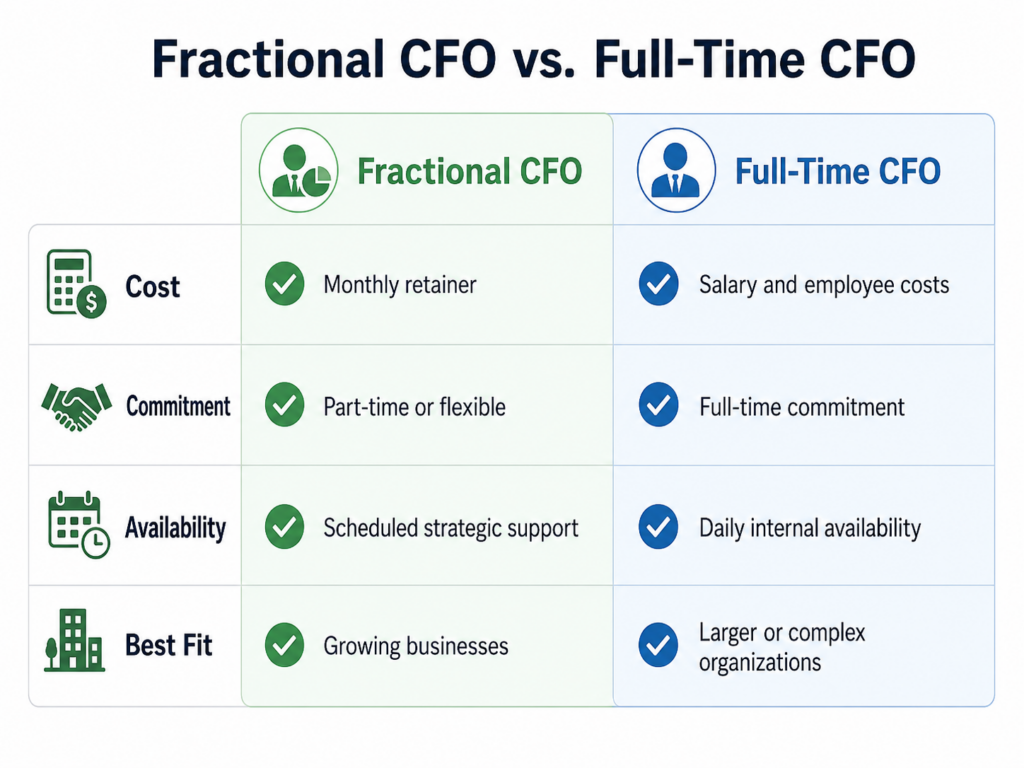
The cost gap is the headline, but flexibility matters just as much for a growing business. A full-time CFO’s salary doesn’t shrink in a slower month; a fractional CFO’s scope can.
When a fractional CFO is the right choice
A fractional CFO is the right choice when your business generates real CFO-level questions — pricing, financing, forecasting — but not enough of them to fill forty hours a week. That’s the profile of most companies between $1 million and $50 million in revenue, which is exactly why the fractional model exists at that stage.
It’s also the right call when speed matters more than permanence. A fractional CFO can typically start within weeks, compared to the months a full-time executive search usually takes — useful when a bank renewal or a financing conversation is closer than your hiring timeline would otherwise allow.
When a full-time CFO is the right choice
A full-time CFO makes sense once the business has enough daily financial complexity to occupy the role five days a week — usually north of $50 million in revenue, or sooner if the company is managing multiple entities, an active acquisition strategy, or heavy board and investor demands. At that point, the fixed cost of a full-time hire starts to make more sense than a scaled retainer.
A full-time CFO also fits when the business needs someone embedded in every operational decision, not just the financial ones — deeply involved in hiring, product strategy, or day-to-day leadership meetings in a way that’s harder to scope into a part-time engagement.
What if you need neither yet?
Sometimes the honest answer is that your business needs neither a fractional nor a full-time CFO right now — it needs a controller. If your books close late, or you don’t trust your own financial reports, that’s an accuracy problem, and no CFO, fractional or full-time, fixes bad data. They just produce confident-sounding conclusions built on top of it.
This is the piece every competitor guide skips, because it doesn’t lead anywhere near a sale. Fractional controller services solve the accuracy layer first, at a fraction of CFO-level cost, and often that’s the right first step before either CFO conversation makes sense. If you’re not sure which gap you actually have, our free discovery call includes a GAP Analysis that tells you plainly.
How the decision changes as you grow
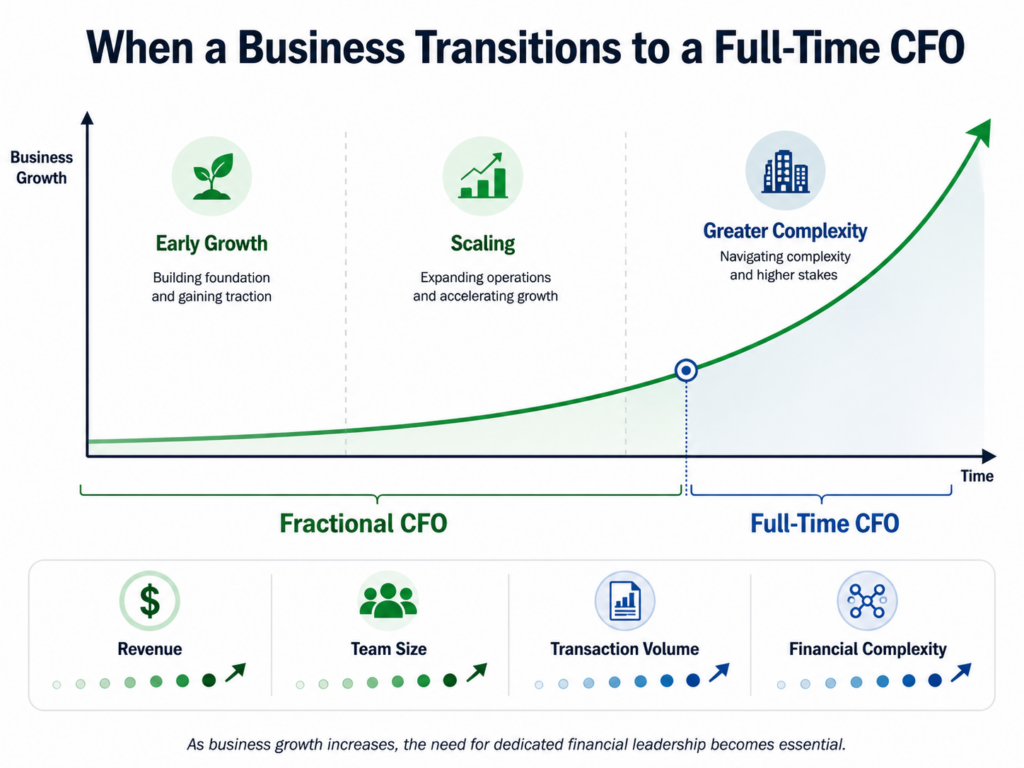
The fractional-versus-full-time decision usually isn’t permanent — it shifts as the business grows, and the trigger is workload, not a fixed revenue number. In 30-plus years of CFO work, the pattern Stan Alhadeff sees most often is a business staying fractional far longer than owners initially expect, simply because the workload takes longer to fill forty hours a week than the revenue growth alone would suggest.
Stan worked with one client, Amerigo Metal Recycling, through more than a decade of fractional engagement while the company grew from $8 million to nearly $50 million in revenue — well past the point many owners assume a full-time hire becomes necessary. According to SCORE, the SBA’s nationwide mentoring resource partner, the progression from bookkeeper to controller to CFO is a natural stage tied to complexity, not a countdown clock — and the same logic applies to the fractional-to-full-time transition specifically. When the workload finally does justify a permanent hire, a good fractional CFO will tell you so directly, sometimes even helping recruit their own replacement.
Making the call for your business
The right structure — fractional, full-time, or a controller first — depends on your specific numbers, not a general rule of thumb. Two businesses at the same revenue can need completely different answers depending on complexity, financing activity, and how the books stand today.
Book a free strategy call with Stan — it starts with the GAP Analysis, and it ends with a straight answer about which model actually fits your business right now, not a generic recommendation based on revenue alone.
FAQ
What is the difference between a fractional CFO and a full-time CFO? A fractional CFO does the same strategic work as a full-time CFO — forecasting, financing, pricing strategy — on a part-time retainer instead of a full-time salary. The skill set is identical; the difference is commitment level and cost.
Is a fractional CFO cheaper than a full-time CFO? Yes, significantly. A fractional CFO typically costs $3,000 to $10,000 a month, compared with $300,000 to $450,000 a year fully burdened for a full-time CFO. Even at the top of the fractional range, the annual cost is a fraction of a full-time hire’s lower end.
When should a business hire a full-time CFO instead of a fractional one? A business should consider a full-time CFO once it generates enough daily financial complexity to fill the role five days a week, typically north of $50 million in revenue or sooner with heavy transaction activity. Below that, a fractional CFO usually delivers more value per dollar.
Can a fractional CFO become full-time? Yes, though it’s more common for a fractional CFO to help a business scope and recruit a full-time replacement once the workload justifies it. Some fractional CFOs do transition to full-time roles with a client, but it’s not the default outcome of the relationship.
What size company needs a full-time CFO? Most companies don’t need a full-time CFO until they’re generating daily financial complexity that a part-time engagement can’t cover, which typically starts around $50 million in revenue. Company size alone isn’t the only factor — transaction activity and organizational complexity matter just as much.