A CFO, or chief financial officer, is the senior executive responsible for a company’s financial strategy — forecasting, financing, reporting, and the decisions that determine whether growth is actually funded. Unlike a controller or accountant, who focus on what already happened, a CFO’s job is forward-looking: turning financial data into the calls that shape where the business goes next.
That’s the short version. What the role actually looks like changes enormously depending on the size of the company, which is exactly where most explanations of this job fall short.
Key takeaways
- A CFO owns financial strategy: forecasting, financing, pricing, and the numbers behind major decisions like a hire, an acquisition, or a fundraise.
- The job looks different at every stage of a company’s life — a startup CFO and an enterprise CFO barely resemble each other day to day.
- According to the U.S. Bureau of Labor Statistics, the median annual wage for financial managers — the category that includes CFOs — was $161,700 in May 2024.
- Most businesses between $1 million and $50 million in revenue get more value from a fractional CFO than a full-time one, simply because the workload doesn’t fill forty hours a week yet.
- A CFO isn’t the fix for messy books. That’s a bookkeeping or controller problem, and layering a CFO on top of bad data just produces confident-sounding wrong answers.
What is a CFO?
A CFO is the highest-ranking financial executive in an organization, responsible for financial strategy, forecasting, financing, and reporting accuracy at the highest level. The role sits at the top of the finance function, typically reporting directly to the CEO and, in larger companies, the board.
Where a controller ensures the numbers are correct, and a bookkeeper records the transactions, a CFO uses the numbers to decide what happens next. That forward-looking mandate — deciding, not just reporting — is what separates the CFO seat from every role beneath it.
What does a CFO do day to day?
Most of a CFO’s time goes toward five things: building financial forecasts, managing financing and lender or investor relationships, setting pricing and margin strategy, overseeing financial reporting and compliance, and advising the CEO and board on major decisions. The exact mix shifts with company size, but these five hold across almost every CFO role.
In practice, that breaks down further. Cash flow forecasting sits at the center — a rolling 13-week model plus a 12-month view that tells the business whether a decision is actually affordable before it’s made. Financing work covers bank relationships, debt structuring, and — for growth-stage or venture-backed companies — fundraising and investor reporting. Pricing and margin strategy means using real cost data to decide what to charge, not guessing. Reporting and compliance cover GAAP-compliant statements, tax coordination, and audit readiness. And the advisory piece — sitting with the CEO on a hiring decision, an acquisition, or an expansion — is often the part that separates a real CFO from someone doing a controller’s job with a bigger title.
The four roles every CFO plays
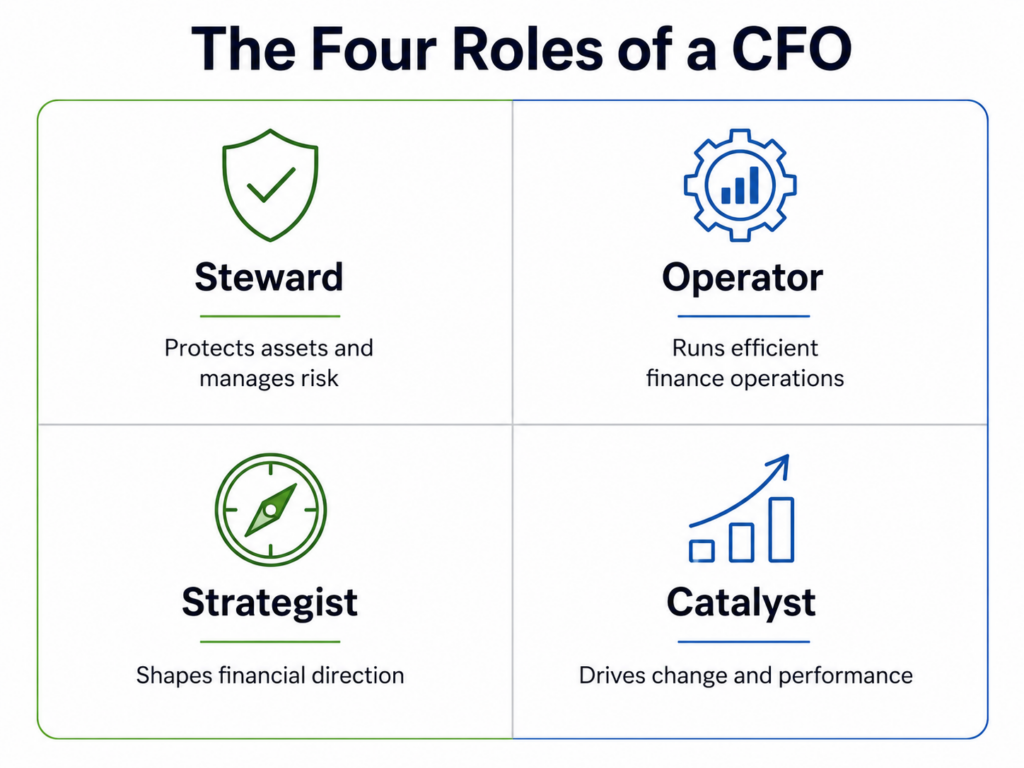
Deloitte’s CFO research describes the modern role as four overlapping functions: steward, operator, strategist, and catalyst. Steward means protecting the company’s assets and minimizing risk — the traditional, compliance-focused core of the job. Operator means running an efficient finance function that actually delivers accurate numbers on time.
Strategist and catalyst are where the role has expanded most in the last decade. As strategist, the CFO helps shape overall company direction, sitting genuinely at the table for decisions that used to be the CEO’s alone. As catalyst, the CFO drives change across the business — questioning whether a product line is actually profitable, or whether an expansion plan is funded by real numbers or optimism. A CFO who’s only playing steward and operator is doing half the job.
CFO responsibilities by company size
The CFO title covers wildly different jobs depending on company size, and most explanations of the role flatten that difference into a vague three-bucket list. Here’s a version built from actually having done the job at every stage.
| Company stage | Typical revenue | CFO’s primary focus | Common engagement model |
| Pre-revenue / early startup | Pre-revenue to ~$1M | Building financial infrastructure from scratch, tracking burn rate and runway, early investor reporting | Rarely full-time; often no dedicated CFO yet, or a part-time advisor |
| Growth-stage | $1M–$50M | Cash flow forecasting, pricing and margin strategy, preparing for financing or an exit, building reporting the owner can actually use | Fractional CFO — executive-level work without a full-time executive salary |
| Lower middle market | $50M–$250M | Formal FP&A function, board-level reporting, more complex financing (multiple lenders, possible private equity involvement), building a finance team under the CFO | Often the first full-time CFO hire, though some businesses in this range stay fractional depending on complexity |
| Large / enterprise | $250M+ | Capital markets strategy, investor relations, M&A, regulatory compliance including SEC reporting for public companies | Full-time CFO leading a department, typically with treasury, tax, and FP&A directors reporting in |
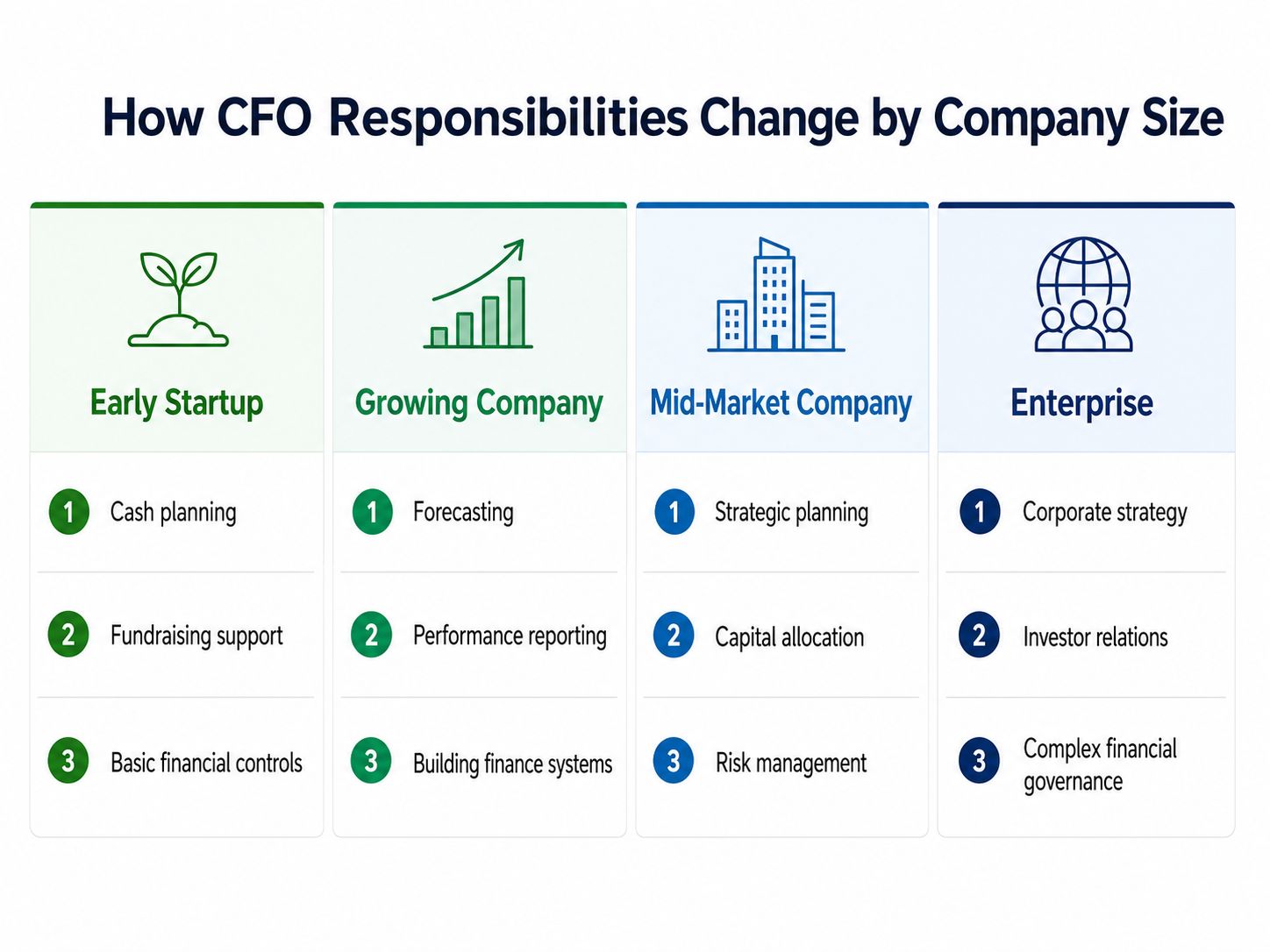
In 30-plus years of CFO work — managing companies from early-stage startups to organizations with more than $1 billion in revenue — the pattern Stan Alhadeff sees most often is owners assuming the CFO role is a single fixed job description. It isn’t. The title stays the same; almost everything else about the work changes.
CFO vs. controller vs. VP of finance: how the roles differ
A controller ensures the numbers are accurate and the books close on time; a CFO uses those numbers to plan strategy and drive decisions; a VP of Finance often sits between the two, managing FP&A and reporting without full CFO-level authority over company strategy. Titles vary company to company, but the functional split holds fairly consistently.
The clearest test: if the job is making sure the numbers are right, that’s controller-level work — covered in detail in what a financial controller actually does. If the job is deciding what the numbers mean and what to do next, that’s the CFO seat. A VP of Finance frequently does real CFO-adjacent work but without final authority on financing or board-level strategy — in smaller companies, the title sometimes gets used interchangeably with CFO, which is more about org-chart naming than an actual difference in responsibility.
What skills and background does a CFO need?
Strong CFOs combine deep financial expertise with genuine business judgment and the ability to communicate financial reality in plain language to people who aren’t finance professionals. Most have a background in accounting or finance, often a CPA or MBA, and years of experience moving from analyst or controller roles into progressively more strategic positions.
Technical skill is table stakes — financial modeling, GAAP or IFRS fluency, and comfort with the reporting tools a business actually uses. What separates a good CFO from a great one is judgment: knowing which numbers matter this quarter, which risks are real versus theoretical, and how to say “no” to a plan that doesn’t hold up without simply being the person who kills every idea. Communication matters just as much as the analysis — a CFO who can’t translate a forecast into a decision a CEO can act on isn’t doing the job, no matter how sound the model is underneath.
How much does a CFO cost?
A full-time CFO’s compensation typically tracks near the U.S. Bureau of Labor Statistics’ financial managers category, which reported a median annual wage of $161,700 in May 2024 — before benefits, bonus, and equity, which commonly push a true CFO hire to $300,000–$450,000 a year fully burdened at growth-stage companies. That’s a serious commitment for a business that isn’t generating forty hours a week of CFO-level work yet.
A fractional CFO delivers the same strategic work on a scaled retainer, typically $3,000 to $10,000 a month depending on complexity and scope. For a business between $1 million and $50 million in revenue — the range where most companies genuinely need this kind of leadership but can’t yet justify a six-figure executive salary — that gap is the entire reason the fractional model exists.
When does your business need its first CFO?
Most businesses need CFO-level financial leadership once they pass roughly $1 million in revenue and major decisions start being made without real financial analysis behind them. Revenue alone isn’t the only signal, though — a few concrete versions of the moment tend to show up first:
- You’re making hiring or expansion decisions on gut feel, because nobody can build the model to test them first.
- Cash gets tight even in profitable months, and nobody can explain why before it happens.
- A financing round, bank renewal, or acquisition conversation is coming, and your financials wouldn’t hold up under real scrutiny.
- You’re doing this work yourself at night, instead of running the business during the day — the exact trap Stan Alhadeff wrote Run the Business, Don’t Become It about.
According to SCORE, the SBA’s nationwide mentoring resource partner, the shift from bookkeeper to controller to CFO is a natural progression tied to a growing company’s financial complexity, not a single fixed trigger. If you’re not sure which stage your business is actually in, our free discovery call includes a GAP Analysis that tells you plainly where the gap sits.
Full-time vs. fractional CFO: which one fits your stage?
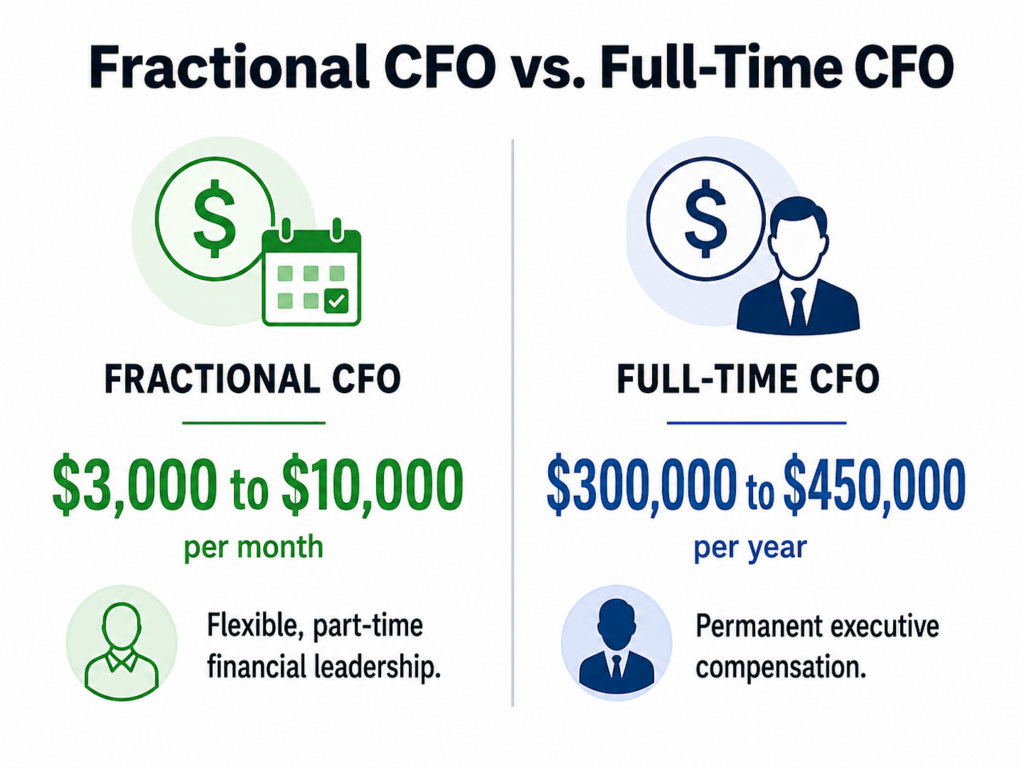
A full-time CFO makes sense once the workload genuinely fills the role — usually north of $50 million in revenue, or sooner if the business is preparing for a complex financing event or a sale. Below that, a fractional CFO typically delivers more value per dollar, because the strategic work exists but doesn’t require someone in the seat five days a week.
Here’s the honest part: not every growing business needs a CFO yet, fractional or otherwise. If the real problem is that your books close late or you don’t trust your own reports, that’s a controller-level gap, and hiring a CFO on top of bad data just produces confident-sounding wrong answers. Get the accuracy layer solid first. Once the numbers are reliable and the question has shifted from “are these right” to “what do we do about them,” that’s when a fractional CFO earns its cost. Stan Alhadeff worked with one client, Amerigo Metal Recycling, through more than a decade of exactly that kind of engagement, and the company grew from $8 million to nearly $50 million in revenue over the relationship — a good illustration of what the fractional model looks like sustained over time rather than as a short-term fix.
Where the CFO role fits in your next stage of growth
The CFO title covers a wide range of real jobs, and knowing which version your business actually needs — and in what form — matters more than the title itself. For a deeper look at how the fractional model specifically works, what a fractional CFO is breaks down the engagement model, cost, and fit in more detail than this guide covers.
If you’d like a straight read on where your business stands and what kind of financial leadership actually fits your stage, book a free strategy call with Stan — it starts with the GAP Analysis, and it ends with a plain answer, not a sales pitch.
FAQ
What does a CFO do? A CFO oversees a company’s financial strategy, including forecasting, financing, pricing, and reporting, and advises the CEO and board on major decisions. Unlike a controller, who focuses on the accuracy of what already happened, a CFO’s role is forward-looking and decision-driven.
What are the main responsibilities of a CFO? A CFO’s main responsibilities include cash flow forecasting, managing financing and lender relationships, setting pricing and margin strategy, overseeing financial reporting and compliance, and advising leadership on major decisions like hires, acquisitions, or fundraising. The exact mix shifts significantly with company size.
What is the difference between a CFO and a controller? A controller ensures the numbers are accurate and the books close on time; a CFO uses those numbers to plan strategy and drive decisions. Controllers look backward and present, while CFOs look forward — many growing businesses eventually need both roles.
How much does a CFO make? According to the U.S. Bureau of Labor Statistics, the median annual wage for financial managers — the category that includes CFOs — was $161,700 in May 2024, before benefits and bonus. Total compensation for a full-time CFO at a growth-stage company often reaches $300,000 to $450,000 fully burdened.
What skills does a CFO need? A CFO needs strong financial modeling and reporting skills, usually backed by a CPA or MBA, along with the business judgment to know which numbers actually matter and the communication skills to translate them for non-finance leaders. Years of progressively senior finance experience are typical before reaching the role.
When does a company need a CFO? Most companies need CFO-level financial leadership once they pass roughly $1 million in revenue and major decisions start being made without real financial analysis behind them. Cash flow surprises despite profitability and an upcoming financing event are other common triggers.
What is the difference between a CFO and a fractional CFO? A fractional CFO does the same strategic work as a full-time CFO — forecasting, financing, pricing strategy — but on a part-time, scaled retainer rather than a full-time salary. It’s the same role at a commitment level matched to businesses that don’t yet generate forty hours a week of CFO-level work.

Stan Alhadeff
Founder & Fractional CFO