An income statement shows whether your business made money over a period of time. A balance sheet shows what your business owns and owes at a single point in time. A cash flow statement shows whether the money you made actually moved through your bank account. All three matter, and none of them tells the whole story on its own. That’s the part most explanations skip.
Key takeaways
- The income statement answers “did we make money,” the balance sheet answers “what do we own and owe,” and the cash flow statement answers “did the cash actually move?” Three different questions, three different reports.
- A business can be profitable on its income statement and still run out of money, because profit is an accrual concept and cash is not.
- The three financial statements aren’t separate documents. One transaction, like buying equipment, hits all three at the same time in three completely different ways.
- Lenders lean on the balance sheet, owners lean on the income statement, and everyone should be watching the cash flow statement, because it’s the one that tells you if you can make payroll.
- According to the SEC’s Beginners’ Guide to Financial Statements, no single statement tells the complete story on its own — they’re designed to be read together.
What is an income statement?
An income statement, also called a profit and loss statement or P&L, reports your revenue, expenses, and the resulting profit or loss over a specific period, like a month, quarter, or year. It starts with revenue at the top, subtracts the cost of what you sold and your operating expenses, and ends with net income, or the bottom line.
The income statement runs on accrual accounting, which means it counts a sale when you earn it, not when the customer’s check clears. That’s useful for seeing your true performance trend. It’s also exactly why the income statement can’t tell you whether you can cover next week’s payroll — that’s a cash question, and this isn’t a cash report.
What is a balance sheet?
A balance sheet lists what your business owns, what it owes, and what’s left over for the owners, as of one specific date. It’s a snapshot, not a trend line. The equation behind it never changes: Assets = Liabilities + Equity, and the two sides always balance, which is where the name comes from.
Assets include cash, receivables, inventory, and equipment. Liabilities include loans, accounts payable, and anything else you owe. Equity is what remains once liabilities are subtracted from assets, and it’s the number a buyer or lender cares about most, because it represents real, tangible net worth. In at least one case, a clean, current balance sheet made the difference in securing $1.5 million in alternative funding that a lender wouldn’t extend based on a P&L alone. Balance sheets are what banks and investors ask for first, because a strong income statement built on a weak balance sheet is a business one bad quarter away from trouble.
What is a cash flow statement?
A cash flow statement tracks the actual cash moving into and out of your business across operating, investing, and financing activities over a period of time. Unlike the other two reports, it strips out accrual accounting entirely and shows only what really happened to your bank balance.
This is the statement that catches the gap between “we’re profitable” and “we’re broke.” A company can show high net income on its income statement while its cash flow statement shows a shrinking bank balance, because customers haven’t paid yet, inventory is tied up in cash, or a big loan payment came due. If you only read one statement for peace of mind, this shouldn’t be the only one, but it’s the one that tells you the most about whether you can survive the next 90 days.
Income statement vs. balance sheet vs. cash flow statement: the core differences
Put side by side, the differences are sharper than most explanations make them sound. Each statement answers one question, and only one.
| Income statement | Balance sheet | Cash flow statement | |
| Answers | Did we make money? | What do we own and owe? | Did cash actually move? |
| Time frame | A period (month, quarter, year) | A single point in time | A period (month, quarter, year) |
| Accounting basis | Accrual | Accrual | Cash |
| Core equation | Revenue − Expenses = Net Income | Assets = Liabilities + Equity | Operating + Investing + Financing = Net change in cash |
| Best for deciding | Pricing, margins, cost control | Borrowing capacity, net worth, solvency | Liquidity, timing, whether you can pay this week’s bills |
| Who asks for it first | Owners tracking performance | Lenders and investors assessing risk | Anyone trying to know if the business will survive |
How the three financial statements connect
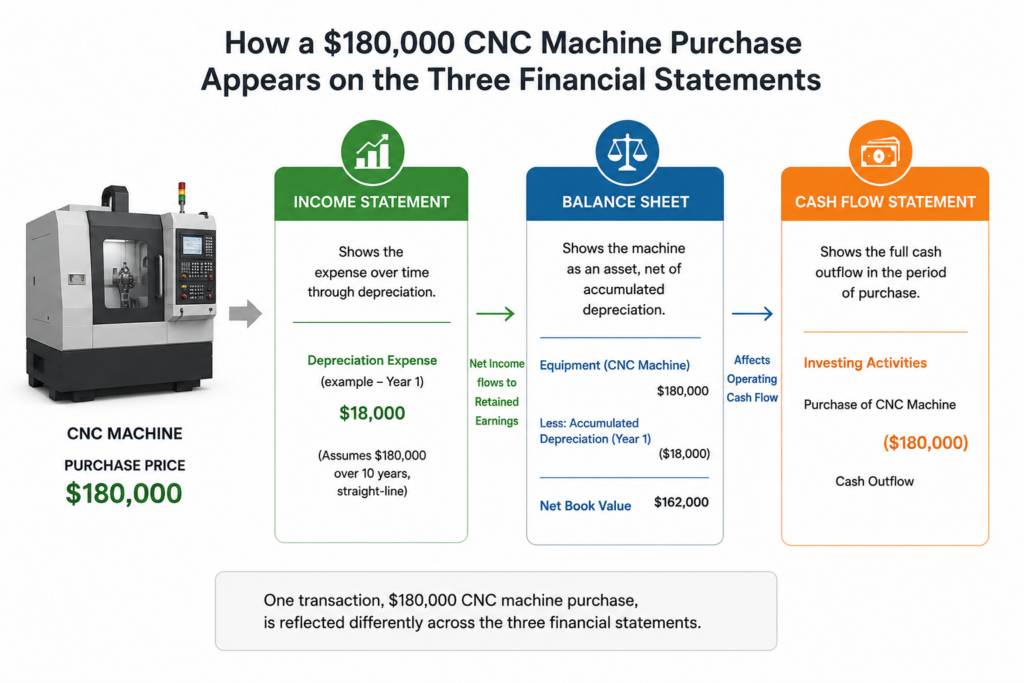
They’re not three separate documents. They’re three views of the same underlying events, and one transaction proves it. Say a $12 million manufacturing company buys a $180,000 CNC machine, financed entirely by a five-year bank term loan. Watch what happens to each statement, in the same month, from the same purchase.
| Statement | What it shows that month |
| Income statement | No impact this month. Depreciation of roughly $3,000 a month begins the following period and reduces net income going forward, even though no new cash goes out the door for it. |
| Balance sheet | Equipment (an asset) increases by $180,000; the loan (a liability) increases by $180,000. The two sides move together and the sheet still balances. |
| Cash flow statement | Investing activities show a $180,000 outflow for the purchase; financing activities show a $180,000 inflow from the loan. Net change in cash: zero. |
Same event, three completely different pictures. The income statement barely notices it happened. The balance sheet shows the company got bigger without getting richer or poorer. The cash flow statement shows exactly where the money came from and where it went, even though the net cash effect was nothing at all. Miss any one of the three, and you’re missing part of what actually happened to the business that month.
Which statement should you actually look at?
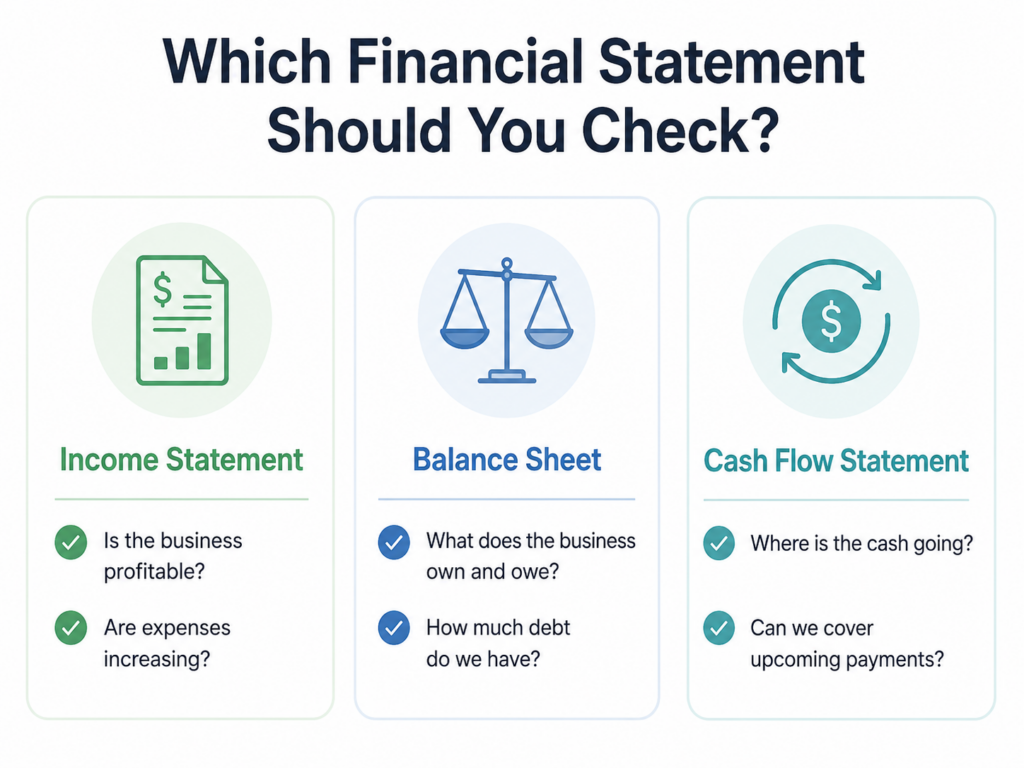
Most owners don’t need a lecture on accrual accounting. They need to know which report to pull up for the decision in front of them. In practice, it breaks down like this:
- Deciding whether to raise prices or drop an underperforming product line? Check the income statement. That’s where margin trends live.
- Deciding whether you can take on a loan, a lease, or a line of credit? Check the balance sheet first. Lenders will, and so should you, before you ask.
- Deciding whether you can afford to hire before the new revenue actually arrives? Check the cash flow statement. This is the one that tells you about timing, not just totals.
- Preparing to sell the business, bring on a partner, or raise outside capital? You need the income statement and the balance sheet together — profitability drives the multiple, and net worth drives the floor.
- Trying to explain to a lender why you’re profitable but still tight on cash? That’s a three-statement conversation, not a one-statement problem, and it’s one we have with clients constantly.
The mistake growing businesses make: reading only one statement
In 30-plus years of CFO work, the pattern Stan Alhadeff sees most often isn’t an owner who ignores their numbers. It’s an owner who reads one number closely and assumes it’s the whole picture — usually the income statement, because it’s the one that feels most like a report card. Revenue is up, profit looks fine, so the business must be healthy.
It’s a reasonable assumption, and it’s often wrong. A company can look profitable every month and still be quietly weakening its balance sheet with debt, or bleeding cash because receivables are aging out past 60 days. Stan grew one client, Amerigo Metal Recycling, from $8 million to nearly $50 million in revenue over more than a decade, and that kind of growth doesn’t survive on a P&L glance once a quarter. It survives on checking the balance sheet before every major financing decision, the income statement every month for margin drift, and the cash flow statement constantly, because growth has a way of outrunning the bank account long before it shows up as a problem anywhere else.
When you can read these yourself, and when you need help
If your business is simple — one location, straightforward revenue, a handful of expense categories — a monthly review of all three statements, even a basic version, is genuinely something most owners can do themselves. Accounting services that produce clean, timely statements are the foundation everything else in this article depends on. No statement is useful if the underlying bookkeeping is three months behind or built on guesswork.
It gets harder once the business gets more complex: multiple revenue streams, inventory, debt covenants to track, or a fundraise, bank financing, or exit on the horizon. At that point, someone needs to own the monthly close and keep the three statements tied together and accurate — that’s the role a fractional controller plays. And once the question shifts from “are these numbers right” to “what do they mean for the business,” that’s fractional CFO work — reading the three statements together to drive pricing, hiring, financing, and exit decisions instead of reacting to them after the fact. If you’re weighing a sale or an ownership transition, business valuation services lean heavily on the balance sheet and income statement working in concert, which is exactly why getting them right early matters more than most owners realize.
If you want a clear-eyed look at where your own three statements stand today, our free discovery call includes a GAP Analysis that shows you exactly what they’re telling you, and what they’re not.
How often should you review your financial statements?
Review your income statement and cash flow position monthly, and your balance sheet at least quarterly, more often if you’re carrying debt, growing fast, or approaching a financing decision. A monthly review catches a margin slide or a cash gap while it’s still a fixable problem instead of an emergency.
Some businesses benefit from a lighter weekly glance at cash position alone, layered on top of the fuller monthly close. The frequency matters less than the habit. A financial statement nobody reads is just a compliance document. A financial statement reviewed every month, against last month and against the same month last year, is a decision-making tool.
Reading all three together is the whole point
None of these three statements was built to stand alone. The income statement tells you if the business model works. The balance sheet tells you if the business is solvent enough to survive a bad stretch. The cash flow statement tells you if you’re going to make it through this quarter without a scramble. Read only one, and you’re only getting a third of the answer, at best.
For more on the reporting habits that keep a growing business ahead of its numbers instead of behind them, visit our Knowledge Center. And if you’d rather have someone read these three statements with you every month than try to piece it together alone, book a free strategy call with Stan — it starts with a straight look at where your numbers actually stand.
FAQ
What is the difference between an income statement and a balance sheet? An income statement reports revenue, expenses, and profit over a period of time; a balance sheet reports assets, liabilities, and equity at a single point in time. One shows how the business performed; the other shows what the business is worth on that specific date.
What are the three financial statements? The three financial statements are the income statement, the balance sheet, and the cash flow statement. Together they show profitability, financial position, and liquidity, which is why lenders, investors, and CFOs always ask for all three, never just one.
Which financial statement is more important, the income statement or the balance sheet? Neither one is more important on its own; they answer different questions and both matter. The income statement shows whether the business is profitable, while the balance sheet shows whether it’s financially stable enough to survive a rough stretch.
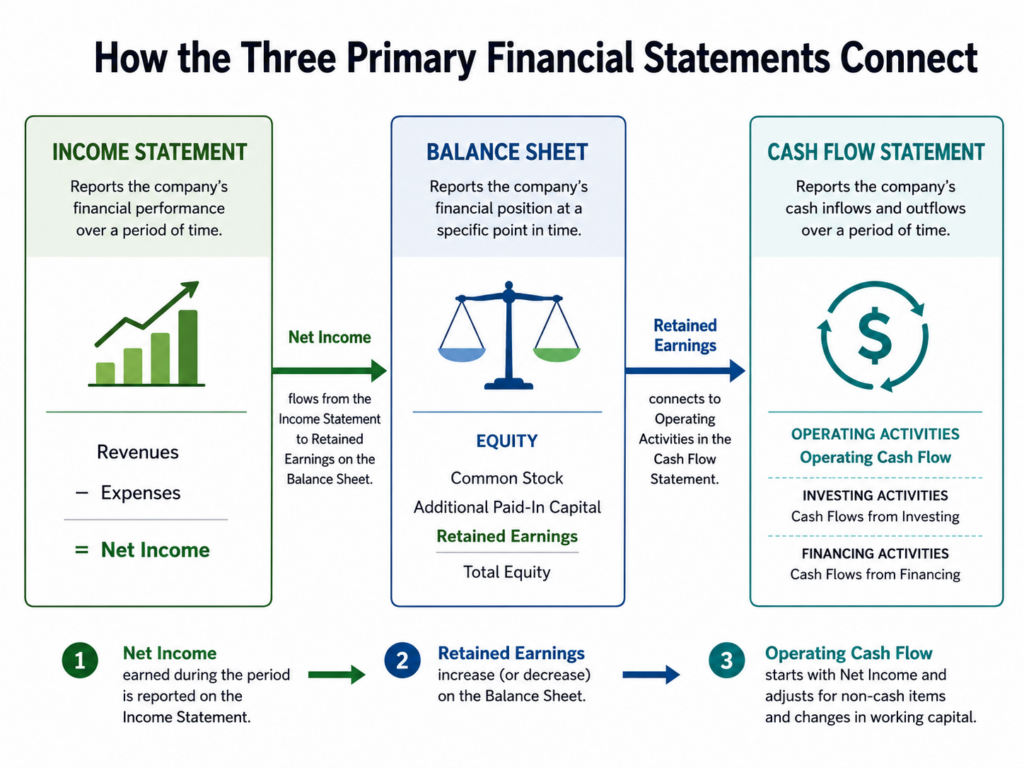
How are the income statement, balance sheet, and cash flow statement connected? Net income from the income statement flows into retained earnings on the balance sheet and starts the cash flow statement’s operating section. A single transaction, like an equipment purchase, shows up differently on all three at once, which is why they’re meant to be read together, not separately.
Can a business be profitable and still run out of cash? Yes, and it happens more often than owners expect. A company can show high net income on its income statement while its cash flow statement shows a shrinking bank balance, usually because customers haven’t paid yet or cash is tied up in inventory.
How often should a small business review its financial statements? Review the income statement and cash flow position monthly, and the balance sheet at least quarterly, more often when carrying debt or growing quickly. Monthly review catches a margin or cash problem while it’s still fixable instead of becoming an emergency.
What financial statement do lenders look at most closely? Lenders typically start with the balance sheet to assess net worth, collateral, and existing debt before reviewing the income statement for profitability. A strong balance sheet often matters more to a lending decision than a single good year on the income statement.